
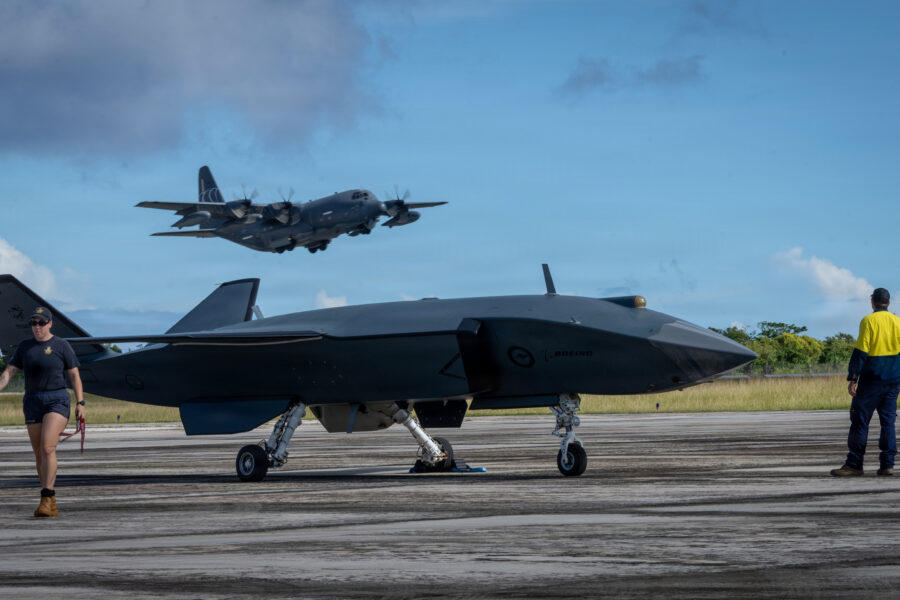
The U.S. Air Force is testing out a Collaborative Combat Aircraft in the Pacific this week as part of a large-scale exercise. But the CCA they’re flying is not one the two the service has committed to buying.
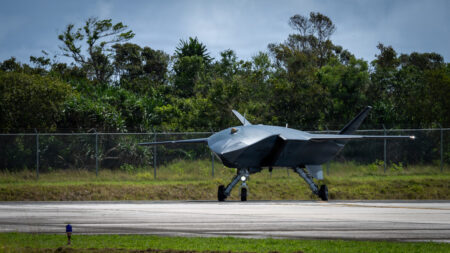
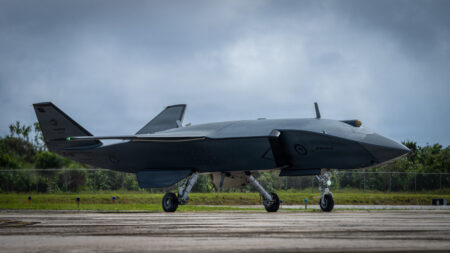
Boeing’s MQ-28 Ghost Bat will fly alongside manned aircraft during Exercise Valiant Shield 2026 to help Airmen practice how they will team manned fighters with semi-autonomous CCAs, Pacific Air Forces announced earlier this month. They will fly “a variety of missions … to include defensive and offensive counter air missions,” according to the announcement.
Images released by PACAF show the Ghost Bat taxiing and taking off in Rota, one of the Northern Mariana Islands. The Pentagon has also released photos showing U.S. Air Force F-35s and F-22s, U.S. Marine Corps F-35s, and U.S. Navy F/A-18Es participating in the exercise. A PACAF spokesperson declined to share details on how the MQ-28 is being used in the exercise or what platforms it would pair with.
“For operational security reasons, we do not discuss specific flight operations or tactical integration details,” the spokesperson told Air & Space Forces Magazine.
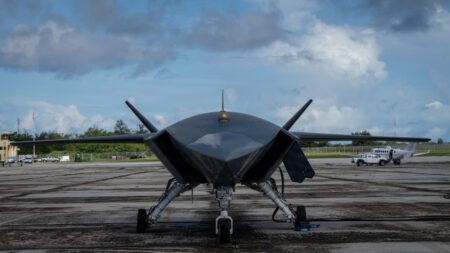
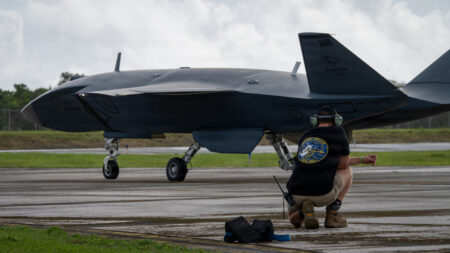
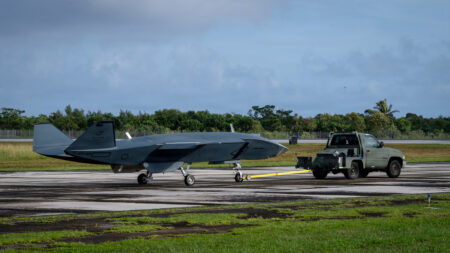
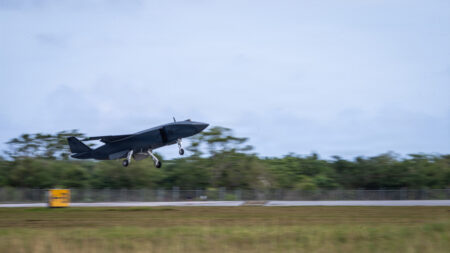
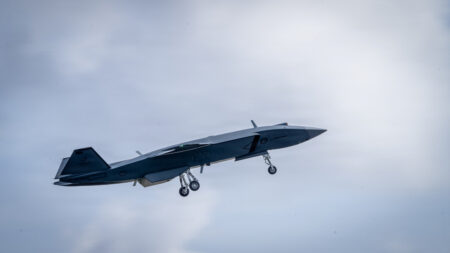
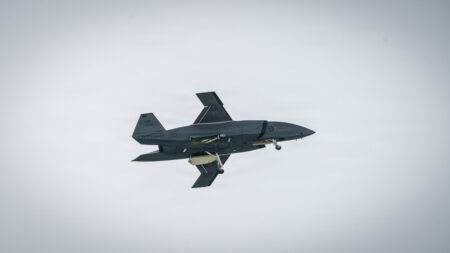
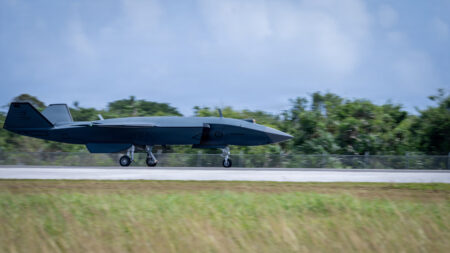
Given the Air Force’s recent decision to contract for two different CCAs, the use of the Ghost Bat—a third option—is surprising. Air Force operators flew the YFQ-44 prototype in an exercise in April, at Edwards Air Force Base, Calif. Lt. Col. Matthew Jensen, commander of the Air Force’s Experimental Operations Unit, said in February at AFA’s Warfare Symposium that the service planned to bring CCAs to major exercises “as soon as we can.”
The PACAF spokesperson noted that the MQ-28 was developed with the Royal Australian Air Force, which is participating in the exercise.
“This partnership allows us to build critical experience in autonomous platform operations, employment, and sustainment concepts,” the PACAF spokesperson said. “The insights and lessons learned from this collaboration are one of several efforts directly informing the development and fielding of the U.S. Air Force’s own Collaborative Combat Aircraft program.”
The MQ-28, which debuted in 2021 and is expected to enter operational service in 2028, is a little ahead of the U.S. Air Force’s CCA program, which has not committed to a firm timeline for operationalizing CCAs so far.
Like the FQ-42 and FQ-44, the MQ-28 is expected to be able to carry munitions to extend fighters’ strike capabilities. Boeing has also said its modular design lends itself to regular updates.
USAF’s Experimental Operations Unit, which has been tasked with developing and refining the service’s tactics, techniques, and procedures, is involved with Valiant Shield.
“The future of airpower is a partnership between our greatest assets: our skilled warfighters and the technology that empowers them,” Maj. Daniel Pesich, Experimental Operations Unit collaborative combat aircraft detachment officer in charge, said in a statement. “By advancing human-machine teaming, we are increasing our power projection while building a more resilient, capable, and lethal joint force.”
