
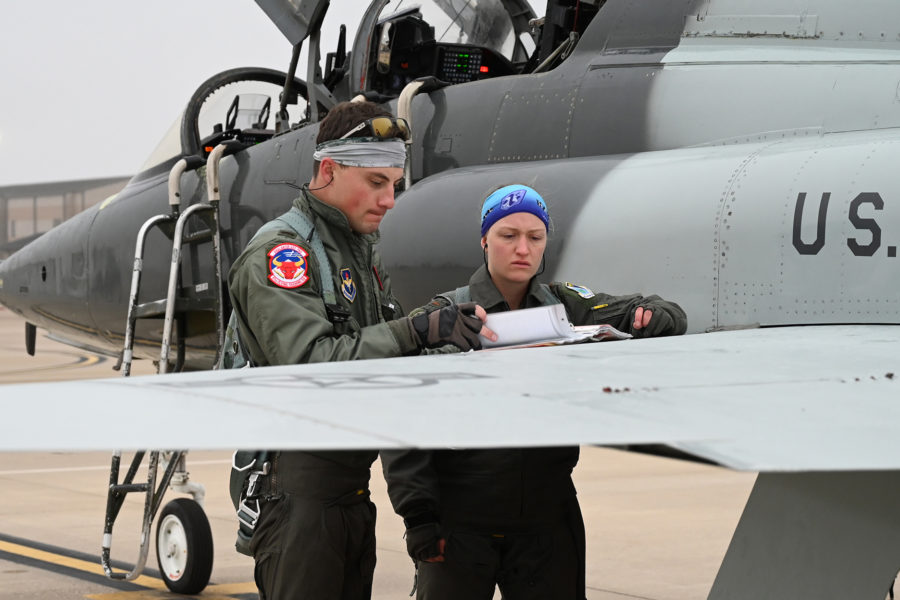
NATIONAL HARBOR, Md.—The Air Force is on track to exceed its annual goal of graduating 1,500 new pilots that had proved elusive to this point, one year after the service launched a sweeping overhaul of its undergraduate pilot training program, Air Education and Training Command Boss Lt. Gen. Clark J. Quinn said Sept. 15.
Reaching the milestone under the new Future of Undergraduate Pilot Training, or FUPT, program, will help “support the Air Force’s broader effort to address a pilot shortage,” a release from AETC stated.
“As of today, 1,408 people have been winged; there’s another 147 more that will graduate prior to the end of the fiscal year, barring somebody getting sick or a maintenance cancel,” Quinn told reporters at a roundtable discussion during AFA’s Air, Space & Cyber conference. “So we’re actually going to exceed the goal by about 50 pilots.”
AETC announced in spring 2025 it was moving to a hybrid private/military instruction model designed to reduce overall course time, a move aimed at ending the years of struggles to reach its benchmark of 1,500 trained pilots per year and “to produce elite aviators through a training system that is more deliberate, data-driven, and aligned with the demands of operational units,” Maj. Gen. Travolis A. Simmons, 19th Air Force commander, said in the announcement.
AETC’s new pilot training model offloads much of the basic, initial instruction to a commercial, university-based program, while retaining military-specific elements at Air Force training bases.
“Moving foundational flight training to civilian partners allows us to reserve military aircraft, instructor capacity, and flying hours for the advanced, military-specific training only the Air Force can provide,” Quinn said.
The new construct gives flight students 120 flying hours over 139 days at one of four flying universities, in a course now called Initial Pilot Training, or IPT. Upon completion, students receive their private pilot licenses—with instrument and multi-engine ratings—under FAA Part 141 standards. They then transfer to one of USAF’s four Undergraduate Pilot Training, or UPT, bases—Columbus Air Force Base, Miss.; Laughlin Air Force Base, Texas; Sheppard Air Force Base, Texas; and Vance Air Force Base, Okla.
“Achieving 1,500 validates that we can scale future undergraduate pilot training and we now continue the focus on refining the training to ensure the quality of our graduates matches the scale,” Quinn said. “Our instructor pilots, maintainers, and support teams adapted this enterprise to meet the need ensuring a steady flow of skilled aviators for our combatant commands.”
FUPT was “built to overcome long-standing constraints including instructor shortages and aircraft availability to deliver the aviators our combatant commanders require,” Quinn said.
The Air Force pilot shortage stood at roughly 2,470 pilots at the end of fiscal 2025, a shortfall officials have attributed over the years to issues across the service, including pilot production, retention, and absorption.
Quinn said AETC will be unable to “erase that pilot deficit in a short period of time.”
“I wish I could say, ‘Hey, the math shows if I make this many more pilots, the [2,470] will be gone in this fiscal year, but there’s just so much to it that it’s hard to predict,” he said. “I do know that if we don’t make 1,500, we’re never going to get that number down.”
Earlier this year, on May 20, Air Force Chief of Staff Gen. Kenneth S. Wilsbach gave a hint that the benchmark was within reach, telling lawmakers on the House Armed Services Committee that AETC was “meeting our goals for creating 1,500 pilots per year.”
“We did that this year, and we see no issues with doing that into the future,” Wilsbach said during the hearing. “The challenge will be absorbing all those into line cockpits.”
At the time, the class of student pilots at Vance Air Force Base had just started their training. Their graduation will be what gets AETC to its goal of 1,500 new pilots in fiscal 2026, an AETC spokesperson said.
Wilsbach also stressed to lawmakers that the service needs the roughly $10 billion its requesting in the fiscal 2027 budget for a plus-up for pilot flying hours. The Air Force is asking for $7.4 billion to fund Active-Duty flying hours, which would be a 22 percent increase from the $6.1 billion budgeted in fiscal 2026. Another $1.6 billion would cover Air National Guard hours, and $867 million would go to Air Force Reserve hours, for a total of $9.9 billion. That funding would pay for the fuel, spare parts, and consumable supplies pilots and maintenance crews need to safely and reliably fly aircraft.
“This 2027 budget gets us about $10 billion for flying; the pilots want to fly, they don’t want to sit on the ground and do admin,” Wilsbach said, adding that the service will offer pilots the ability to stay at duty locations for longer periods of time versus moving every two or three years.
The hope is that these efforts will “help us with pilot retention and that will, in turn, help with the pilot shortage,” Wilsbach said.
Gen. Adrian Spain, commander of Air Combat Command, added that it will likely take “at least” a decade to make a meaningful improvement in the pilot shortage.
“I think if we are disciplined about keeping production at 1,500 [per year] then in a decade, we’ll be in a much better place than we are today,” Spain said.