


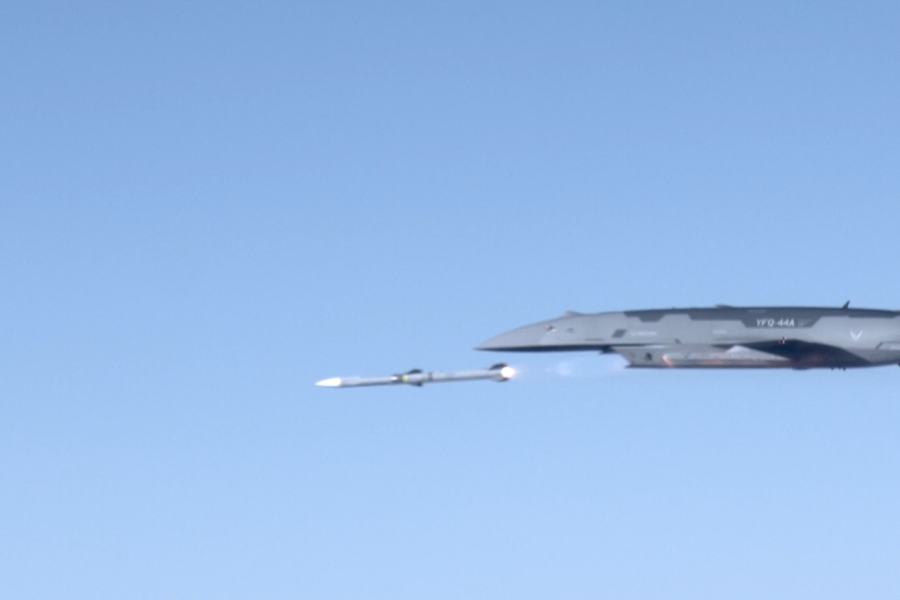
One of the Air Force’s developmental Collaborative Combat Aircraft fired a live missile in a recent test, marking a critical step forward in the development of the service’s fleet of semi-autonomous drone fighters.
The Air Force said in a July 15 statement that an Anduril YFQ-44A drone fired an AIM-120 AMRAAM, or Advanced Medium-Range Air-to-Air Missile, at a digital target over the Mojave Desert in California. In its own social media post, Anduril said the drone was flying from Edwards Air Force Base, Calif.
“This live-fire test is an important next step in the development of Collaborative Combat Aircraft,” Air Force Chief of Staff Gen. Kenneth S. Wilsbach said. “We’re one step closer to delivering capabilities to the warfighter.”
Mark Shushnar, vice president of autonomous airpower at Anduril, called the test “an important milestone in turning CCA into an operational capability.”
“This was more than a simple weapons release test,” Shushnar said in the company’s own statement. “It demonstrated an end-to-end, beyond-line-of-sight strike against a simulated target.”
CCAs are meant to be semi-autonomous, meaning they will fly alongside crewed aircraft and execute tasks based on basic directions from a human aviator. The Air Force eventually wants a fleet of about 1,000 CCAs to add “mass” to its combat fleet at a cheaper price point than manned platforms. Air Force officials have said they want CCAs to perform strike, reconnaissance, electronic warfare, and communications missions, or even act as decoys to confuse enemy forces.
The Air Force is developing Anduril’s FQ-44A and General Atomics Aeronautical Systems’ FQ-42A as its first increment of CCAs, which will focus on air-to-air missions.
Shushnar said that after Anduril’s CCA took off from Edwards, its autonomous Lattice software received information on the target it was meant to engage. An operator then told the YFQ-44A to strike the target, and the CCA fired the missile as instructed.
The Air Force and Anduril both said the test took place recently but would not specify when.
The Air Dominance Combined Test Force from Edwards’ 412th Test Wing helped carry out the live-fire test, the Air Force said. That test force is made up of Active-Duty military, government civilians, and contractors working to refine and validate the models needed to conduct a safe live-fire test.
In a statement to Air & Space Forces Magazine, General Atomics spokesman C. Mark Brinkley said his firm will conduct a live-fire test off its YFQ-42A by the end of 2026.
“Firing weapons from any unmanned aircraft is a huge milestone,” Brinkley said. “That’s something General Atomics pioneered and we’re known for, so we know what it means for everyone involved. Our team remains on schedule to fire from the internal bay of the FQ-42A later this year, and everyone is looking forward to showing more of what our aircraft can bring to the fight.”
The Air Force said these live-fire tests are the latest development in “a deliberate, phased test progression that began with inert carriage evaluations earlier this year.”
Wilsbach announced the start of those inert carriage tests in February at AFA’s Warfare Symposium. Those first flights focused on gathering in-flight data to make sure the CCA was handling as intended, the Air Force said. Follow-up evaluations, which took place in a simulated environment, made sure the data links were properly integrated and the CCA precisely carried out the operator’s commands.
“Moving from inert carriage earlier this year to this weapons release demonstrates program maturity, allowing us to validate our digital integration models with actual data,” Gen. Dale White, the Pentagon’s direct reporting portfolio manager for the Air Force’s critical major weapon systems, said in a statement. “These tests provide operational validation that Collaborative Combat Aircraft can execute the weapon employment sequence autonomously within pilot-defined parameters, accelerating capability delivery to the warfighter.”
The Air Force stressed that humans will retain oversight of CCAs and the drones will not autonomously use their weapons without a human’s command.
“The decision to release any weapon system remains exclusively with a human operator, who maintains command and control of the platform at all times,” the Air Force statement said.