
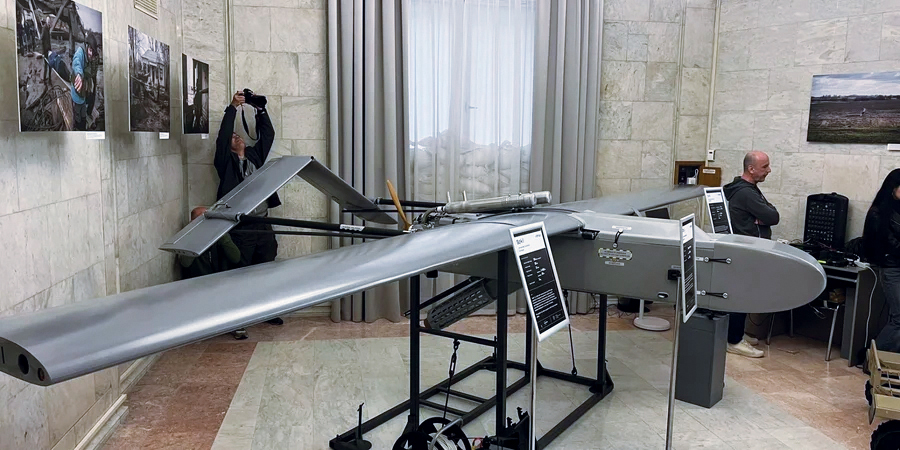
Since Russia’s 2022 invasion, outside observers have measured Ukraine’s prospects by a familiar yardstick: miles of territory gained or lost on the ground. By that standard, the war often appears static, attritional, and brutally expensive. But Ukraine is now demonstrating an alternative—and more effective—means to fight, taking the war deep into Russian territory not simply to punish Moscow, but to disrupt the systems that enable its military to continue fighting.
This is not a new idea. It is one of the oldest tenets of airpower: Attack the sources of an enemy’s military power directly, paralyze the systems on which the enemy depends, and impose costs that change the adversary’s strategic calculus. What is new is the means. Ukraine is executing strategic attacks with improvised, long-range, one-way uncrewed aircraft—more accurately described as low-cost cruise missiles. It is also employing special operations, maritime strike systems, cyber-enabled intelligence, and adaptive targeting.
One recent analysis suggests Kyiv pursue strategic neutralization: to shift away from measuring success solely by territorial movement on the ground and toward a broader objective of making Russia’s aggression operationally futile. The concept is not simply to attrit Russian forces at the front, but to persistently disrupt the systems that allow Moscow to regenerate combat power, export energy, produce weapons, launch missiles, and sustain the political fiction that the war can remain distant from Russian society.
Ukraine’s attacks on oil refineries, export terminals, military factories, command-and-logistics nodes, air defenses, airfields, semiconductor facilities, and cruise missile production centers are precisely the kinds of targets that make sense when the objective is not battlefield attrition alone, but systemic disruption.
Ukraine’s long-range strike campaign successfully adapts classic airpower theory to its own present-day constraints.
That logic reaches back to the early Airmen of the 1920s and 1930s. Giulio Douhet, Billy Mitchell, Hugh Trenchard, and the Air Corps Tactical School all argued in different ways that modern states had become vulnerable because they depended on interlocking industrial, transportation, energy, and command systems. The Air Corps Tactical School’s industrial web concept held that a nation’s war-making potential could be attacked through critical nodes in manufacturing, power, transportation, fuel, and other essential sectors. In my 2001 monograph on how the Desert Storm air campaign was designed and executed, this point is highlighted explicitly: the Air Corps Tactical School favored the destruction or paralysis of national organic systems such as electric power, transportation, railroads, fuel, food distribution, steel manufacturing, and related industries vital to a state’s war-making capacity.
The theory was first attempted on a large scale in World War II, but technology was not yet sufficient to fully exploit its potential. Strategic airpower could reach deep into enemy territory, but it could not reliably hit precise aimpoints without enormous mass. Even after Allied forces gained air superiority over Germany in 1944, precision bombing often required hundreds of aircraft to destroy a single target because only about 20 percent of bombs aimed at precision targets landed within 1,000 feet of the aimpoint. The strategic insight was real; the execution was only rudimentary.
That changed in 1991. The Desert Storm air campaign attacked Iraqi leadership, command-and-control, air defenses, electricity, transportation, oil, weapons production, and fielded forces in parallel to produce cascading effects. Much of Desert Storm’s success is rightly attributed to stealth and precision, but what made the operation so successful was its effects-based approach to planning and execution. Starting with the desired strategic and operational outcomes, planners worked backward to identify the key systems and critical nodes whose disruption would produce those desired effects—paralyzing decision-making, blinding air defenses, isolating fielded forces, degrading mobility and logistics, and collapsing Iraq’s ability to conduct coherent military operations. The objective was to orchestrate integrated attacks that would impose rapid, system-wide paralysis with speed, precision, and economy of force. It worked. The 43-day air campaign rapidly degraded Iraq’s fighting capacity, paving the way for the removal of Iraqi forces from Kuwait once land forces were employed.
Operation Allied Force in 1999 reinforced these lessons under different conditions. Though politically constrained and not a pure example of parallel warfare, the defense of Kosovo from Serbian aggression demonstrated how precision attacks against selected systems could achieve coercive effects. NATO’s own history describes Allied Force as an air campaign launched after diplomacy failed; RAND’s assessment, NATO’s Air War for Kosovo, characterized it as a 78-day air war designed to compel Slobodan Milosevic to end ethnic cleansing in Kosovo. Allied Force combined global attack, parallel precision engagements and elements of an effects-based approach to achieve those objectives.
Ukraine now finds itself under far harsher constraints. It lacks the air superiority achieved by the coalition in Desert Storm and by NATO in Allied Force. It cannot send large packages of manned aircraft deep into Russian airspace. It lacks the mass of a superpower air force. Yet it has recognized the same enduring truth: modern war depends on systems, and systems contain vulnerable nodes.
That is why Russian oil infrastructure matters. Oil is Russia’s economic engine, vital for revenue and political power, as well as for fuel, transportation capacity, industrial output. Ukrainian long-range cruise missile strikes against refineries, oil terminals, pumping stations, and export infrastructure are designed to reduce Moscow’s freedom of action. Recent attacks against facilities near Moscow, Crimea, Krasnodar, and even Tyumen demonstrate how Ukraine is steadily expanding both the reach and strategic ambition of its long-range campaign. In doing so, it is imposing costs: lower throughput, disrupted exports, higher repair and insurance burdens, diverted air defenses, and growing uncertainty inside Russia’s political and industrial system.
This campaign has already shown strategic-economic effects, with Ukrainian President Zelenskyy asserting that in March alone, Russia suffered $2.3 billion in lost revenue as a result of intensified long-range attacks against Russian port and energy infrastructure. Sustained attacks on revenue, fuel, transport, and repair networks reduce Moscow’s ability to finance, supply, and politically normalize the war.
The same logic applies to strikes on airfields, air defense systems, military production facilities, and electronics plants. Long-range strikes against facilities such as Angstrem Microelectronics in Zelenograd and MKB Raduga in Dubna are part of a campaign to reach the industrial and technological foundations of Russian military power. That is classic strategic attack: identify the systems that enable the enemy’s war effort, find the critical nodes within those systems, and attack to produce operational and strategic effects disproportionate to the costs of the weapons used in the attack.
Operation Spiderweb, Ukraine’s daring, covert operation to strike Russian long-range combat aircraft deep inside Russia on Russian bases with remotely operated drones, sharpened the point. The Center for Strategic International Studies described the operation delivered a major blow to Moscow’s long-range bomber fleet; the Washington Post reported Ukrainian intelligence claims that up to 12 bombers, including Tu-95 aircraft used to strike Ukrainian cities, were damaged or destroyed. Even if final battle damage assessments vary, the operational message is unmistakable: Ukraine is attacking Russia’s ability to project air and missile power, not merely reacting to it at the point of impact.
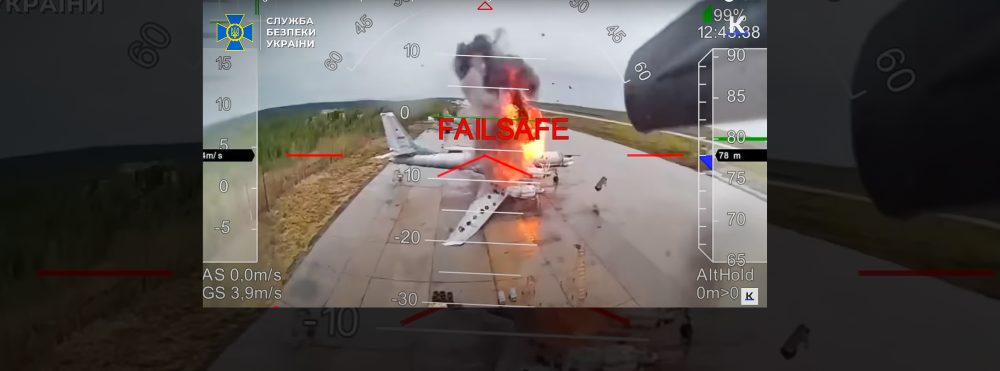
This is strategic attack adapted to account for the limitations of Ukraine’s military. Desert Storm used stealth aircraft, cruise missiles, precision-guided munitions, airborne command and control, space-enabled navigation, and massive conventional combat aircraft and logistics capabilities. Ukraine is leveraging commercially influenced electronics, adapted airframes, distributed launch methods, maritime uncrewed systems, and intelligence fusion to the same kind of effects. Due to limits on what U.S. and European deep attack systems the West will provide, Ukraine is domestically producing its own unique long-range capabilities, such as the FP-1 Firepoint, RS-1 Bars, and Bars-SM Gladiator, to penetrate dense Russian air defenses and strike military related facilities in the Moscow region.
Ukraine is not replicating Desert Storm but rather translating the logic of that air campaign into a new context: a war in which neither side has air supremacy, and in which Ukraine lacks sufficient weapons and faces a nuclear-armed adversary with strategic depth. Its campaign is therefore more episodic, more improvised, and more constrained. But its essence is recognizable: parallel pressure against military, industrial, energy, and psychological systems; precision sufficient to attack specific nodes; and a theory of victory that seeks to change enemy behavior by making the cost of aggression increasingly costly.
That is also why the campaign should not be judged solely by whether it produces immediate territorial gains. Strategic attack only rarely achieve their objectives with a single blow. It accumulates effects. It forces the adversary to divert air defenses from the front to the homeland. It compels dispersal of aircraft and production. It raises insurance, transport, repair, and security costs. It reduces refinery throughput. It complicates military logistics. It imposes political costs, creating uncertainty in the minds of commanders, industrial managers, political elites, and citizens.
This is precisely the realm of effects-based operations. Strategy must be understood as the orchestration of means to accomplish ends and to optimize actualization of that goal target selection must focus not on the absolute destruction of a list of targets, but on the effects desired upon target systems. That sentence captures Ukraine’s emerging approach. Kyiv is not trying to bomb Russia into submission in the crude sense sometimes associated with early airpower theory. It is trying to deny Russia the ability to wage war cheaply, confidently, and indefinitely.
The moral and legal distinction is essential: Strategic attack does not mean indiscriminate attack. In fact, the maturation of airpower from World War II to Desert Storm was, in large part, the story of moving from area destruction toward more precise attacks on military and war-sustaining systems. That distinction is visible today in the contrast between Ukrainian and Russian long-range strike. Russian attacks have repeatedly targeted civilian areas, apartment blocks, hospitals, schools, civil power grids, and other nonmilitary sites. These attacks suggest either deliberate terrorism, poor intelligence, weak target development, or a disregard for civilian harm. Ukraine’s legitimacy depends on continuing to do the opposite: focusing on military objectives and war-supporting infrastructure, using accurate, precise, and timely intelligence, and applying disciplined target planning to minimize civilian harm.
Russia possesses proportionately greater long-range strike capacity, but it lacks the leadership, training, perspective and doctrine required to translate that capacity into decisive strategic advantage. Ukraine has fewer means, but it is learning how to make them count. That is the fundamental difference between the two sides: one uses strike largely as punishment and coercion against society; the other is increasingly applying strike as a targeted means of disrupting the systems that sustain aggression.
There is an important lesson for the United States and its allies here. Ukraine’s campaign demonstrates that long-range strike is not a luxury, but a strategic necessity. A state that can only defend at the front is condemned to absorb punishment indefinitely. A state that can reach the enemy’s arsenals, refineries, command nodes, ports, airfields, and production base can change the war’s logic. That is why sustained support for Ukraine’s long-range attack capacity should not be viewed as escalatory. Properly bounded, legally employed, and strategically directed, it is a means of shortening the war by attacking Russia’s capacity to continue it.
The West has too often treated long-range strike as a reward to be rationed rather than as a requirement to be integrated into a coherent theory of victory. That caution has carried costs. Every delay in providing Ukraine the means to hold Russia’s war-sustaining systems at risk gives Moscow the gift of time to adapt, repair, disperse, and continue its assault. Recent steps to expand Ukraine-based and European production of long-range missiles and air-defense systems are welcome, but the strategic logic should be clearer: Ukraine needs the ability to impose recurring costs on the systems that sustain Russia’s aggression. The objective should not be symbolic retaliation or indiscriminate punishment. It should be the systematic disruption of the military, industrial, logistical, energy, and command systems that allow Russia to keep fighting.
The Airmen of the interwar years of the 1930s understood the vulnerabilities of modern industrial states before they had the tools to exploit them effectively. World War II proved both the ambition and the limits of their theories. The Desert Storm air campaign showed what happened when precision, stealth, information, and operational design finally converged. Allied Force showed that airpower could contribute to coercive political outcomes under severe constraints. Ukraine is now writing the next chapter: strategic attack conducted by a nation without air superiority, using improvised but sophisticated long-range systems to impose systemic costs on a larger aggressor.
Technology alone has never won wars, but strategy determines whether technology matters. Ukraine’s achievement is not simply that it has built longer-range weapons. It is that it is using them in accordance with a coherent strategic logic: attack the systems that sustain Russian aggression, complicate Moscow’s choices, reduce Russia’s ability to generate combat power, and improve Ukraine’s position for an eventual settlement.
If the United States and its allies want this war to end sooner, they should help Ukraine expand that logic—not constrain it. Providing Ukraine the long-range attack means to hold Russia’s war machine at risk could accelerate the conclusion of the war by making continued aggression more costly than negotiation.
But there is another imperative as well. Ukraine is paying in blood for real-world lessons about long-range strike, air defense, uncrewed systems, electronic warfare, targeting, intelligence fusion, resilience, dispersal, deception, and the operational art of fighting a larger adversary under persistent attack. Even a modest increase in U.S. and allied investment—including the placement of U.S. military observers in Ukraine—would yield lessons that could prevent American and allied forces from having to relearn them later at far greater cost. Supporting Ukraine is therefore not only about bringing this war to a faster and more favorable conclusion. It is also about absorbing the lessons of this war before the next one imposes those lessons on us.
The weapons have changed. The theory has endured. Ukraine is proving that even improvised means, when guided by sound strategic logic, can produce effects once reserved for great-power air forces.
U.S. and allied leaders must therefore recognize that helping Ukraine achieve its strategic attack objectives may be the fastest path to ending the war, turning battlespace strength into decisive leverage, bringing closure sooner than any other available course, and ensuring that the hard lessons Ukraine is learning are not paid for again by American and allied forces in a future conflict.
Lt. Gen. David A. Deptula, USAF (Ret.), is the Dean of the Mitchell Institute for Aerospace Studies. He has been involved in planning and executing multiple major coalition air campaigns and was a Joint Task Force commander twice during his long military career.