


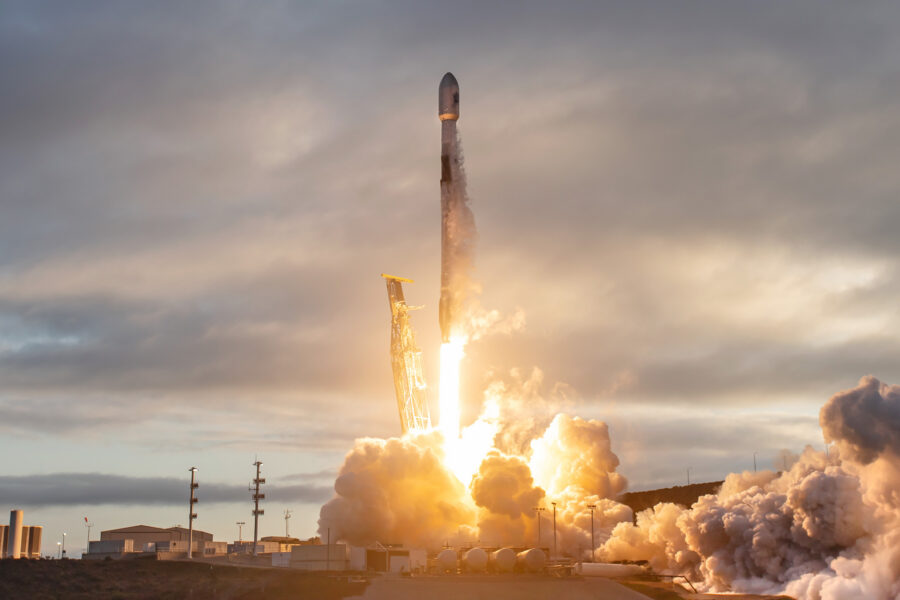
A new White House policy calls for the Pentagon to craft plans for additional space launch facilities to support a projected increase in launch demand that could see the U.S. supporting as many as 1,000 launches by 2030, more than a fivefold increase from 2025.
The memo, issued Aug. 20, is the first official update to the National Space Transportation Policy since 2013. In the 13 years between updates, launch rates have spiked and proliferated constellations with hundreds and even thousands of satellites are in the works. The U.S. had 19 launches for all of 2013; in 2026, it hit that number by mid-February.
“Access to, from, and within space is a vital national and economic security interest,” the new policy states. “American space transportation capabilities underpin the global economy, and commercial space innovation flourishes with affordable, reliable, and safe space transportation.”
Of particular interest for the Pentagon, the document calls on the Department of Defense to work with the Department of Homeland Security, NASA, and other government agencies to explore options to build additional spaceport infrastructure on federal property. The agencies will brief the White House in February on their findings as well as any policy changes, resourcing, or authorities needed to move forward with launch range infrastructure projects.
It also directs both the Pentagon and NASA to “prioritize and coordinate on infrastructure investments that optimize launch and reentry capacity, flexibility, agility, resilience, and economies of scale at Federal launch and reentry facilities and ranges.”
Today, the Space Force manages two major spaceports at Vandenberg Space Force Base, Calif., and Cape Canaveral Space Force Station, Fla. Activity at the two ranges accounts for the bulk of U.S. commercial and military launches, and together they supported 175 launches in 2025.
The Space Force has acknowledged those sites are running out of room to handle the demand that’s forecasted over the next five to 10 years. In congressional testimony in May, Air Force Secretary Troy Meink said the service needs a third launch facility that can handle the larger heavy and super heavy-class rockets. And outgoing Chief of Space Operations Gen. Chance Saltzman said in July the Space Force may need to put a cap on the number of missions it can support each year without additional funding.
The service is building new facilities and trying to make the most of limited real estate—particularly at Cape Canaveral—but without more resources, its infrastructure is approaching capacity limits.
“We don’t want to put a cap on the number of launches that we can support from our ranges, but we have to consider that our existing resources will fail if we don’t consider a cap,” Saltzman said. “And I think that’s kind of where we are right now.”
Short of infrastructure investments, the White House also directs DOD and NASA to implement more efficient range scheduling processes at their spaceports and to be more transparent with the public and industry about launch schedules.
The new policy also addresses other major trends in the spacelift industry. Another provision calls on the Pentagon and other departments to identify what “regulatory, programmatic, operational, and technological barriers” hinder efforts to provide more responsive and resilient access to space. That’s familiar territory for the Space Force, which has been trying to refine its processes for rapid launch in recent years.
In its most recent exercise in June, the service and its industry partners demonstrated the ability to launch a satellite just 16 hours and 42 minutes after receiving orders and then conduct a series of maneuvers in orbit involving multiple spacecraft. The service has more missions in the works that will further explore rapid launch timelines as well as orbital maneuver and in-space propulsion—another area the White House highlighted in its memo.
The document directs DOD and NASA to pursue in-space transportation capabilities for missions like on-orbit logistics or servicing and to factor in those platforms and services when designing new architectures. It specifically calls for “diversity of transportation types,” to include spaceplanes, like the Space Force’s X-37, which to date has largely conducted classified and experimental missions for the military and NASA.