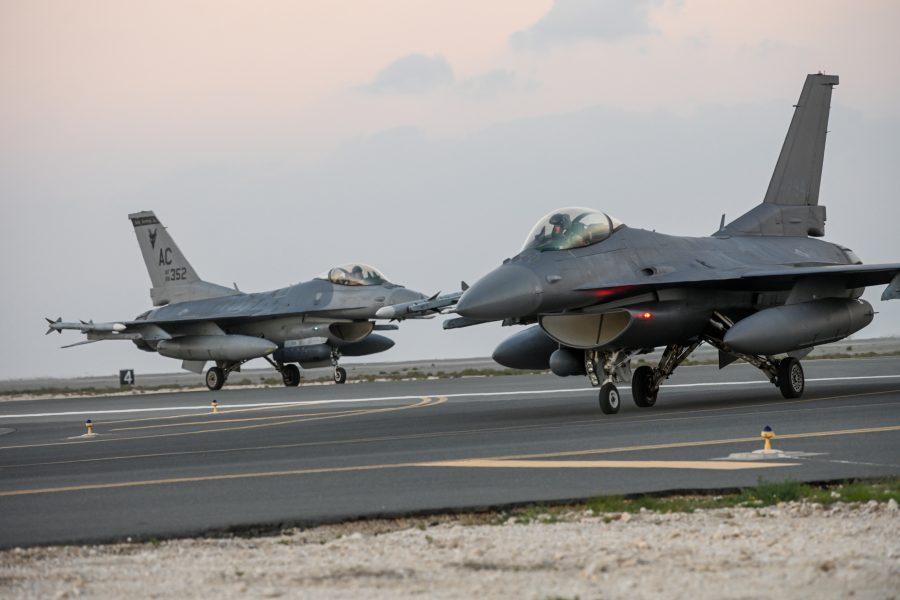
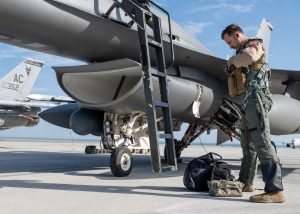
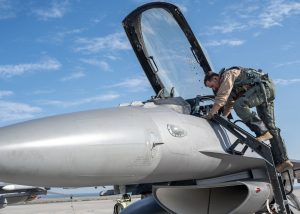
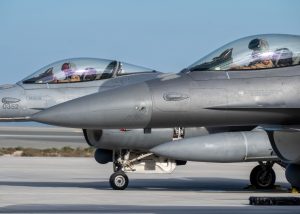
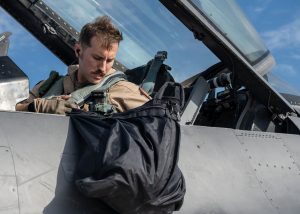
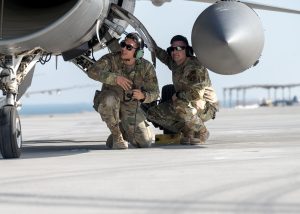
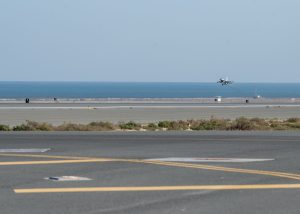
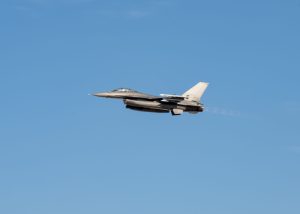
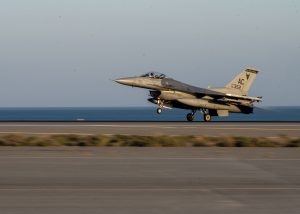
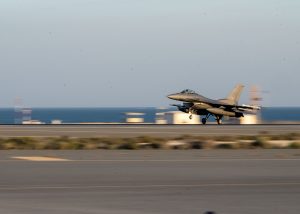
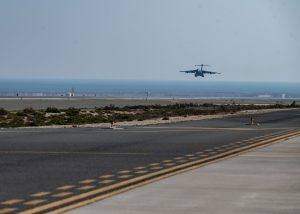
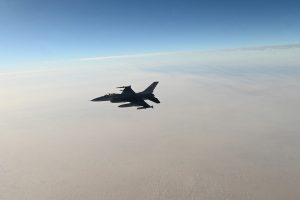
U.S. Air Force F-16 Fighting Falcons taxi at an undisclosed location in the U.S. Central Command area of responsibility in preparation for combined Exercise Ballast Cannon, Jan. 6, 2024. Exercises like Ballast Cannon allow the U.S. and partner nations to improve interoperability, the ability to address adversaries and provide stability in the region. (U.S. Air National Guard photo by Tech. Sgt. Megan Floyd)
Audio of this article is brought to you by the Air & Space Forces Association, honoring and supporting our Airmen, Guardians, and their families. Find out more at afa.org
U.S. Air Force F-16 fighters are in the midst of a weeklong training exercise with the Royal Bahraini Air Force, Air Forces Central announced.
The exercise, named Ballast Cannon, started Jan. 6 and will last until Jan. 12. In addition to the F-16s, KC-135 tankers are participating. Airmen are incorporating Agile Combat Employment (ACE) objectives into the exercise, as well as practicing aerial refueling, coalition command and control, and tactical integration between the USAF and the RBAF.
“By constantly integrating with our partners at the tactical edge, while still testing our expeditionary capabilities, we are building readiness and developing operational approaches that complicate the adversary’s problem as well as maintains our strategic advantage.” Brig. Gen. Quaid Quadri, 378th Air Expeditionary Wing Commander, said in a statement.
Images released by AFCENT show the F-16s participating in the aircraft to be from the New Jersey Air National Guard—the 119th Expeditionary Fighter Squadron arrived in the Middle East in late October to bolster the Air Force’s fighter footprint in the region amid increased attacks by militia groups aligned with Iran and concerns about possible region-wide escalation of the Israel-Hamas war.
An Air Forces Central release emphasized that this latest exercise is a “routine” event, with new editions of Ballast Cannon occurring roughly every three months. Previous iterations have not been publicized, but the USAF and RBAF have worked together before, participating in regional coalition operations, contributing to missions over Yemen and Iraq against Islamic State group fighters. In 2022, the two organizations also conducted a subject matter expert exchange focused on the C-130J aircraft.
“Through decades of collaboration and cooperation with our wonderful partners in the region, we have developed key relationships, bolstering our ability to integrate and employ airpower across the coalition,” Quadri said.
Agile Combat Employment is the Air Force’s operational concept whereby teams of Airmen and aircraft disperse from large central bases to various remote or austere locations, where they can operate with fewer resources and move quickly as needed.
Bahrain has operated F-16s of its own since the early 1990s. In 2018, the Gulf nation ordered 16 of Lockheed Martin’s newest Block 70 F-16s in a $1.1 billion contract. After completing flight tests at Edwards Air Force Base, Calif., the initial batch of these jets are set to be delivered to the RBAF this year.
Audio of this article is brought to you by the Air & Space Forces Association, honoring and supporting our Airmen, Guardians, and their families. Find out more at afa.org
BAE Systems has received a contract from Lockheed Martin to install an upgraded Block 4 electronic warfare system into new F-35 Joint Strike Fighters, as well as to retrofit some older jets.
The Air Force has figured out a way for maintainers to inspect what had been a “blind spot” in F-16 engines, after problems in that area led to the catastrophic crashes of two jets in recent years.
The Air Force has begun evacuating stealth fighters, gunships, and special operations planes ahead of Hurricane Isaias expected landfall over the Gulf Coast this weekend.
The Air Force’s B-52 bomber may soon be able to carry up to 20 stealthy long-range anti-ship missiles to strike moving targets at sea, a key capability in a potential fight with China.
A reported surge of MQ-9 Reaper drones to Latin America could widen the scope of intelligence gathering and free up more strike options against cartels in the region, experts tell Air & Space Forces Magazine.
Northrop Grumman has broken ground on a major new production facility for the B-21 Raider, the company and the Air Force announced Oct. 6. The construction comes as a top service official said testing on the bomber is going well in the lead up to its planned introduction into the…
An OA-1K Skyraider II belonging to Air Force Special Operations Command went off the runway while landing at a small Oklahoma City airport Oct. 5 and is waiting to be moved, according to officials and flight tracking data.
More than two dozen F-35 Lightning II fighters are heading to Kingsley Field, Ore., after Air Force Secretary Troy Meink signed the official record of decision to base the jets there on Oct. 5, clearing the last bureaucratic hurdle for the Air National Guard base to host the service’s third…
✓
Thank You!
Check your inbox to verify your email address and finish setting up your AFA account.
★
Welcome Back!
An account with this email already exists. Please log in to continue.
Subscribe to the Air & Space Forces Daily Report
The latest news from Air & Space Forces Magazine, as well as news from other leading publications, delivered right to your inbox every morning!
We’re sorry, there has been an error. Please review your input or try again later.