


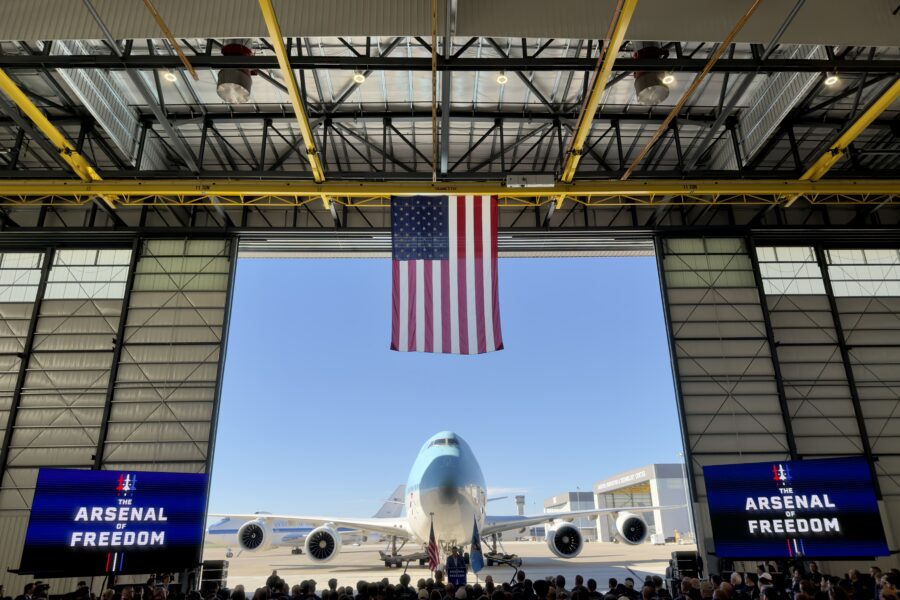
DAYTON, Ohio, and EAU CLAIRE, Wis.—Secretary of Defense Pete Hegseth took his Arsenal of Freedom tour to the swing states of Ohio and Wisconsin on Oct. 20, highlighting efforts to boost defense manufacturing before the midterm elections next month, including by visiting future E-4C “Doomsday” planes.
“We plan to spend even more in the future,” Hegseth said during a visit to the Sierra Nevada Corporation in Dayton, Ohio, where he praised President Donald Trump and Sen. Bernie Moreno, an Ohio Republican.
“We are providing larger and longer and more predictable contracts to companies so that they can deliver at scale and at pace,” he added. “That means more jobs, more reliable jobs, high-paying jobs as companies invest in their people. We’re going to reward leaders who invest in their workers, who expand their capacity, and who share our utter sense of urgency.”
Sierra Nevada purchased five Korean Air 747-8i jetliners and plans to convert at least four into the new E-4C Survivable Airborne Operations Center, or SAOC. Hegseth championed the company, which won a $13 billion contract to build America’s next-generation nuclear command-and-control aircraft over Boeing. Shield AI was recently awarded a contract to integrate artificial intelligence into aircraft. And there are signs the Air Force may choose to grow the fleet.

Speaking to reporters, Hegseth discussed his recent trop to the Middle East, where he visited U.S. fighter units and Airmen, among others, and told Air & Space Forces Magazine he met with Israeli Prime Minister Benjamin Netanyahu. He declined to say what he had discussed with the Israeli leader, including the possibility of renewing attacks on Iran, but added that the Israeli military “has great capabilities.”
“We’ve worked with the Israeli military quite a bit,” Hegseth said. “They’ve been good partners.”
Hegseth also told Air & Space Magazine the Pentagon had not ordered a slowdown of SpaceX’s Starlink or its military version Starshield, which the DOD controls, for Ukraine—Ukrainian officials say their access to the space internet service has been throttled, hampering their drones and air defenses.
“We haven’t changed our posture in any way to all the Ukrainians,” Hegseth said. “We haven’t pulled anything back. There are terms of service that ultimately need to be complied to, and that’s where Starlink has the option to make those decisions. But nothing’s changed from our view. We haven’t made any directives or anything like that. And we wish the Ukrainians, obviously, success.”
The Wall Street Journal reported later on Oct. 20 that the move to throttle Starlink was decided by Elon Musk, the chief executive of SpaceX.
But Hegseth’s trip was mainly intended as an opportunity for him to make his case for more defense spending and the Pentagon’s push to help the defense industry.
“We’re asking for a $1.5 trillion investment to make a generational investment to ensure that we remain the strongest and most powerful military in the world,” Hegseth said. “And those types of investments translate directly into high-paying jobs for American manufacturers.”
The aircraft being overhauled by Sierra Nevada Corporation are due to replace the four aging E-4B National Airborne Operations Center aircraft, which are on average over 50 years old.
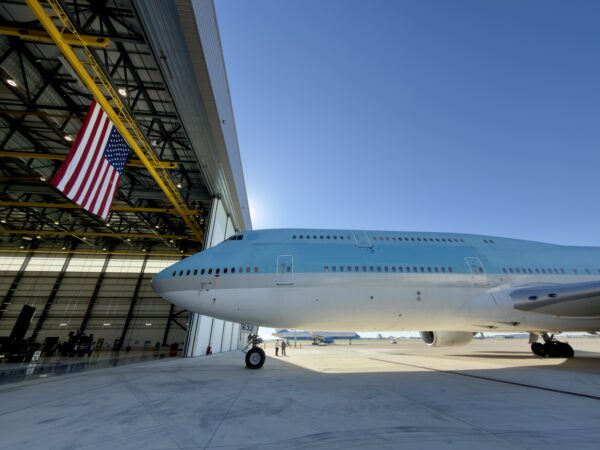
Boeing was eliminated from the competition to modernize the E-4 nuclear command and control fleet in 2023, leaving SNC as the sole competitor; the E-4C airframe itself is still based on Boeing’s 747-800i.
That gave SNC its largest contract in six-decade history, which is also one of the largest aircraft modernization deals given to a company that isn’t the plane’s original manufacturer. The E-4C flew its first test flight last year.
Hegseth also touted his Future of War initiative, Project Meridian, and his plans for a new four-star Autonomous Warfare Command—and, he said, the effort he has embarked on over the last year to champion American manufacturing.


Hegseth then jetted to Wisconsin to visit the rural congressional district of Rep. Derrick Van Orden, a close administration ally, who is currently locked in a tight reelection battle predicted to be a toss-up. Hegseth’s visit to the small business Riverside Machine and Engineering, alongside Small Business Administrator Kelly Loeffler, highlighted an effort to invest in small defense companies. The company is a small subcontractor that builds parts that go in radars and other equipment for BAE Systems and Lockheed Martin, including the F-35.
“Tens of thousands of small businesses are the core of our defense industrial base,” Hegseth said. “Any supply chain is only as weak as its weakest link, and if you can’t make a critical subcomponent, then ultimately that F-35 doesn’t fly or ultimately that radar isn’t working.”