


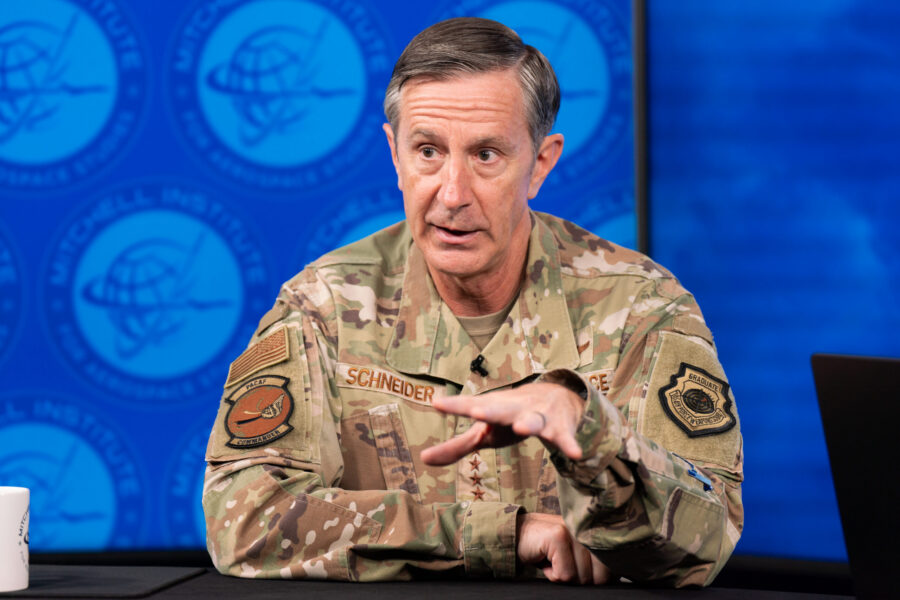
The Air Force will incorporate its sister services and more allies into the next edition of its large-scale Pacific exercise, which will take place in spring 2027, a top general revealed July 27.
The first edition of Resolute Force Pacific, which took place last summer, was one of the service’s biggest exercises in recent memory and the anchor of the larger Department-Level Exercise series. It featured around 300 aircraft across a host of locations in Japan, Guam, and more.
Yet despite that massive scale, Gen. Kevin B. Schneider described that exercise as a “stepping stone” for his command, Pacific Air Forces. Specifically, he noted that it was largely limited to U.S. Air Force personnel and platforms.
“It was largely USAF-focused in 2025. We’re bringing more joint forces into it now that we’ve got a one rep under our belt and we know what we’re doing, and we’re bringing more allies and partners into it as well,” Schneider said at an event with AFA’s Mitchell Institute for Aerospace Studies.
Schneider also confirmed that planning for REFORPAC 2027 has ramped up as of late.
“ REFORPAC 2027 planning probably started about the day that we finished REFORPAC 2025. It is in earnest right now. We’ll look to execute this the springtime of 2027,” he said.
Resolute Force Pacific was born out of the Department of the Air Force’s so-called “reoptimization” effort starting in 2024 meant to pivot the Air Force and Space Force toward great power competition with the likes of China. While that effort was later shelved with a change in department leadership and presidential administrations, officials kept the large-scale exercise and said it provided key lessons on “large operations in contested, dynamic environments,” Schneider said in September 2025.
But while REFORPAC was described as a biennial event, Air Force leaders haven’t said much about the 2027 edition until now, including when it might take place.
“We have gone through a couple of the initial conferences,” Schneider said of the planning. “We have briefed it to Pacific Command, and the combatant command is fully supportive and understanding of what it is that we’re trying to do. So that is moving out, and really appreciate the team, both Air Force, joint force, and ally and partner teams, that are really going all in on this one.”
Other Exercises
While exercises like REFORPAC help the Air Force practice the large-scale operations that would be necessary in a conflict with China or another adversary, they come with a cost to readiness as Airmen and aircraft need time to prepare or recover.
“An exercise is a great way to build skill sets. We build interoperability, and there’s a lot to be gained,” Schneider said at AFA’s Air, Space & Cyber Conference in 2024. “There’s also a burn that’s associated with exercises.”
Any cost to readiness is getting fresh scrutiny amid Air Force Secretary Troy Meink and Chief of Staff Gen. Kenneth S. Wilsbach’s drive to improve the service’s readiness rates. At the Mitchell Institute, Schneider said he and his team are taking a look at the dozens of exercises that PACAF participates in every year to determine which ones are worth it.
“We do 45 of those in PACAF, give or take a couple every year, and that’s a lot,” Schneider explained.
“They’re all valuable; they all have benefits. But we’re taking a look at, what are the ones that are readiness gainers? What are the ones that are maybe not high on that list of building readiness for our Airmen? And then making some decisions to go, we’re going to continue to do these; we’re not going to do these; or we’ll do these in reduced volume, just to make sure that we are preserving that readiness within our formations, so that we can be responsive to our commander at PACOM, as well as provide the Air Force options for other parts of the world.”
Schneider’s reference to “other parts of the world” is particularly relevant, given the large number of forces the Pentagon has poured into the Middle East for operations against Iran—dozens of fighters, bombers, tankers, and more.
“I think we’ve done a pretty good job of identifying amongst commanders where we’re going to take risk or how we manage the risks as we prioritize efforts in the CENTCOM region right now, and what are those things that we are able to absorb as commanders elsewhere in the Air Force enterprise,” Schneider said.
As PACAF considers how to prioritize exercises, Schneider said he will focus on those that get after “the most critical, the most challenging, the most difficult” problems the Air Force faces, like fifth-generation fighter tactics, large-scale command and control, and long-range kill chains.
One such exercise that took place recently was Valiant Shield, a major endeavor that included the U.S. Navy, Japanese forces, and more. One of the highlights of that exercise was the presences of the Royal Australian Air Force’s in-development MQ-28 Ghost Bat, a semi-autonomous drone meant to fly alongside manned platforms and extend their reach.
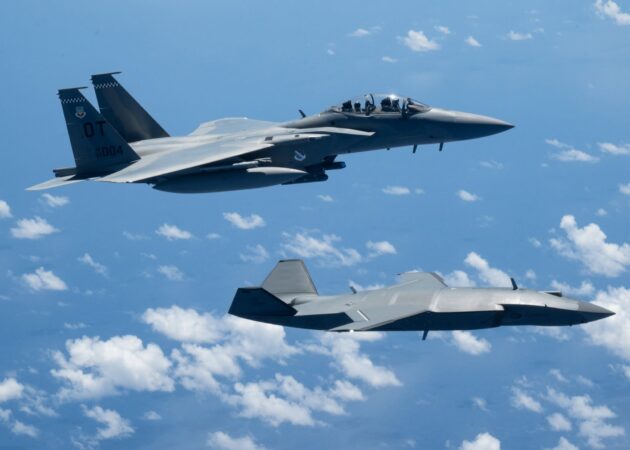
The MQ-28 flew with multiple U.S. aircraft during the exercise, but Schneider largely demurred when asked about it, pointing instead to the Air Force’s test enterprise that is deep into developing Collaborative Combat Aircraft like the Ghost Bat.
Those testers, he noted, were able to use the exercise as a way to develop tactics, techniques, and procedures for the advanced capabilities the Air Force is pursuing with the CCA program.
Other training events focused on lower-end skills, he said, may have to be curtailed.
“I grew up in PACAF doing exercises where we’d go to a different country and we would do basic fighter maneuvers … which was a hoot. I really enjoyed it,” Schneider said. “But while that does provide some capability, those are also things that can be done at home station without the cost or expense of a deployment.”