
The U.S. military launched a new series of airstrikes on Iran June 26, a day after Tehran struck a commercial ship in the Strait of Hormuz with a drone. The twin attacks presented a fresh test for the tenuous ceasefire and negotiations between the two countries.
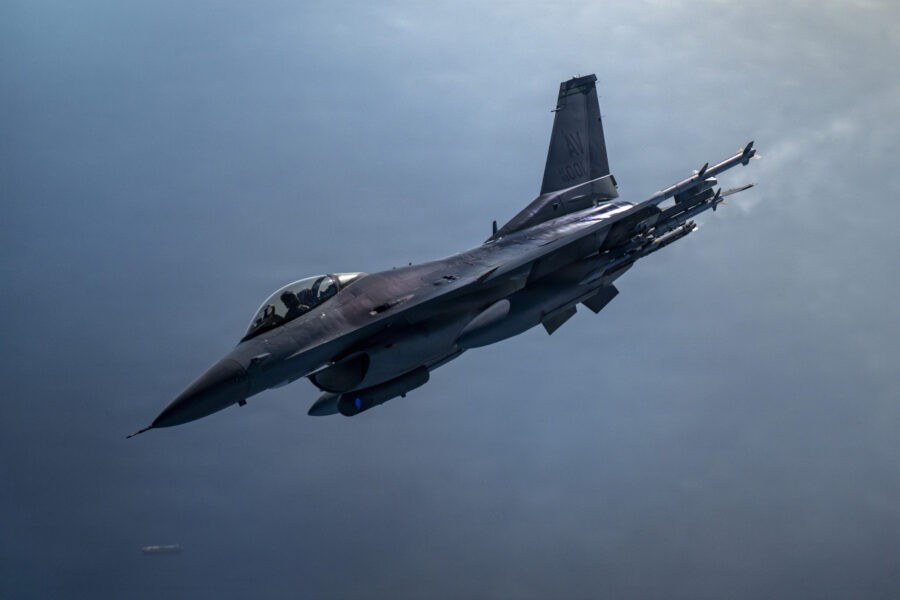
American aircraft struck Iranian missile and drone storage locations and also coastal radar sites, according to the U.S. military. U.S. Central Command termed the airstrikes a “powerful response” to Iran’s June 25 attack on the Singapore-flagged container ship M/V Ever Lovely with a one-way attack drone.
Six U.S. warplanes struck four targets along the Iranian coast, a person familiar with the matter told Air & Space Forces Magazine.
“The unwarranted aggression against commercial shipping by Iranian forces clearly violated the ceasefire,” CENTCOM said in a statement. “Furthermore, Iran’s dangerous behavior undermined freedom of navigation as commerce increasingly flows through the vital international trade corridor.”
President Donald Trump, posting on social media earlier in the day, said Iran’s attack included at least four one-way attack drones, three of which were “knocked down” by the U.S. Although a spokesperson for CENTCOM did not comment about U.S. forces’ involvement in shooting down the Iranian drones, other officials confirmed Trump’s account.
“Obviously, this is a foolish violation of our Ceasefire Agreement,” Trump wrote.
A half dozen U.S. Air Force aerial refueling tankers and a U.S. Navy P-8 Poseidon maritime patrol aircraft were flying over the Persian Gulf and Strait of Hormuz around the time of the U.S. airstrikes, according to open-source flight tracking data.
In response, Iran’s Islamic Revolutionary Guard Corps claimed, without substantiating its statement, that it was able to “thwart and foil the attack,” causing U.S. forces to retreat. The IRGC promised to retaliate: “This aggression will not go unanswered, and the response will be swift and decisive, at a time and place of our choosing.”
Trump has threatened to resume the hostilities if Iran violates the terms of a memorandum of understanding signed by both sides a week ago. The MOU was supposed to open the Strait of Hormuz—a narrow strategic chokepoint between the Persian Gulf and the Gulf of Oman, which opens into the Indian Ocean—to oil traffic and set the stage for talks on steps to constrain Iran’s nuclear program. That led oil prices to drop to pre-war levels earlier this week.
But with midterm elections approaching and oil inventories still at a reduced level, the White House would prefer to avoid a renewal of the war.
“Iran signed a ceasefire agreement. We have honored it,” Vice President JD Vance wrote on X. “If they have disagreements about how the MOU is being applied, they can pick up the phone. But violence will be met with violence.”
Following the June 19 signing, the U.S. military lifted its blockade of Iranian ports for the first time since April 13. The U.S. and Israeli bombing campaign against Iran, known as Operation Epic Fury, lasted from Feb. 28-April 8, the biggest U.S. air war in a generation. But Iran has refused to give up easily and has not surrendered its nuclear program.
Iran and the U.S. have traded salvos since the first ceasefire was reached in early April.
“I don’t like the fact that they took a shot yesterday—actually four, we knocked down three—at a ship,” Trump said June 26, before the strikes began. “Not an allied ship, but a ship—a very expensive ship. And it was fine—it took a little beating. They shouldn’t be doing that.”
The International Maritime Organization had encouraged ships to pass through the strait via a southern route near the coast of Oman, a lane backed by the U.S.
Iran, meanwhile, has insisted that mariners must coordinate with its government in order to pass through the strait. Since the war began, Iran has worked to exact tolls on ships using the Iranian-sanctioned routes.
The Ever Lovely was struck near the Omani coast, according to U.S. officials and the United Kingdom Maritime Trade Operations Center, a British government-run monitoring organization. After Iran’s attack, shipping in the region was disrupted. The IMO said it would “temporarily pause” its plan following the incident.
The U.S. military said it would continue to support the U.S.-backed route through the Strait of Hormuz, despite Iranian interference.
“CENTCOM forces continue to provide safe passage coordination and support to commercial vessels transiting the strait,” the command added in its statement. “The U.S. military remains present and vigilant to ensure all aspects of the agreement with Iran are adhered to, obeyed, and in full force and effect.”
Though Iran is not currently collecting tolls, it still insists that a final deal should allow it to collect revenue from commercial ships passing through the Strait of Hormuz. U.S. officials have rebuffed that demand.
