


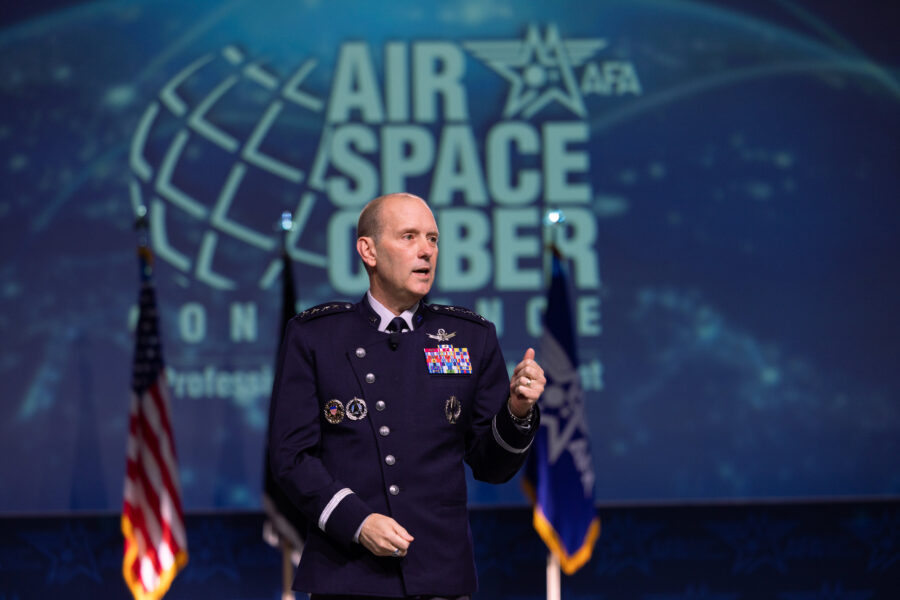
NATIONAL HARBOR, Md.—Guardians are playing a critical role in U.S. operations against Iran, applying electronic warfare effects to stifle enemy air defenses and communication systems and contributing other space capabilities vital to the war effort, said Gen. Douglas Schiess in his first major address one since becoming Chief of Space Operations 12 days ago.
In fact, Schiess said, Operation Epic Fury may not have happened at all without the Space Force.
“Our Guardians have been tested several times this past year. When the order came for Epic Fury, the Space Force was a part of the decision calculus on whether we executed the joint campaign at all—we were part of the minimum force package,” Schiess said Sept. 15 at AFA’s Air, Space & Cyber Conference here. “This is the minimum force required that a commander considers when sending military forces into harm’s way. The joint force made it clear: Without the Space Force’s capabilities, the joint force could not—and would not—move forward.”
Since the start of the conflict in late February, U.S. officials have touted space systems’ importance to operations. During a briefing in early March, Chairman of the Joint Chiefs of Staff Air Force Gen. Dan Caine said U.S. Space Command was among the “first movers” during initial strikes on Iran, helping create a path for the joint force to strike more than 1,000 targets in the campaign’s first 24 hours.
“During Operation Epic Fury, our components, notably at U.S. Central Command and Space Command—with support from components at European Command and Pacific Command—demonstrated that Guardians are not supporting from the sidelines as a ‘nice to have,’” said Schiess, who previously oversaw operations for the Space Force prior to becoming CSO. “We are delivering spacepower directly into the fight as a ‘need to have.’”
The Pentagon and U.S. Central Command have provided broad details on space effects that have contributed to the effort, and Schiess’ and other officials’ comments underscore just how important the Space Force has been in U.S. efforts against Iran.
“Just look at our doctrine, and it’ll tell you everything,” Chief Master Sergeant of the Space Force John Bentivegna added during a media briefing. “It’s all the things that underpin the lethality of the joint force.”
A key role of the Space Force in the conflict, U.S. officials have told Air & Space Forces Magazine, is the use of electronic warfare to disrupt Iranian air defenses to clear a path for U.S. strike aircraft.
During his speech, Schiess shared a dramatic example of the Space Force’s EW efforts. A Guardian he referred to only as Specialist Gray, who deployed to CENTCOM with the 42nd Electronic Warfare Detachment in the opening hours of Operation Epic Fury, played a particular role.
“She received a priority target package with one critical objective: reconfigure her weapon system and execute critical nonkinetic fires,” Schiess said.
She continued to operate a key EW console as enemy missiles targeted her site.
“Even as Alarm Red sirens were blaring and incoming missiles targeted her site, she courageously held the line—protecting forces, denying adversary capability, and delivering space effects until her commander had to literally pull her from the console to safety,” he said.
Like every service component in CENTCOM, U.S. Space Forces Central (SPACECENT) has contributed to U.S. targeting, locating targets such as Iranian jammers for other platforms’ strikes.
The Space Force is also using sensors and radars that can detect incoming Iranian missiles aimed at U.S. bases, providing critical minutes of warning to allow service members to escape to cover and allowing base air defenders to be ready to combat the threats with Patriot and THAAD ballistic missile interceptors, U.S. officials said. Iran has attacked U.S. bases dozens of times since the conflict began on Feb. 28.
“Missile warning and missile tracking was incredibly important,” Schiess told reporters after his address. “Being able to tell our forces to be able to take cover was extremely important, and as we’ve seen from Ukraine to Iran. The folks that are doing that each and every day are incredible, and they are saving lives.”
The Space Force is delivering “combat-credible forces to combatant commands,” Schiess said, to “give combatant commanders like Adm. Cooper in Central Command the space capabilities needed to fight and win. … A bad day in space is felt by everyone—it’s felt by our joint force, it’s felt by our nation’s economy, and the citizens all around that rely on space capabilities. Guardians, we cannot fail, and we know that we won’t.”
Dozens of Guardians are serving in SPACECENT, U.S. officials have told Air & Space Forces Magazine. SPACECENT is headquartered at MacDill Air Force Base in Tampa, Fla., which is also the home of CENTCOM.
Iran has validated the importance of U.S. space assets by hitting back at them. U.S. missile defense and space assets have become prime targets for Iranian missiles and drones, which have struck and damaged radar sites throughout the region. Iran can access satellite imagery despite lacking a space force, noted the general in charge of the service in the Middle East.
“You used to have to be a world power via spacepower, and now the smallest nation or group can have access to space,” SPACECENT boss Brig. Gen. Todd Benson said when asked about reports of Chinese space assets being used to assist Iranian targeting of U.S. forces and assets. “I’ve been coining the term hyper-transparent warfare. Nothing you do today is without being seen. You just can’t hide anymore, and so that’s great for us for our advantage. But you have to assume that any adversary will find some way to access imagery, and so we have to use that, and we have to operate knowing that we can be seen.”
That means that while Space Force is engaged in warfare, its capabilities play a key defensive role that enables the U.S. military to go on offense more effectively.
“Most of our capabilities and contributions, to be honest, really narrowly focus on force protection,” Benson said. And that includes protecting Guardians deployed overseas.
“We do a lot of operations from the United States, and they’re absolutely contributing to the joint force,” Benson said. “But we also have a component, Space Forces Expeditionary, and they’re downrange. … Your Space Force is in the fight; we’re in harm’s way; we’re doing all the things that any other service would do. We’re defending; we’re attacking.”
“We have developed, proven, and validated that we are a combat-credible force,” he added. “We are a service that can provide contributions, impose a cost to the adversary, and protect the valuable folks that are defending our country abroad and around the world.”