
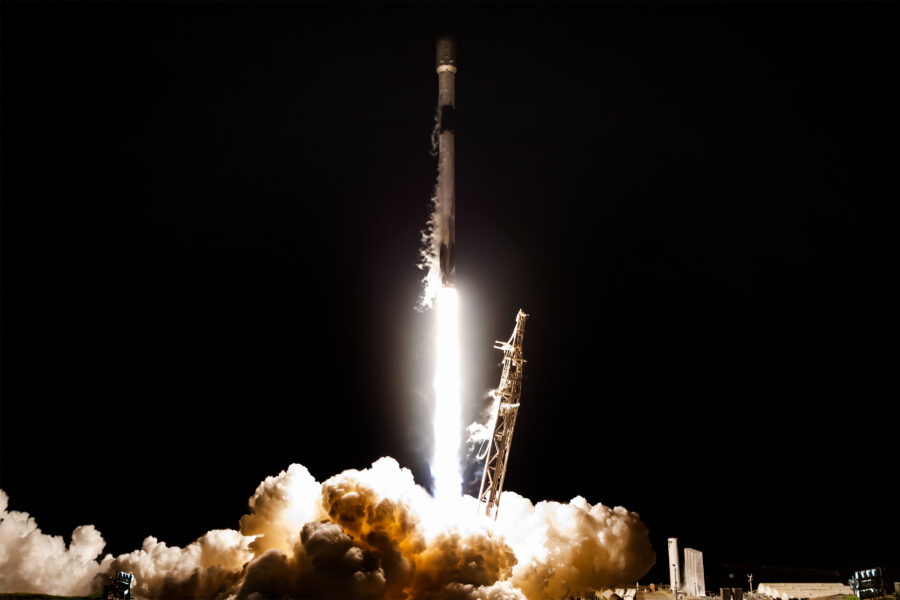
The “backbone” of the Space Force’s new Space Data Network is coming on line as dozens of new communications satellites are on pace to provide an initial, “regional” capability by year end.
The Space Force confirmed “three successful launches in two weeks” put the first SDN-Backbone satellites in orbit. The Nov. 21 press release provided a brief but significant update on the ambitious satellite network intended to give the U.S. armed forces a new means to rapidly and securely move data around the globe.
The Space Force was sketchy on details, but launch trackers had already noted three USSF launches from Vandenberg Space Force Base, Calif., on Nov. 6, Nov. 11, and Nov. 20. Space-Track.org, a public database maintained by the Space Force, catalogued 23 satellites from each launch, for a total of 69.
Each missiong launched on a SpaceX Falcon 9 rocket. SpaceX is building satellites for the Space Data Network-Backbone program under a $2.29 billion contract inked in May.
The Space Data Network is envisioned as leveraging both military and commercial satellites to provide secure tactical communications and high-throughput, low-latency connectivity for high-volume data applications. It unites two sets of requirements previously viewed as separate: the Space Development Agency’s Transport Layer, conceived for secure, tactical comms, aand MILNET, envisioned to move large data streams.
The “Backbone” program will provide “high-throughput, low-latency” connectivity while simultaneously serving as the “foundational data backhaul layer” for the entire system, the Space Force said in May.
Space Force officials have said little about the Backbone program since awarding the SpaceX contract, but the Nov. 21 announcement confirmed the constellation will be government-owned and -controlled. The satellites are “on track to deliver regional capability this year and global support by next year.”
SpaceX’s Starlink and Starshield constellations are related. Starlink provides high-speed broadband services worldwide, while Starshield is its militarized cousin. It is unclear if Starshield satellites will also provide services for the SDN-Backbone. A Space Systems Command previously told Air & Space Forces Magazine that the program will “leverage commercially derived technologies and platforms,” but did not specify whether Starshield would be part.
This most recent announcement also does not specify if these three recent launches were the first for the Space Data Network-Backbone. The Federal Aviation Administration listed the payloads for each launch as R-4, R-5, and R-6; previous Space Force launches with payloads marked R-1, R-2, and R-3 took place Aug. 15, Sept. 10, and Sept. 26.
The Space Force’s desire to move fast on the program is running into some backlash from Congress—in a draft appropriations bill released this month, the Senate Appropriations Committee said USSF appeared to “abandon meaningful competition in favor of sole-source awards” for the Space Data Network-Backbone and Air Moving Target Indication programs and directed service officials “to maintain multiple vendors” for both programs.
USSF officials have insisted competition will remain a key part of the Space Data Network. It added five other vendors to the project through small initial contracts in August.
In addition to moving fast on SDN-Backbone, the Space Force awarded SpaceX a $4.2 billion contract to build its fleet of air moving target indicator satellites. Air Force Secretary Troy E. Meink said Sept. 14 the first AMTI spacecraft would launch soon, and on Sept. 16, a classified mission called USSF-259, launched from Vandenberg carrying a payload identified by the Federal Aviation Administration only as “TH-1.” A subsequent TH-2 mission launched in October.
USSF-266, another classified mission, is set to launch Nov. 24 from Vandenberg. The FAA has yet to publish any details.