


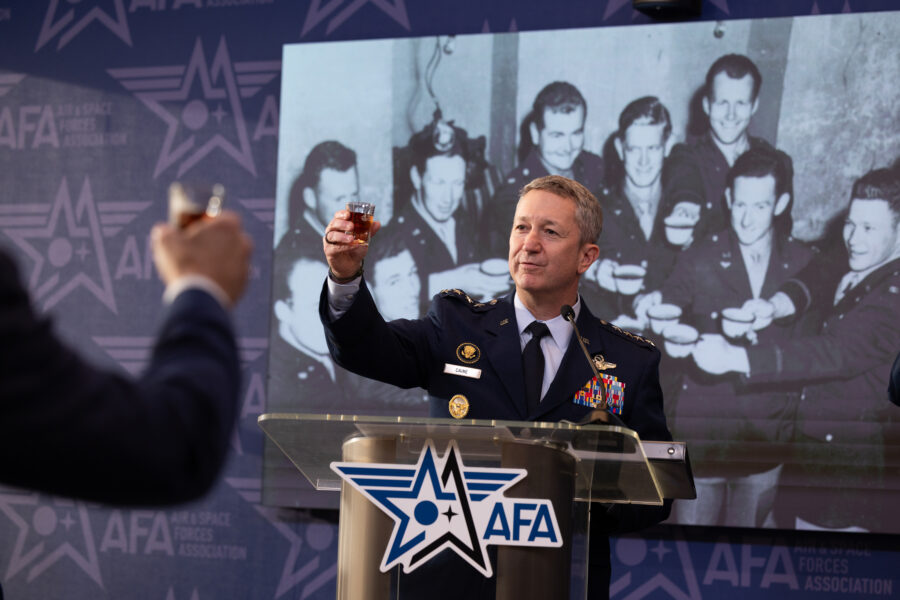
Top Air Force leaders and other dignitaries paid tribute to the “audacity” of Airmen past and present to carry out dangerous and vital missions at the Doolittle Raiders Memorial Toast hosted by the Air & Space Forces Association on April 17.
The toast, commonly held every April, honors the memory of the 80 Airmen, led by Gen. Jimmy Doolittle, who on April 18, 1942 launched 16 B-25B bombers from an aircraft carrier to strike mainland Japan, just four months after the attack on Pearl Harbor.
One day shy of exactly 84 years later, Chairman of the Joint Chiefs of Staff Gen. Dan Caine and Air Force Chief of Staff Gen. Kenneth Wilsbach toasted the memory of those Raiders—and said their legacy lives on with current Airmen flying missions like Operation Midnight Hammer, the 2025 strike against Iranian nuclear facilities, and the rescue of DUDE 44, the search-and-rescue effort to save two F-15E aviators downed over Iran.
At AFA’s headquarters in Arlington, Va., Caine said the Doolittle Raid marked the beginning of the culture of what would become the U.S. Air Force.
“They proved that if you have the guts to try, great things can be done by the United States of America,” Caine said.
“And I contend, as someone who has read a lot of airpower history, that borne from the audacity and courage of the Doolittle Raiders came many more things that today’s Air Force and joint force have had the guts to go try. … Legendary missions like Eagle Claw, Midnight Hammer. And some of those incredible Americans who carry that exact same legend that those Doolittle Raiders had in their soul are in this room tonight.”
The ceremony included a salute to some of those Airmen from the 509th Bomb Wing, whose B-2 bombers carried out Midnight Hammer last June. Col. Joshua Wiitala and Chief Master Sgt. Jeff Sipos, commander and command chief of the wing, were recognized on behalf of their Airmen who enabled and flew the grueling and dangerous 36-hour mission into Iranian airspace to deliver 30,000-pound Massive Ordnance Penetrators on heavily fortified nuclear facilities.
Retired Air Force Lt. Col. Rich Cole, the son of Doolittle’s co-pilot Dick Cole, helped recognize Wiitala and Sipos.
“The children of the Doolittle Raiders felt it was appropriate to recognize the connection between the Doolittle Raid flown by their fathers and grandfathers and the B-2 crews and planners informally known as the Fordow Raiders,” said retired Air Force Col. Dr. Patrick Donley, head of AFA’s Doolittle Leadership Center.
In addition to the “Fordow Raiders,” both Caine and Wilsbach said the Doolitte Raid legacy continued with the rescue of DUDE 44 just last month. Wilsbach noted that he had spoken with many of the crews involved in the rescue and found them “humble and are willing to do it again if they have to.”
“This spirit, this courage, this tenacity, the audacity to do something that no one would ever believe you could pull off, is still alive in your Air Force,” Wilsbach added.
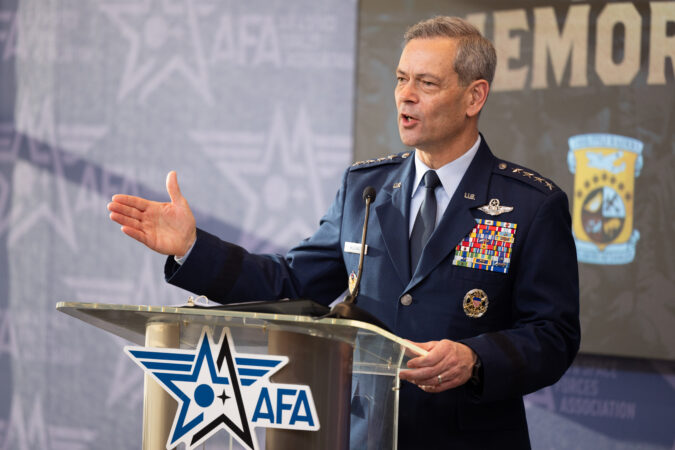
Photo by Jud McCrehin, Air & Space Forces Association
The Doolittle Raiders
More than eight decades later, the Doolittle Raid remains one of the defining moments in the history of American airpower.
The raid—which was planned by Doolittle and dubbed “Special Aviation Project No. 1”—was intended to prove the U.S. could deliver a counterstrike against Japan, and bolster America’s wounded morale. The 80 Airmen who became the Raiders trained in secret at then-Eglin Air Field in Florida, learning to take off from a carrier and to get airborne in just 500 feet, instead of the 3,000 feet B-25s typically used.
“They know how incredibly difficult this was going to be,” Caine said. “They never practiced landing on the boat, they only practiced launching from the boat, because [landing] was never part of the plan.”
Doolittle’s plan was to strip 16 B-25B Mitchell bombers of everything they could lose, so they could carry a literal ton of bombs and as much fuel as possible. Even the rear defensive turrets were pulled and replaced with painted broomsticks as decoys to dissuade Japanese fighters.
The B-25s were crammed onto the aircraft carrier Hornet, which set sail towards Japan on April 2, 1945. After an encounter with a Japanese spy ship 200 miles short of the planned launch site, Navy Adm. William “Bull” Halsey feared the Raiders’ cover was blown and ordered them to launch early.
Churning seawater splashed over the bow of the Hornet, and the bombers slid around the heaving flight deck. Doolittle and Cole’s B-25 took off first, getting airborne against the odds despite having the least amount of space, and before long all 16 bombers were in the air.
They flew hours to reach major Japanese cities including Tokyo, just 200 feet above sea level, before pulling up and dropping their payload of four 500-pound bombs apiece. The Raiders knew they wouldn’t have enough fuel to get back to their carrier, so their plan was to fly on to China and land.
But the added flying distance meant the planes weren’t able to make it to their intended Chinese airfields. One plane landed in the Soviet Union, and others crashed in China after running out of gas.
Doolittle received the Medal of Honor for the mission; the other Raiders received the Distinguished Flying Cross.
“These 80 young Americans were extraordinary in every single way,” Caine said. “Not just on the day of this operation, but on the lives that they led after that. … And they were led by an absolutely incredible American.”
The Doolittle Raid not only boosted American morale. It also alarmed Japanese military leadership, who pulled fighter groups and other forces back as reinforcements. Japanese Admiral Yamamoto ordered an attack on Midway Island to prevent the U.S. from launching more attacks against Japan, which led to the battle that became a turning point in the Pacific theater.
Doolittle pledged to his men before the mission that if they survived, “I’m going to throw you guys the biggest party you’ve ever seen.” That first reunion came in December 1945—a reportedly epic party to celebrate Doolittle’s birthday, that left the Miami hotel in which they gathered with significant damage.
The surviving Raiders continued to gather in the years and decades that followed. The city of Tucson, Arizona, presented them with 80 sterling silver goblets in 1959, most of which had each Raider’s name engraved both upside down and right-side up. After each Raider died in the years that followed, his goblet would be ceremonially turned upside down during the toast to mark his passing.
The Raiders toasted their comrades who had passed with a bottle of 1896 Hennessy cognac—Doolittle’s favorite, from the year he was born—and the traditional toast, “To those who have gone.”
This year, the same toast was recited, as guests raised their own glasses to the Raiders.
“It is nothing short of extraordinary what [the Raiders] did those many years ago, and nothing short of extraordinary what [modern Airmen] continue to do this day,” Caine said.