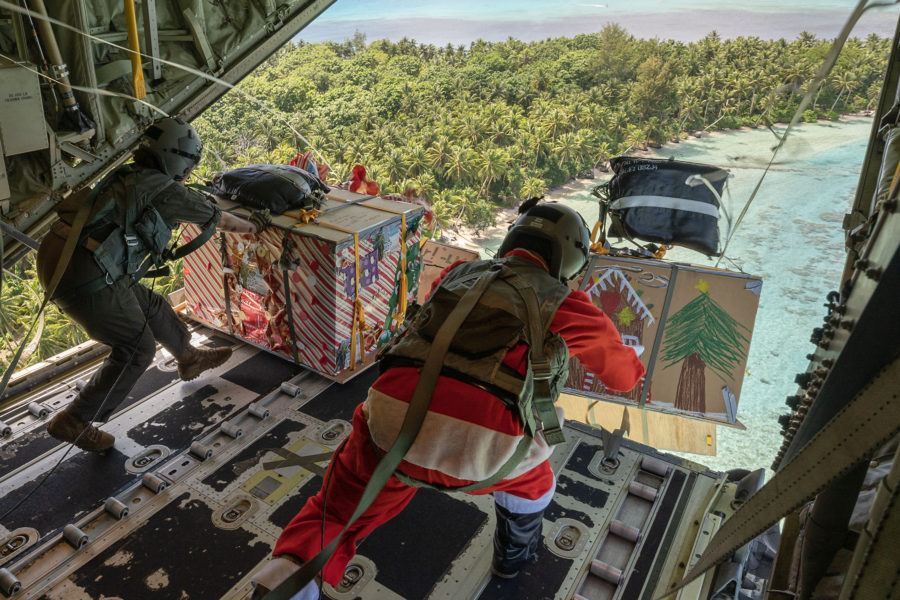
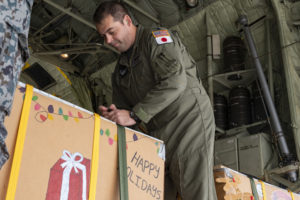
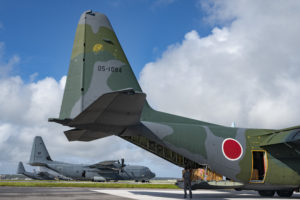
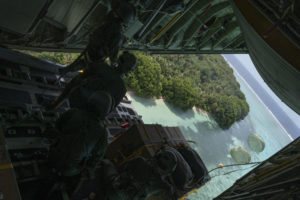
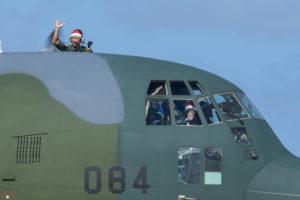
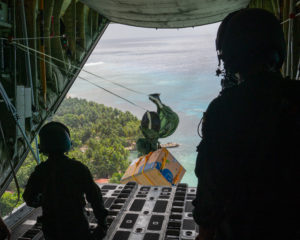
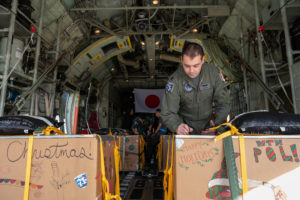
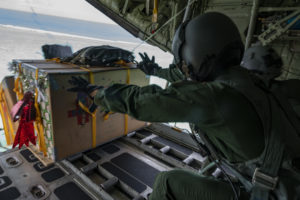
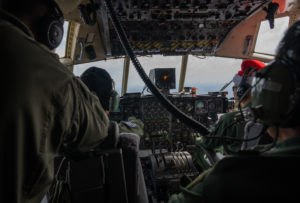
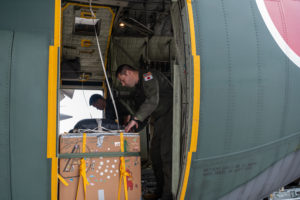
Senior Airman Janealle Hogans, 36th Expeditionary Airlift Squadron loadmaster and Master Sgt. Luke McLimans, 36th EAS operations senior enlisted leader, drop four humanitarian aid bundles over Fananu atoll in the state of Chuuk, Federated States of Micronesia, Dec. 9, 2022, during Operation Christmas Drop 2022. U.S. Air Force photo by Yasuo Osakabe
Audio of this article is brought to you by the Air & Space Forces Association, honoring and supporting our Airmen, Guardians, and their families. Find out more at afa.org
The U.S. and partner nations delivered supplies from the sky in December, concluding the 71st iteration of Operation Christmas Drop on Dec. 13 after over a week of airdrops of more than 75,000 pounds of supplies to remote islands in the western Pacific.
The exercise delivers supplies such as food, fishing equipment, school books, medical gear, clothes, and other items to 57 remote locations in the Federated States of Micronesia and the Republic of Palau, according to the Air Force. It is the longest-running Department of Defense humanitarian mission. In 2022, 209 bundles were delivered to around 22,000 remote islanders, Pacific Air Forces said.
The effort was not just an American one. Drawing on their air forces’ commonality in operating the C-130, the U.S., New Zealand, Japan, South Korea, and Australia came together and participated in air drops operating from Anderson Air Force Base, Guam.
“Everybody can speak that same language, ‘Hey, we’re going to go out and deliver these goods, and it‘s going to be awesome,’” Capt. Andrew Zaldivar, Operation Christmas Drop mission commander, told Air & Space Forces Magazine. “And I think that is something that I know people understand.”
U.S. personnel included Airmen from the 374th Airlift Wing from Yokota Air Base, Japan; the 36th Wing, Andersen Air Force Base, Guam; and the 15th Wing from Joint Base Pearl Harbor-Hickam, Hawaii. Partner nations brought eight C-130s, according to PACAF.
Zaldivar explained that Operation Christmas Drop is a nearly year-long effort “starting pretty much the day after the drop.”
Starting in January, coordination begins with the mission commander and PACAF, which handles the invitations to partner countries. In its 71st year, the Air Force knows when and how certain aspects of the operation need to be done.
“It takes about a year for all information to get to where it needs to be,” Zaldivar, a pilot with the 36th Airlift Squadron, said in a phone interview from Japan.
The Air Force works with a private organization dedicated to the effort that collects supplies as part of the Denton Humanitarian Assistance Program. That program allows the U.S. military to transport and drop privately donated aid for free. The supplies are tailored to the needs of the island—Bruce Best, or Brother Bruce as he is known, connects with the remote islanders. Best is a researcher at the University of Guam who has been associated with Operation Christmas Drop for nearly 40 years.
Beginning in December, the Air Force and partner nations began practice drops. A few days later, the mission started.
“It is a very challenging task,” said Zaldivar, who also helped plan 2021’s operation. “But I told this to many people, and I am not lying when I say that this is the best thing I’ve ever done in the Air Force, the most rewarding thing I’ve ever done. When you drop those bundles, and then you see the children running to it and waving, it is just a feeling unlike any other thing I’ve ever had. It’s incredible.”
According to Zaldivar, the planes are loaded with two to 10 bundles of aid, and aircraft fly between two and four different islands per sortie, with islands ranging from 800 to 2,500 miles away from Anderson. A typical day included about two U.S. aircraft and two to three allied aircraft, which the nations rotate by day, he said, and trips took around four to nine hours round-trip. What are known as low-cost, low-altitude airdrops (LCLA) occur at around 300 feet.
“It takes the whole village to really make this happen,” Zaldivar said. “It really helps just bring everybody together. And also feel really good about it.”
The last flight of the 2022 operation was to Chuuk in the Federated States of Micronesia in a C-130J, callsign SANTA 67.
“One of our folks from a partner nation came back, and they were saying, ‘Hey, we dropped our bundle.’ Some of these islands have radios so that they can talk to us, they got all the children around the radio, and they screamed ‘Merry Christmas!’” Zaldivar recalled. “That was just like a feeling they’ve never experienced. I think the feedback has been overall very, very, very positive, and very rewarding.”
Audio of this article is brought to you by the Air & Space Forces Association, honoring and supporting our Airmen, Guardians, and their families. Find out more at afa.org
Air Force depots are not typically meant for quick repair jobs, but during Operation Epic Fury, the service moved some of its stateside heavy maintenance capability forward to fix battle-damaged aircraft closer to the fight.
The 55th Wing officially retired the EC-130H Compass Call aircraft in a ceremony Sept. 18 at Davis-Monthan Air Force Base, Ariz., while the 355th Wing there retired its final A-10 Warthog, another major transition for the base.
As the threat of Iranian-made drones grew, the Air Force rushed last year to equip F-15E Strike Eagles in the Middle East with a cheap, cost-effective way of defeating them. The service fielded the new capability in roughly a week.
An F-16 Fighting Falcon assigned to the Texas Air National Guard’s 149th Fighter Wing crashed during a training mission in Michigan on Sept. 17. The fighter's sole pilot ejected and is in stable condition at a local hospital.
The Air Force’s new Collaborative Combat Aircraft will take part in their first large-force engagement exercise in December, the head of the drones’ Experimental Operations Unit said Sept. 15.
The Pentagon announced a deal with Lockheed Martin on Sept. 17 to expand production of the AIM-260 Joint Advanced Tactical Missile, an advanced new Air Force and Navy air-to-air missile meant to equip fifth- and sixth-generation fighters.
Lockheed Martin has unveiled its concept for a modular version of one of the Air Force’s main air-to-ground cruise missiles, opening up a range of possible upgrades and uses for the weapon.
The Air Force will consider acquiring new F-16 Fighting Falcon jets to answer capacity shortfalls in its aging fighter fleet, according to multiple people familiar with the matter. These discussions are happening as the Air Force is building its proposed fiscal 2028 budget and the five-year spending plan that goes…
✓
Thank You!
Check your inbox to verify your email address and finish setting up your AFA account.
★
Welcome Back!
An account with this email already exists. Please log in to continue.
Subscribe to the Air & Space Forces Daily Report
The latest news from Air & Space Forces Magazine, as well as news from other leading publications, delivered right to your inbox every morning!
We’re sorry, there has been an error. Please review your input or try again later.