
As President Donald Trump and other alliance leaders gather for the long-awaited NATO summit meeting in Turkey, a pressing question is how the alliance adapts as Europe seeks to replace long-standing American air warfare capabilities.
The Trump administration put the alliance on notice in May that it was scaling back the forces earmarked for NATO in the event of a crisis so that more U.S. assets can be allocated to the Pacific and the Western Hemisphere. The U.S. military is also reviewing the size, types, and requirements for American forces in Europe.
With Europe scrambling to fill the gaps, the two-day summit, which began with a dinner July 7 and continues with top-level meetings July 8, will be an opportunity to focus on “pragmatic and realistic outcomes,” said Air Force Gen. Alexus G. Grynkewich, Supreme Allied Commander Europe, NATO’s top military officer.
“We ought to, as a team of friends, hold each other to account. Are we meeting our Hague Summit commitments? Are we meeting our capability targets? Do we have the right resilience that we’re building into our force? How are our plans looking?” Grynkewich said in a recent interview with Air & Space Forces Magazine at his headquarters near Mons, Belgium. “And there will be some things as we do that—in that honest and open discussion—to celebrate. And there’ll be other things where we need to hold ourselves to account and get everyone to row a little harder.”
The Trump administration’s National Defense Strategy, published in January, calls for giving NATO allies “primary responsibility” for Europe’s conventional defense “with critical but more limited support.”
Details about which responsibilities are shifting to European partners are being spelled out in classified discussions of the so-called NATO Force Model. It specifies the forces and assets nations would provide during the first 10 days, 30 days, and 180 days of a conflict or crisis, which includes the numbers and types of aircraft that could be available to defend Europe in a contingency.
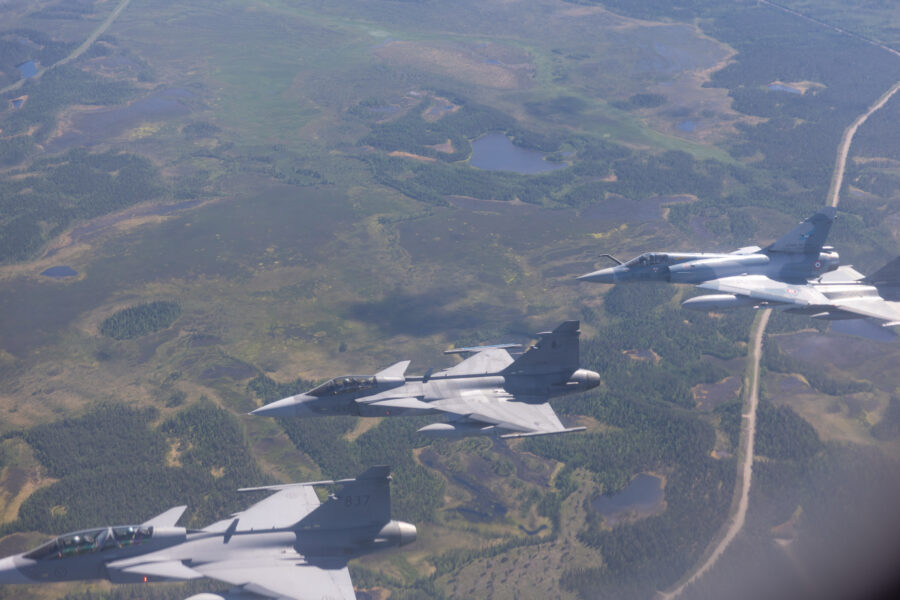
Europe’s role as an airpower provider was on display in June during the Ramstein Flag exercise, where NATO air forces practiced their ability to defend Europe’s frontiers. Air & Space Forces Magazine observed the exercise, with its northern portion carried out in Norway, Sweden, and Finland.
With many U.S. air assets supporting the war in Iran and the ensuing unsteady ceasefire that followed, European air forces fielded most of the 200-plus aircraft that took part in the exercise. Of some 180 fighter aircraft, only 20 were American F-35s—12 U.S. Air Force F-35As, and eight U.S. Marine Corps F-35Bs. The remainder were from other NATO members. The exercise was planned before the U.S. announced its cuts.
Multiple European allies are acquiring F-35s, which puts Europe in a position to pick up much of the slack. But replacing other non-fighter American assets will be more complicated. The U.S. is the only Western country with long-range bombers and other NATO members’ air-to-air refueling capabilities are limited.
That tanker crunch was evident during Ramstein Flag. With much of the U.S. tanker and bomber force deployed for operations against Iran, the USAF deployed just one Air Force KC-135 tanker—a capability the U.S. has in far more abundance than European allies—for the exercise. Some of the slack was picked up by European Airbus A330 MRTT tankers. Otherwise, a variety of operating locations provided fuel on the ground.
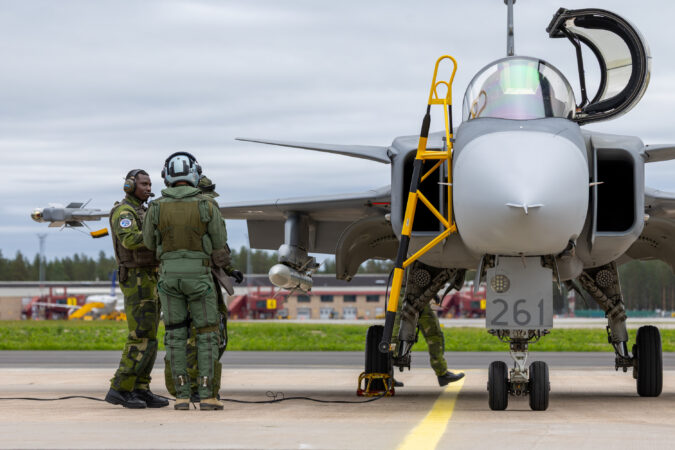
The head of NATO Allied Air Command, Lt. Gen. Jason Hinds, who also leads U.S. Air Forces in Europe, said Europe’s geography is such that ground bases can be valuable substitutes for aerial refueling. “When you have a shortfall of tankers, then we take advantage of 40 air refueling points that are scattered throughout the Scandinavian [nations] and also scattered throughout the center part of Europe,” he told Air & Space Forces Magazine. “That gives you the benefit of being able to fight, enter the combat zone, land at a different location, refuel, potentially even rearm.”
He was speaking from Luleå air base in Sweden’s Arctic Circle, where a short time earlier a Gripen fighter jet had been refueled and rearmed by a small team of personnel in less than 20 minutes.
Scaling back the commitment to send American long-range bombers in a crisis will likely require NATO members to deploy more land-based missiles and rely more on fighters, though critics question whether this would be sufficient.
“What the U.S. is doing is accounting for other global contingencies that it might find itself in and not just promising something that it may not be able to give,” said Grynkewich, who is dual-hatted as head of U.S. European Command. “Therefore, allies have a realistic expectation of what they’re going to need to contribute.”
The need to act quickly is clear, given the threat of Russian aggression in the region. While Russia’s ground forces have been caught up in a grinding war of attribution in Ukraine, much of its air and missile forces are intact, Grynkewich said in an interview.
“I would say those have not been subject to the same level of attrition and attritional warfare that the Ukrainians have imposed on Russian ground forces,” Grynkewich said. “So, they do still have the platforms and capabilities, whether it’s bombers or fighters or ballistic missiles.
“They, of course, are expending some munitions in Ukraine, but the platforms are there, and then their production for replacement ballistic missiles and cruise missiles continues. So, they have considerable firepower and considerable potential.”
Both Republicans and Democrats in Congress have questioned the Trump administration’s decision to reduce American presence in Europe.
Rep. Don Bacon (R-Neb.), a retired Air Force brigadier general who commanded a wing at Ramstein Air Base in Germany in the past, said in an interview that “with the invasion of Ukraine and the threats towards the Baltics, it’s pretty unconscionable why we pull out two of the five [U.S. Army] brigades [in Europe] without any concessions from Russia.”
Bacon said the timing is regrettable: “It’s sending terrible messages to our allies and to Russia, who’s our adversary.”
While NATO defense spending has lagged for years, some members, including Germany and Poland, have stepped up military spending. The alliance’s goal, spelled out at a 2025 summit meeting in The Hague, calls on NATO members to spend 3.5 percent of their gross domestic product on core military capabilities by 2035. Another 1.5 percent would be spent on broader security needs, including cyber defense, critical infrastructure, and strengthening the industrial base.
“NATO is adapting,” said Italian Adm. Giuseppe Cavo Dragone, Chair of the NATO Military Committee. “Canada and European nations are taking more responsibility” in sharing costs and in the alliance’s command structures.
Other senior allied military officials say that the steps NATO is now taking are paying off. The alliance launched the Eastern Sentry mission last year following Russian drone incursions into Poland in September.
Air Chief Marshal Johnny Stringer, who serves as the deputy NATO commander, said that the mission had been an opportunity to strengthen the alliance.
“Eastern Sentry really marked, I think, a transition from air policing into the air defense mindset,” he said in an interview at Supreme Headquarters Allied Powers Europe. “The activities we do are generating readiness and capability in forces. They reassure our nations and their people that actually the alliance is out there defending and deterring every day. And it’s making sure that our adversaries get the message that whilst we are a defensive alliance, we are deadly serious about protecting all our people.”
Gen. Markus Laubenthal, Grynkewich’s German chief of staff at SHAPE, said one of the most important shifts has been the appreciation among allies of the urgency of these efforts.
“Transformation for us never stops. This permanently continues, but as Chief of Staff, I need to give the staff and the [Allied Command Operations] commands clear direction and guidance,” Laubenthal said. “Therefore, I declared the ‘transition to warfighting headquarters’ over. I said we are a warfighting headquarters if you wish or not. If you are asked tonight, we must perform tonight.”