
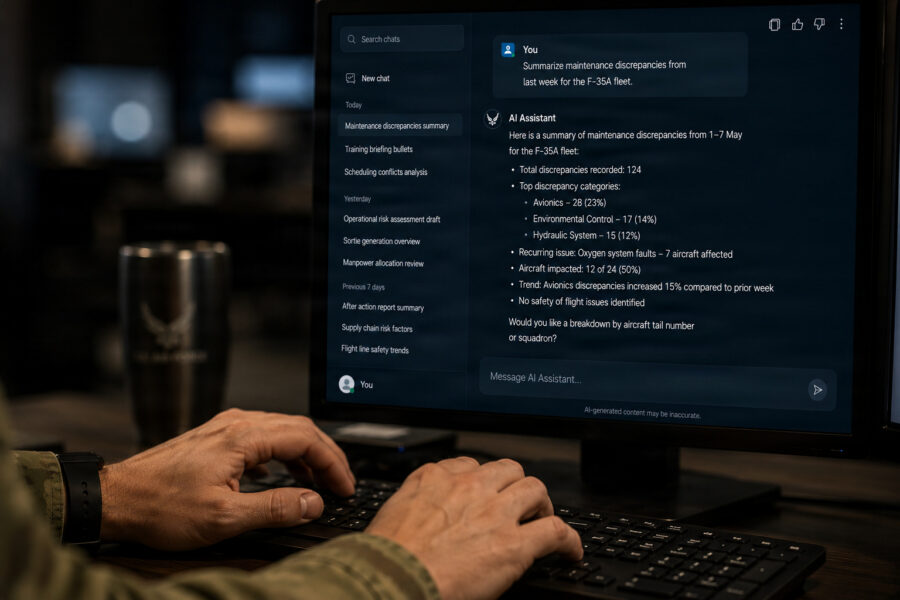
GenAI.mil, the Pentagon’s main generative artificial intelligence platform, has more than 1 million users and access to some of the world’s biggest AI models like ChatGPT and Google’s Gemini. But a handful of startups, including one founded by an Air Force veteran, say there’s room for more military-focused AI tools too.
Smack Technologies, cofounded by a former Marine special operator, recently raised $32 million to build AI tools it says are trained on combat-specific data to enable faster decisions on the battlefield. Edgerunner AI, cofounded by an Army vet, has launched an agentic AI assistant that can perform tasks autonomously, also focused on edge compbattlefield decision-making.
AI Cowboys, led by CEO and retired USAF senior master sergeant Michael Pendleton, is a bit different. Its new Military AI Agent Marketplace is focused less on the front lines and more on the complicated bureaucracy of personnel management.
The startup’s “agents”—essentially an autonomous software program that can execute some tasks on its own—can help users translate military performance documents into language that civilians can understand for job applications, write reports, build lesson plans and training schedules, and run administrative tasks for driver certification, among other tasks.
For Airmen and Guardians specifically, Pendleton told Air & Space Forces Magazine, the marketplace can help manage Enlisted Performance Briefs, Officer Performance Briefs, Air Force Form 911 awards, and Department of Air Force Instruction references.
Pendleton retired in 2022 after a 20-year career that concluded with a stint as a human resources and staffing manager in the Air Force. He saw how high-level offices such as those in the Pentagon and combatant commands were using AI tools to aid in their operational and maintenance work, but he didn’t see tools for the rank and file.
AI Cowboys aims to fix that with ways to reduce the friction of daily admin work that nearly all Airmen and Guardians face and provide a secure way to do that work, he said.
“For Air Force and Space Force use, the security model has to be clear: unclassified personal productivity can happen in the commercial environment, while command-level or sensitive workflows require authorized, controlled, and potentially air-gapped deployment,” he said.
Pendleton was quick to note such tools are not currently part of a DOD or Department of Air Force program; users must pay a $29 monthly fee for access to the content.
But like other startups, AI Cowboys believes its military AI marketplace can be more useful than general purpose AI models for tasks. The key is that their AI is trained on and works from existing DOD and service-specific doctrine manuals.
“The goal is not to throw military data into a generic chatbot,” Pendleton said. “The goal is to give Airmen and Guardians doctrine-grounded support inside security boundaries that make sense for the mission.”
Data for their models is locally maintained on the individual computing device, keeping the users’ data onboard, rather than being handled by a third party, such as OpenAI.
The marketplace has nine categories with 450 AI agents to assist with administrative tasks that service members face.
Embracing AI
The popularity of GenAI.mil and the rise of startups like AI Cowboys means more and more Airmen and Guardians are likely to be using AI in some form or fashion. The Air Force and Space Force are embracing the new tech while also trying to keep a handle on it.
In early May, Chief Master Sergeant of the Air Force David R. Wolfe said that the service plans to train every Airman on AI and it had created AI Action Teams to assist leaders in using the new technology. Part of that is a push to use AI in screenings for promotion boards, Wolfe said in a Military Officers Association of America webinar.
The chief emphasized that AI could help with automating processes for the promotion screening teams, not actually approve the candidates.
The service also announced in late April that it would recruit, train, and retain AI professionals throughout the force and make its hiring and accessions efforts more efficient to do so. That was shortly after it had released its service-wide AI Strategy.
In May 2025, the Air Force announced it was establishing center for artificial intelligence development as part of preexisting programs with Microsoft, Stanford University, and MIT.
