
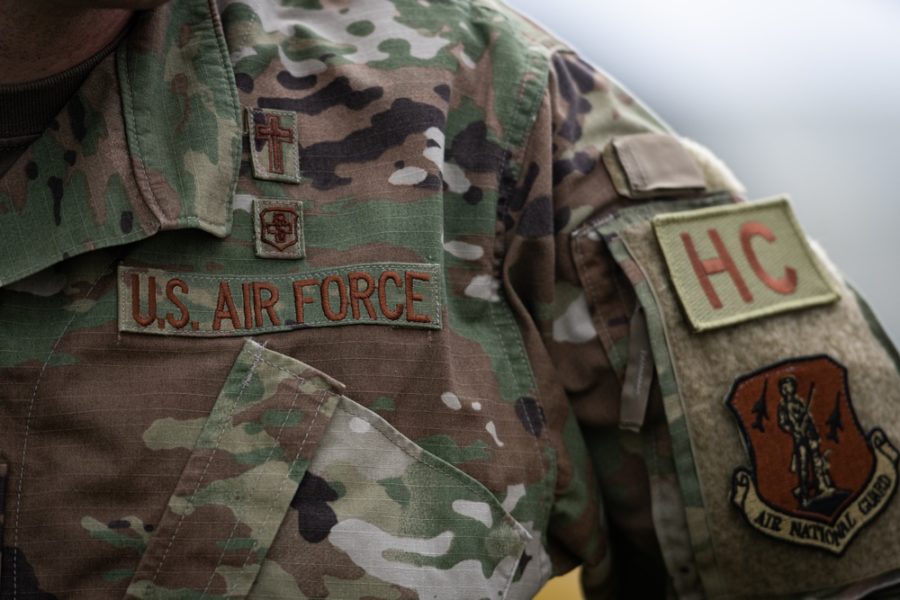
The Pentagon fulfilled Defense Secretary Pete Hegseth’s promise to slash the number of Religious Affiliation Codes used by the military to track the volume of members adhering to different religions and to shape the chaplain corps to support them. The change reduces the number of religions counted for such purposes from more than 200 to just 31.
Changes include collapsing the number of identified Christian denominations to 21 and removing Pagan, Wicca, and other nontraditional faiths from the list. Individual service members, however, “will not be limited” by the list for the purposes of identifying their religious preference on the dogtags they wear around their necks. The tags can be vital for helping chaplains determine the religious needs of warfighters wounded in battle.
Pentagon spokesman Sean Parnell posted the new list June 5, along with a May 20 memo from Undersecretary for Personnel and Readiness Anthony J. Tata. The memo states the new list replaces the previous Faith and Belief Codes and was necessary to “streamline the … collection of religious preferences selection for service members to enhance the delivery of targeted religious support from the Chaplaincy.”
The “long overdue” changes, Parnell wrote, are “designed to allow chaplains to quickly look at the religious composition of their units and determine how they structure resources to best provide for warfighters of all faith groups.”
In addition to 21 Christian denominations, the new list includes Buddhism, Hindu, Islam, and Judaism, among other faiths, but not Paganism, which Hegseth singled out last September because some troops have petitioned for religious exemptions so they could grow beards.
“If you want a beard, you can join Special Forces,” Heseth told hundreds of general officers at Quantico, Va., last Sept. 30. “If not, then shave. We don’t have a military full of Nordic pagans, but unfortunately, we have had leaders who either refuse to call BS and enforce standards, or leaders who felt like they were not allowed to enforce standards.”
Retired Maj. Gen. Randall E. Kitchens, a former Air Force Chief of Chaplains, said the the new list “appears to represent major faith groups,” and that the prior Faith and Belief Codes list had “become difficult to manage.”
“This way forward—while it may not be perfect—helps to represent religious affiliation in broader categories without exclusion and a clear, unified process to add another category if there is a broader need,” he said.
Retired Maj. Gen. Steven Schaick, another former Chief of Chaplains, said previous lists included numerous Christian denominations. “We’ve made the ‘religious preference’ choices exceedingly difficult for a generation that cannot distinguish the term Protestant from Lutheran,” he said. “Many military recruits are overwhelmed by religious choices when filling out entrance forms.”
Instead of multiple varieties of Presbyterian branches, he said, there is now just one. But while broader categories may be eaiser to manage, Schaick said, “I can imagine the endorsers of smaller faith groups feeling a bit marginalized in that their specific numbers will no longer be closely tracked.”
Beyond counting, it is unclear how the new list will impact service members whose religious preferences may now be lumped into the “Other Religions” category. It’s also unclear whether the military has any chaplains whose religions are no longer on the official list and are now covered by “Other Religions.”
Officials said in a social media post June 8 that its previous list “included redundant and unnecessary labeling, and the mistake has been fixed.”
The Pentagon did not provide the old list for comparisons, but a March 2017 memo from the Armed Forces Chaplains Board contained 216 codes, 170 of which were variations of Christanity, 40 covered popular non-Christian religions including Judaism, Islam, Buddhism, Hinduism, Sikhism and Baha’i, and about a dozen represented nontraditional religions including:
- Asatru
- Church Of The Spiral Tree
- Dian Wi (Dianic Wicca)
- Druid
- Gard Wi (Gardnerian Wicca
- Heathen
- Pagan
- Sacred Well Congregation
- Seax Wi (Seax Wicca)
- Shaman
- Troth
In his social media post, Parnell said the Pentagon’s changes to the list makes no “claims on the legitimacy of any faith or religious belief, nor is it intended to provide a list of ‘officially approved’ religions.”
Rather, he said, the Pentagon “places a high value on the First Amendment and the free exercise of religion.”
By reducing the number of religions tracked, the Chaplain Corps can better identify in broad numbers the number and types of chaplains needed to look after the spiritual care and wellbeing of military members. “With this new change, we believe we can provide the best data to support our chaplains in that effort,” he wrote.
| Code ▲ | Description ⇅ |
|---|
| Code ▲ | Description ⇅ |
|---|
