
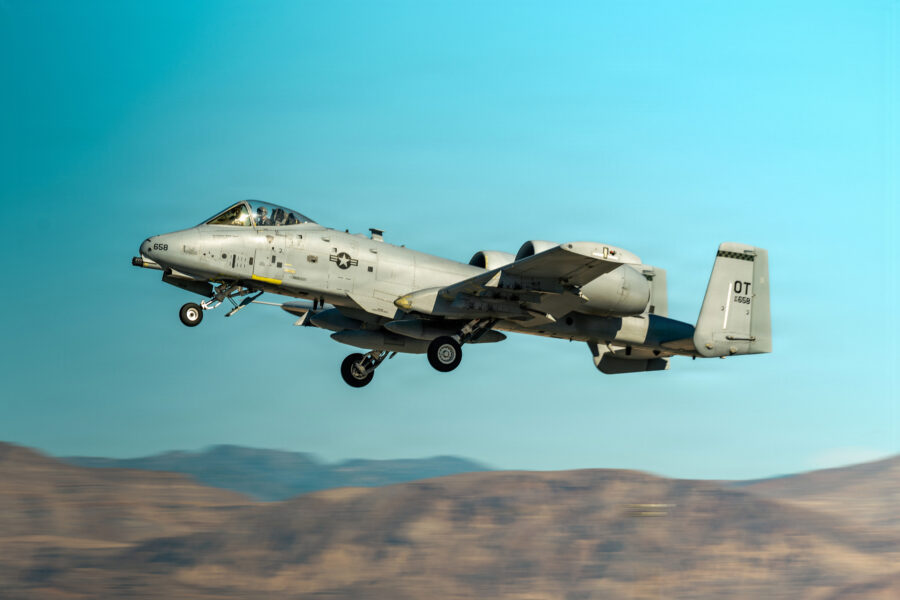
Nellis Air Force Base, Nev.—a longtime hub for A-10 Thunderbolt II tactical training, operational testing and maintenance—ended nearly a half-century of flying the venerable Warthog on Sept. 22.
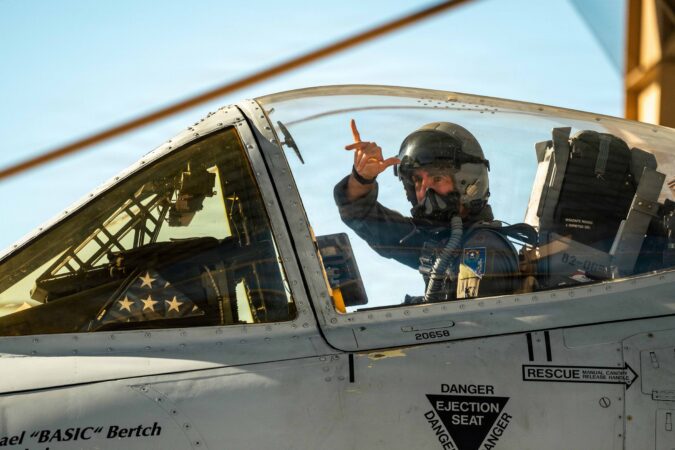
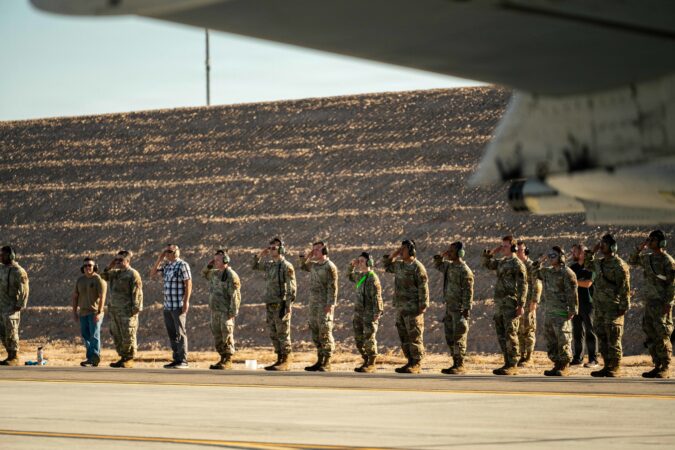
The Air Force said in a Sept. 23 statement that nearly 70 Airmen lined up on the flightline at Nellis for a final salute as the last Warthog there took off.
Nellis has flown A-10s since 1977. The base has been the Air Force’s primary proving ground for A-10 tactical employment, and units have worked to refine its software, avionics and precision weapons, the Air Force said.
The 66th Weapons Squadron at Nellis’ U.S. Air Force Weapons School has also trained more than 300 A-10 weapons officers in 100 classes, the Air Force said.
With its heavy armor and withering GAU-8 30mm cannon, the A-10 was originally built to be a Soviet tank killer and played a central role in the Gulf War against Saddam Hussein’s army. But in the Global War on Terror, the A-10 became best known as a reliable close air support platform to defend U.S. and partner nations’ ground troops when they were besieged by insurgents.
The A-10 also carries out a close air support mission dubbed Sandy during combat search and rescue operations, most recently in April during the successful rescue of two F-15E air crew who were shot down in Iran.
For years, though, the Air Force has tried to retire its A-10 fleet amid concerns that it would not be survivable against an advanced enemy. Congressional opposition has thwarted those plans before, but that has softened in recent years.
The service had pressed to retire all 162 of its remaining A-10s by the end of fiscal 2026, but after the Iran war began and the rescue of the F-15E crew, the Pentagon announced it would delay at least some Warthogs’ retirement until at least 2030.
Still, the fleet and its accompanying enterprise are slowly winding down. Davis-Monthan Air Force Base in Arizona, another longtime A-10 hub, graduated its last class of new Warthog pilots in April and held its farewell flights for its last aircraft in July. The maintenance depot for the A-10, at Hill Air Force Base, Utah, also closed this year.
The Air Force stressed that while the A-10 is retiring, the service will not let its close air support capability fade.
“Foundational tactical expertise, operational roles and personnel are transitioning to multirole and advanced fighter platforms across the service,” the Air Force said in its statement.
The F-35, for example, is taking on CAS and combat search-and-rescue roles, the service said, taking advantage of its fifth-generation stealth capabilities, advanced sensor suites, and secure data-sharing networks to carry out precision ground support missions in contested environments.
The 66th is working to teach pilots of other fighters how to take on the Warthog’s traditional missions, squadron commander Lt. Col. Ridge Flick said. The unit will also keep training combat rescue officers, pararescue Airmen, special tactics officers, and combat controllers, he said.
“We are maintaining the culture of the A-10 by involving as many other fighter communities involved in the close air support mission,” Flick said in the statement. “We are also training F-15 Eagle, F-35 Lightning II and F-16 Fighting Falcon pilots to take on some roles we have had in combat search and rescue.”
Airmen who used to repair and sustain A-10s at Nellos as part of the 757th Aircraft Maintenance Squadron’s Thunder Aircraft Maintenance Unit are being reassigned to other squadrons and airframes like the F-35 and F-16, the statement said.
“The discipline that A-10 maintainers developed over 50 years of managing airframe fatigue, wing replacements and depot-level overhauls is being integrated into those newer flight line programs,” the Air Force said.