
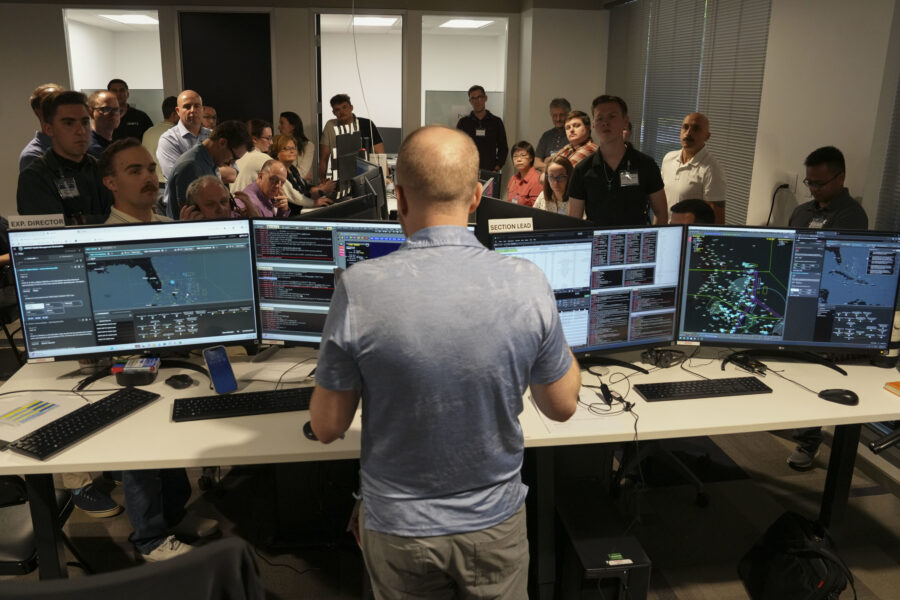
For the first time, members of the Space Force joined with the Air Force in using advanced artificial intelligence in a complex command-and-control experiment to speed up combat decision-making.
Around 100 Guardians, Airmen, and civilians gathered in Las Vegas this May for the two-week Multi-Decision Advantage Sprint for Human-Machine Teaming, or MASH.
The MASH effort builds on previous Decision Advantage Sprints for Human-Machine Teaming, or DASH, experiments and is helping to build a “blueprint” for future multi-domain operations, according to a release from the 505th Command and Control Wing.
“The DASH/MASH events are requirements-development experiments conducted by the [Air Force] to clarify future directions for AI-enabled battle management,” retired Air Force Col. George Dougherty told Air & Space Forces Magazine in an email.
Dougherty, the author of “Beast in the Machine: How Robotics and AI Will Transform Warfare and the Future of Human Conflict,” said that the DASH and MASH events use live experiments with innovators from defense tech companies working alongside uniformed personnel, which is a novel approach to solving the tough technical problems of integrating AI into battle management.
Guardians with the 16th Electromagnetic Warfare Squadron under Mission Delta 3, out of Peterson Space Force Base, Colo., had previously observed DASH experiments but had not operated in the fast-paced simulations.
This time around, they worked with Airmen and software developers, using AI tools to address problems in the air, space, cyber, maritime, and ground domains, according to the release. Those tools included Large Language Models, agentic data platforms, agentic workflows and machine learning, U.S. Air Force Col. John Ohlund wrote in an email response to Air & Space Forces Magazine.
“The Combined Joint All-Domain Command and Control Campaign Plan demands that we make better, timelier decisions,” said Ohlund, the Advanced Battle Management System Cross-Functional Team director. “By incorporating AI into our battle management architecture, we are ensuring our operators can rapidly process vast amounts of data and deliver lethal effects faster than ever before.”
The DASH events have evolved over time and adding “multi” to the name is a a nod to the importance of battle management and command and control across different domains, Dougherty said.
It’s also a reflection of how operators are moving beyond simple decision support systems to information processing at machine speeds, said ABMS-CFT Deputy Director for Space Operations USSF Col. Teina Stallings-Lilly.
During the DASH/MASH experiments, operators focus on finding new ways to use distributed battle networks and AI to advance battle management functions, said Dougherty, the previous director of innovation for the Department of the Air Force’s C3BM acquisition czar.
One example is to orchestrate rapid, real-time changes in battle response to changing circumstances. Unlike in the past, he said, battle managers can use these systems to make coordinated changes in real time.
What Happens in Vegas
MASH participants worked the experiment at the unclassified Shadow Operations-Nellis, hosted by the ABMS-CFT, which partnered with the Air Force Research Lab and the 805th Combat Training Squadron.
“Working with Air Force battle managers opened my eyes to how the air domain tackles these challenges. Their focus on tempo, synchronization and rapid Courses of Action iteration mirrors what Space Force needs, especially when dealing with contested electromagnetic environments,” said U.S. Space Force 1st Lt. Abby Warner, 16th Electromagnetic Warfare Squadron deputy flight commander.
Stallings-Lilly said the integration work done in the experiment is helping build the Department of the Air Force Battle Network.
The DAF Battle Network is the service’s contribution to the overarching, still-in-progress Combined Joint-All Domain Command and Control network that seeks to tie all information streams from any sensor to any shooter across the entire Pentagon.
“As the operations integrator between the services, my goal is to bridge the gap between our domains,” Stallings-Lilly said. “By having our Guardians in the seat for this experiment, they are seeing the direct applicability of these AI tools and, in turn, are providing the expertise needed to build a truly integrated DAF Battle Network.”
Battle management software used in MASH is “directly translatable” beyond DAF to the Navy, Marine Corps and Army, said Air Force Lt. Col. Corey Ellsworth, ABMS-CFT integration lead.
“The reason we challenge the software to solve multi-domain problems is because that’s the reality of the future fight,” Ohlund said. “An Air Force air battle manager doesn’t have the authority to execute a space or cyber effect, but like any good staff officer, it’s their job to prepare the information and package the options for the general. We want the computers to do that work, to ruminate over every possible multi-domain effect; that way we can present the highest quality menu of decisions to the right commander, faster than ever before.”
Growing and Fielding Capabilities
Throughout 2025, the Air Force conducted a series of three DASH events in April, July, and September that culminated in DASH 3, in which USAF, Canada and the United Kingdom personnel tested and refined AI tools for their C2 networks, according to a release.
In that third iteration, seven teams—six with industry and one ShOC-N innovation team—worked with the U.S., U.K., and Canadian operators to test multiple decision advantage tools to quickly build courses of actions through multiple pathways.
“The capabilities produced by industry during the foundational DASH experiments successfully validated our core concepts. This proven maturity allowed us to confidently advance from isolated, single-function tests into the complex, integrated multi-function environment of MASH,” Ohlund said.
Coordination among project management, the Modeling and Simulation Team, AFRL, and Headquarters Air Force enabled the teams to synchronize multiple software services into a “single operational workflow,” Schutlz said in an email response to Air & Space Forces Magazine.
Some examples included recommendations for long-range kill chains, EMS battle management problems, space and cyber challenges, and rebasing aircraft, according to the release.
For the recent MASH experiment, six industry software development teams worked with ShOC-N’s military software development team on the tools that tackled three decision functions, according to the release.
- Recommending what actions can be taken against a target.
- Given a list of possible effects, rank a capability or set of capabilities best suited to each effect, and repeat for each of the other provided effects.
- Given a list of matched effect-effector pairs, add the additional capabilities needed throughout the execution window to support the principal match, and repeat for each of the next-ranked pairs.
Airmen and Guardians worked to “stress-test” the decision logic used by their AI tools to identify limitations and provide feedback to developers, according to the release.
“This is a true co-creation environment where software developers work directly with warfighters to ensure the tools meet their exact needs,” said Elizabeth Frost, AFRL MASH lead.
Getting those tools tuned to the operators’ needs translates into speed and more options for a commander.
“A week ago, it took my team and me 50 minutes to an hour to get one tasking done. With the help of the tool, we were able to get five or six taskings done,” said U.S. Air Force Capt. Adam Sochia, 552nd Operations Support Squadron ABM. “Basically, in the amount of time that we can do one tasking, this tool gives us the data and accurate options to complete five or more additional taskings.”
