
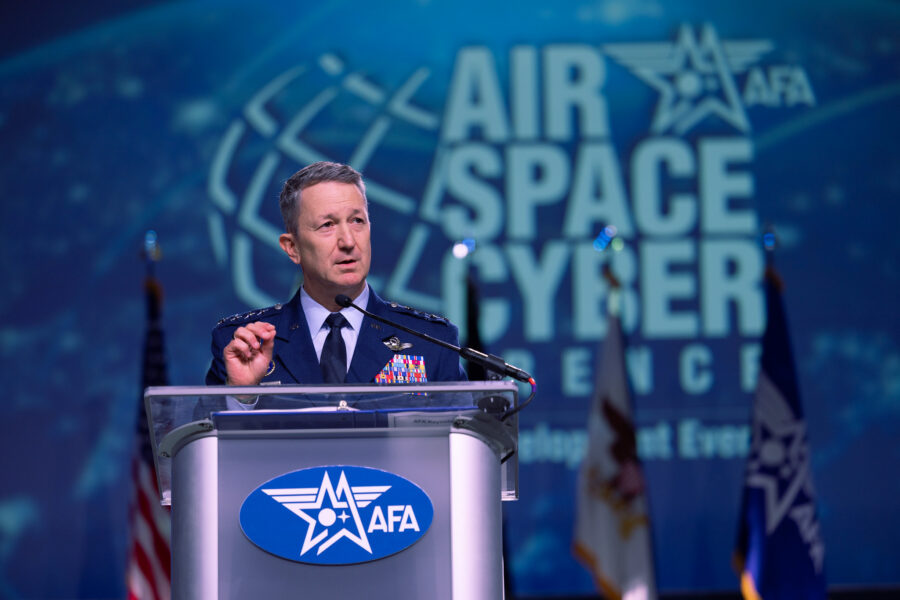
NATIONAL HARBOR, Md.—Chairman of the Joint Chiefs Gen. Dan Caine said the U.S. needs to be prepared for future conflicts in which its adversaries will be able to closely track the location of American forces and attack with autonomous systems that use artificial intelligence.
“We have to assume from now on that our formations will be hunted by autonomous systems, jammed across the spectrum, and tracked in real time,” Caine said in a keynote address at AFA’s Air, Space & Cyber Conference on Sept. 16.
“And we have to transition the joint force to be prepared to fight and win our future wars by generating and delivering lethality at scale with an agile, optimized, high-low mix of combat capabilities,” he added.
The notion of an increasingly transparent battlefield in which U.S. forces will have few places to hide has been hammered home by the ongoing conflict with Iran. Tehran, the State Department said in May, has used satellite imagery provided by Chinese companies to strike at American forces in the Middle East.
Brig. Gen. Todd Benson, the commander of Space Forces Central, said at the conference that small nations and even subnational groups could also potentially access satellite imagery to track American forces.
“I’ve been coining the term hyper-transparent warfare,” Benson said in a Sept. 15 media roundtable. “Nothing you do today is without being seen. You just can’t hide anymore, and so that’s great for us for our advantage. But you have to assume that any adversary will find some way to access imagery, and so we have to use that, and we have to operate knowing that we can be seen.”
It was a theme Caine underscored as well.
“Future conflicts will demand that we operate without the assumptions of uncontested access, secure rare areas, or uninterrupted or uncontested sustainment,” Caine said. “In the future fight, advantage will go to the side who can see first, who can understand first, decide first, and act first, and along the way be a learning organization”
The chairman noted several ways the U.S. can prepare for future fights.
One way is exploit artificial intelligence and cyber capability, said Caine, who noted the use of AI to enable an unmanned vessel to rescue two U.S. soldiers after an Apache attack helicopter was downed in June near the coast of Oman.
“That capacity did not appear overnight,” said Caine. “What made this possible was a bunch of entrepreneurial Sailors and members of the joint force on watch floors at piers, managing networks of unmanned systems across thousands of miles of water and using AI to turn massive amounts of data into a crisp, clear, perfect maritime picture that allowed us to go grab those two Soldiers in the water.”
Caine said it is also important for commands to empower young Airmen and Guardians to innovate and take risks.
“I need you to be adaptive leaders. The fight will not wait for perfect requirements, perfect processes, or perfect information,” said Caine. “You must always be able to recognize when the old way is no longer sufficient, get close to the problem, and help build a better solution.”
He also stressed the important for industry and the government to cooperate more closely.
“We cannot expect industry to invest in capacity, manufacturing, or top talent when we’re moving requirements around, but we have to be able to adapt more quickly. That means sharing risk across government and industry,” he added. “We can buy almost anything in life, but we cannot buy time.”
