


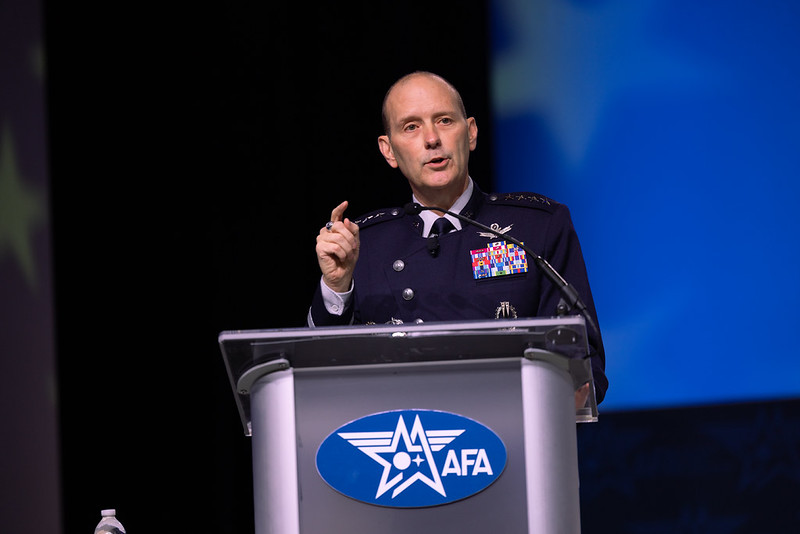
NATIONAL HARBOR, Md.—The Space Force estimates about 10 percent of its programs will be impacted under a continuing resolution for the coming fiscal year, according to Chief of Space Operations Gen. Douglas Schiess.
Earlier this month, Congress passed a continuing resolution funding the government through Dec. 11, and while the move ensures there will be no government shutdown when the new fiscal year begins Oct. 1, it also prolonged a major budget impasse that lawmakers and defense experts don’t expect to be resolved anytime soon. The stopgap measure funds government agencies, including the Defense Department, at prior-year levels, which means that any new programs are on hold until a full-year appropriation is passed.
Speaking with reporters at AFA’s Air, Space & Cyber conference, Schiess said the Space Force can move forward with about 90 percent of its programs but the rest will be in limbo under the CR.
“We’re thankful that we have a CR going into Oct. 1, but I would really be more thankful if we have a budget,” he said. “It’s going to slow us down, and the threat is not slowing down. So, I just urge our congressional colleagues and our folks to get after getting us the budget.”
The Pentagon is no stranger to operating within the constraints of continuing resolutions. DOD has started the fiscal year without new appropriations in 38 of the last 50 years, and Schiess noted that the Space Force has functioned under CR conditions for more than half of its seven-year existence.
But this year is different, because of the scale of the increase the service requested for fiscal 2027—$71.1 billion compared to around $31.6 billion last year. The budget proposal would put the service on a path to double in size over the next few years from around 10,000 Guardians to 20,000. Without it, those expansion efforts will stall, officials warned.
“We need to be able to move forward with the acquisition process so we can build and take possession of the systems we need to help provide that to the mission,” Chief Master Sergeant of the Space Force John Bentevigna said Sept. 15.
The CR also comes as the Space Force is working to speed up its acquisition processes, making plans to start fielding large fleets of targeting, tracking, and communication satellites in the coming years. Erich Hernandez-Baquero, the new assistant secretary of the Air Force for space acquisition and integration, told reporters the budget impasse will likely slow the “ramp up” the service started in fiscal ‘26.
“This CR is definitely going to put the brakes on that for a time period,” he said in a Sept. 15 roundtable. “It really does pace us at a time where we really need to go faster.”
Reconciliation
Further complicating the Defense Department’s fiscal ‘27 budget outlook is its reliance on a $350 billion reconciliation package to supplement a $1.15 trillion base request. That separate reconciliation request is stalled in Congress for now, and it’s unclear what the path is to fund the programs included in that package.
The reconciliation proposal includes a number of Pentagon priorities, including $17 billion for Golden Dome, and about $12 billion in funding for Space Force programs, like Space-Based Air Moving Target Indication and the Space Data Network.
Air Force Secretary Troy Meink said that the funding included in the reconciliation proposal is key to kick-starting Space Force growth in the coming years.
“Those things won’t happen without a budget,” he said. “I think we have general support for Congress on those things. We’ve had great discussions with them. But we can’t continue those things without the budget request in both base and reconciliation.”