


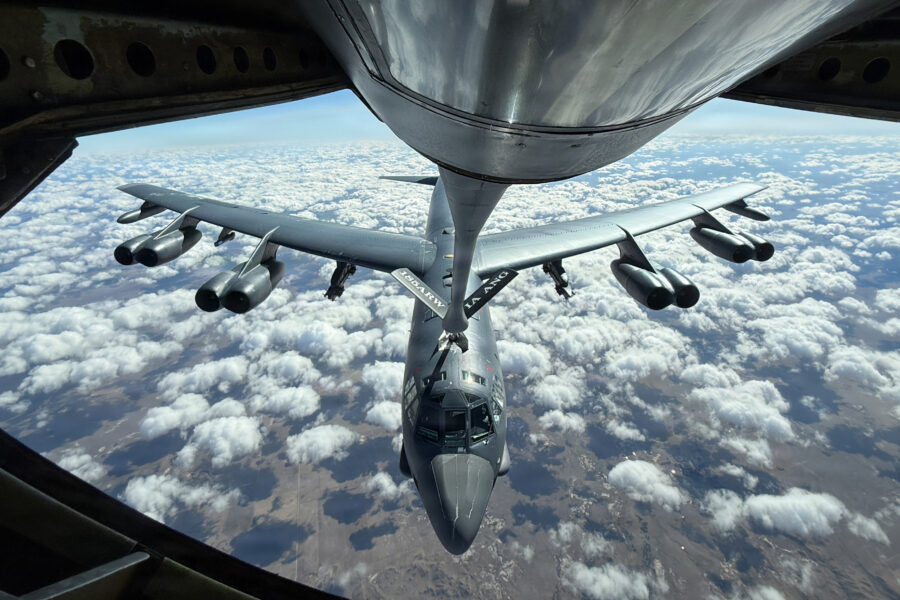
Air Force Global Strike Command has fielded a new prototype system for beyond-line-of-sight communications on the B-52H Stratofortress in a step forward for modernizing the Cold War-era heavy bomber.
IRIS, a communications system developed by Outerlink Global Solutions, integrates a satellite communication terminal with other components both on the bomber itself and on the ground, the command said in an Oct. 1 statement. IRIS is meant to make it easier for B-52 crews to carry out their missions and increase their flexibility when carrying out long-range strike missions, Global Strike said.
“The ability to communicate reliably across vast distances is foundational to our global operations,” Maj. Gen. Ty Neuman, commander of the 8th Air Force and the Joint-Global Strike Operations Center, said in a statement. “Fielding IRIS gives our crews a modern tool to stay connected, share information, and execute the mission in dynamic and contested environments.”
The name IRIS is not an acronym, Global Strike said. A 2022 U.S. Strategic Command release on an early demonstration of the IRIS system said it uses Iridium’s high-bandwidth CERTUS broadband service, which is powered by Iridium Next satellites in low-Earth orbit.
The Air Force is now working on a sweeping array of programs to modernize its fleet of 75 B-52s, which are more than six decades old. The bombers still fly with their original 1960s-era Pratt & Whitney-made TF33 engines, which will be replaced with new Rolls-Royce F130 engines under the Commercial Engine Replacement Program. B-52s will also receive a new radar, upgraded avionics, new cockpit displays, and other systems intended to keep it flying at least into the 2050s.
Modern communication capabilities are essential for the B-52 to continue to support global operations and joint force requirements in increasingly contested airspaces, Global Strike said.
“This is about readiness,” Jackie Ford, chief of Global Strike’s rapid capabilities division, said in the statement. “Rapidly fielding capabilities into our operators hands will ensure the B-52 remains ready not just for today’s mission, but for the missions of tomorrow as well.”
The Air Force first showed an earlier version of IRIS could work on a B-52 in June 2022, when the 49th Test and Evaluation Squadron at Barksdale Air Force Base, La., carried out an aerial demonstration on a Stratofortress. Global Strike said a team from the 608th Air Operations Center, also at Barksdale, studied how well voice and data, including images and videos, transferred from the B-52.
After IRIS’s successful demonstration, the command kept working with other Air Force innovation and acquisition units to evolve it from a test case to operational use, including using a Small Business Innovation Research Phase II contract from AFWERX to integrate the system onto the B-52.
The IRIS work transitioned to a formal program in 2023 into a $26 million Strategic Funding Increase contract, which represented Global Strike’s first such deal, the command said.
The command’s rapid capabilities and bomber requirements divisions took the lead on defining what the program’s requirements should be.
The 49th worked with the B-52 System Program Office and Airmen with operational expertise from the 307th Bomb Wing at Barksdale to make sure IRIS developed into a useful system on the bomber. Global Strike said leaders prioritized the program and ensured it moved forward quickly.
By March 2026, IRIS was ready for ground and flight testing which showed it could reliably stay connected while a B-52 was airborne and was technically mature enough to support operational use.
Testing continued, and by the time April began, Global Strike Command had installed multiple IRIS kits on B-52s and delivered them to the 49th to help support training and operational employment.
While IRIS is fielded operationally, Global Strike said, it remains a prototype, and more testing and evaluation will come as the system matures.
“Partnership is what made this possible,” Maj. Gen. Peter Bonetti, director of Global Strike’s strategic plans, programs, and requirements directorate. “We had a clear operational need, the right partner capabilities, and engaged stakeholders working together to deliver capability operators needed and are using today.”