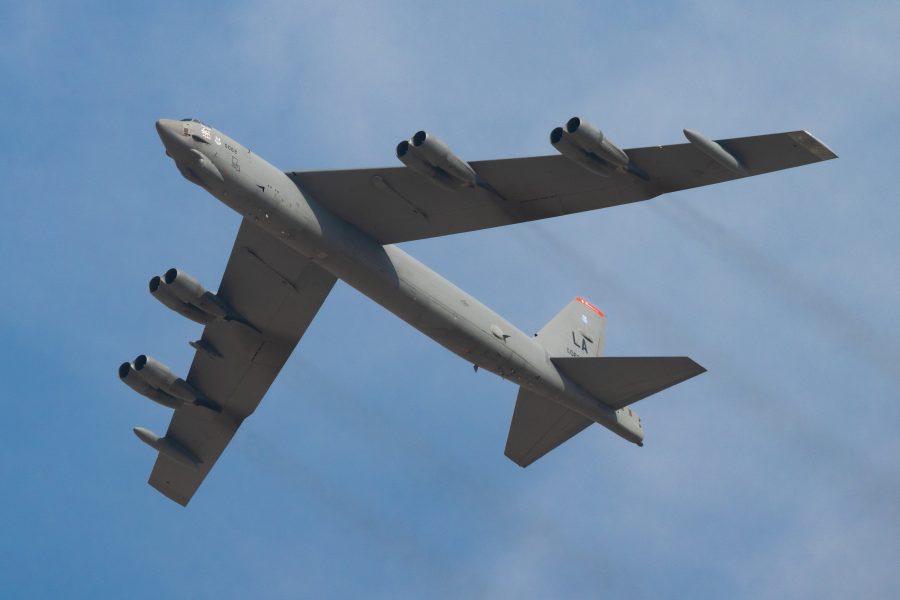
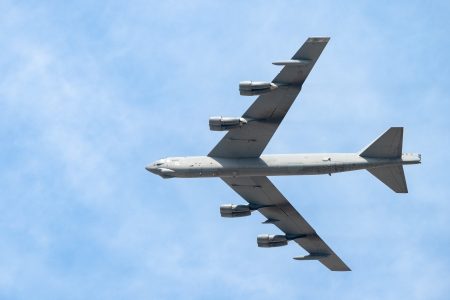
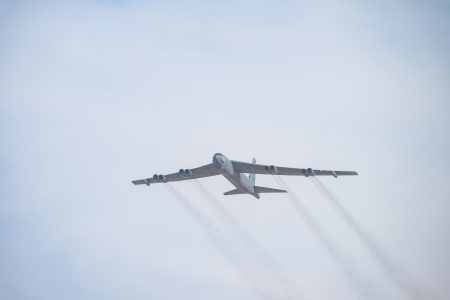
A U.S. Air Force B-52 Stratofortress aircraft, assigned to the 96th Bomb Squadron from Barksdale Air Force Base, La,, flies over spectators at the Dubai Airshow 2025, Nov. 17, 2025, at the Al Maktoum International Airport in Dubai, United Arab Emirates. U.S. Air Force photo by Staff Sgt. Tylin Rust
Audio of this article is brought to you by the Air & Space Forces Association, honoring and supporting our Airmen, Guardians, and their families. Find out more at afa.org
A U.S. Air Force B-52H Stratofortress bomber flew over the Middle East on Nov. 18 as the Trump administration moved to boost ties with Saudi Arabia.
The B-52 flew over the Dubai Air Show in the United Arab Emirates. That flight coincided with a visit this week to the White House by Saudi Crown Prince Mohammad bin Salman, the de facto Saudi leader.
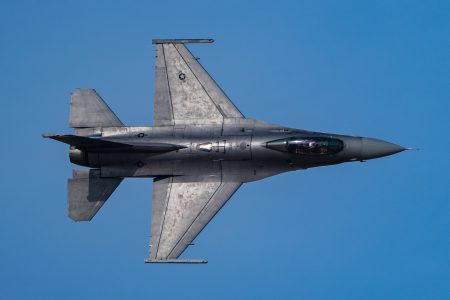
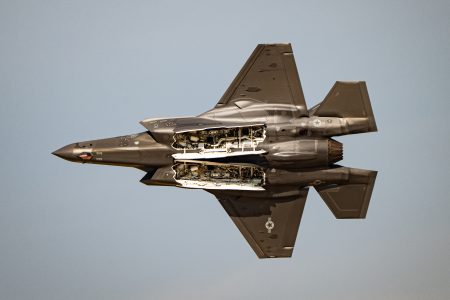
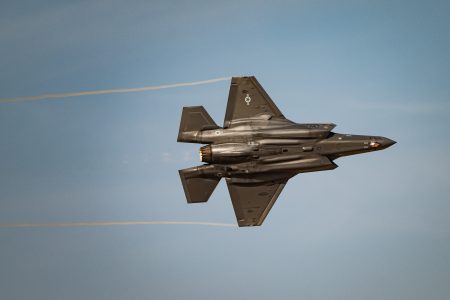
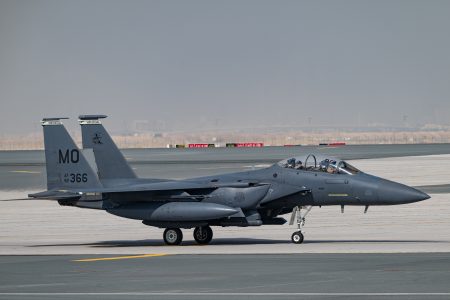
The Middle East’s premier air show also featured displays from the U.S. Air Force’s demo teams for F-35 Lightning II and the F-16 Fighting Falcon, as well as a flyover by a U.S. Navy P-8 Poseidon. F-15 Strike Eagle fighters and A-10 Thunderbolt II attack aircraft, which are known to be based in the region alongside F-16s, were also displayed at the show.
The biennial show is a major regional gathering that draws military and defense industry executives from around the world. It is one of the few defense shows where competing geopolitical alliances are in full display, with a mix of Russian and Chinese firms alongside Western and American ones.
The B-52 also flew with Qatari Rafale fighters and American F-16s “in a joint training exercise,” U.S. Central Command said Nov. 21.
This week, a U.S. B-52 Stratofortress flew in formation with Qatari Rafale (right) and U.S. F-16 fighter jets (left) during a joint training exercise over the U.S. Central Command operating area. With a shared commitment to regional security and stability, training together makes… pic.twitter.com/mQfcT0hsk4
The B-52 departed from Morón Air Base in Spain, where it is deployed as part of a Bomber Task Force of three U.S. strategic bombers from the 2nd Bomb Wing at Barksdale Air Force Base, La. The deployment is overseen by U.S. Air Forces in Europe-Air Forces Africa, but Bomber Task Force missions often cross into different geographic combatant commands.
The B-52 first crossed Saudi airspace and then orbited over Qatar, which hosts the forward headquarters of CENTCOM and its air component Air Forces Central at Al Udeid Air Base.
A second B-52 also departed Morón but turned around over the Mediterranean, according to open-source flight-tracking data.
“Our presence at Dubai is more than just an air show,” said Lt. Gen. Derek France, the commander of Air Forces Central. “We are showcasing our professionalism, training, and lethality on a world stage in plain view. The message we are sending is clear, peace through strength. We along with our partners are committed to regional stability, and we are equipped, trained, and ready to sustain stability and reinforce security.”
This article was updated on Nov. 21 with additional information.
Audio of this article is brought to you by the Air & Space Forces Association, honoring and supporting our Airmen, Guardians, and their families. Find out more at afa.org
The B-2 bomb wings that planned and flew Operation Midnight Hammer, the punishing June 2025 attacks that struck two of Iran's deeply buried nuclear facilities, received the U.S. military’s highest unit-level award, the Presidential Unit Citation.
For the first time ever, the B-2 pilots who flew Operation Midnight Hammer, the mission that leveled Iran’s nuclear program, spoke about the months of preparation beforehand and the 37-hour flight that unfolded in utmost secrecy.
Federal prosecutors have charged an Irish man with methodically vandalizing a U.S. Air Force C-130H so extensively that the $60 million transport aircraft is effectively totaled.
The Senate Appropriations Committee takes a hard line with Air Force programs in its planned defense bill, refusing to back multiyear procurement for the F-35A and F-15EX, among other programs, and funding fewer fighter jets, advanced semi-autonomous drones, and development funds for the Air Force's future F-47 fighter.
The Air Force graduated 1,518 new pilots in fiscal 2026, its most in 35 years, and Air Education and Training Command boss Lt. Gen. Clark J. Quinn credits the shift to a hybrid private/military training model for making it possible.
The arrival of the first permanently stationed F-15EX Eagle II at Kadena Air Base this week doesn’t just give the strategically vital base an advanced new fighter; it also signals a small step toward relieving pressure on the Air Force to keep rotating fighter units there, experts told Air &…
U.S. fighter jets struck an Iranian missile launch site operated by Iran’s Islamic Revolutionary Guard Corps Nov. 17 in “self-defense,” a U.S. military official told Air & Space Forces Magazine. The latest strike comes after Iran renewed its attacks on Gulf state bases and commercial shipping in recent days.
The Air Force will keep flying its 1960s-era T-38C Talon trainer into the late 2030s, the head of Air Education and Training Command said Nov. 16, as he detailed incremental progress on its replacement, the T-7A Red Hawk.
B-1B Lancer pilots can now train using light business jets to hone their flight skills under a new program Air Force Global Strike Command is testing. Officials say it will get pilots more than 100 extra flying hours per year.
Subscribe to the Air & Space Forces Daily Report
The latest news from Air & Space Forces Magazine, as well as news from other leading publications, delivered right to your inbox every morning!
We’re sorry, there has been an error. Please review your input or try again later.