
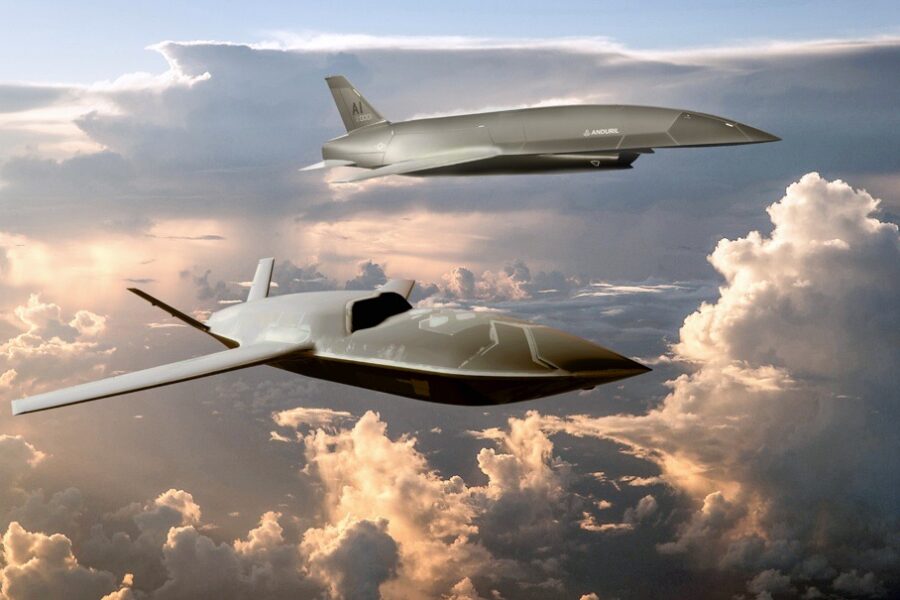
The Air Force’s emerging Collaborative Combat Aircraft program would suffer delays if Congress fails to pass a budget before the end of this calendar year, a top service official said Sept. 28.
Brig. Gen. Timothy Helfrich, the portfolio acquisition executive for fighters and advanced aircraft, said the program is ready for production, but advancing to that next stage requires a new budget. “You can’t go do production without production funding,” he said during a Mitchell Institute for Aerospace Studies appearance. “So that does provide limitations on what we can execute.”
CCAs are the semi-autonomous drone fighters the Air Force believes can bolster its manned fighter force. The first two models—General Atomics Aeronautical Systems’ FQ-42A Vengeance and Anduril Systems’ FQ-44A Fury—are designed for air-to-air strike missions. The objective is for the compact uncrewed CCAs to cost less than $20 million apiece for the airframe, and to rapidly grow the force to include at least 500 in 2032, on its way to at least 1,000 later on.
Fiscal 2027 starts Oct. 1, but Congress failed to pass a budget before taking its recess, instead passing a funding measure that extends appropriations at 2026 levels until Dec. 11. Under such a continuing resolution, new programs, such as CCA production, are not authorized. If Congress fails to pass a budget the government could be forced to shut down. Congress could also vote to extend the CR for a month or more at that time.
Helfrich’s comments echoed concerns raised by Anduril officials at AFA’s Air, Space & Cyber conference in National Harbor, Md., Sept. 14.
Erin Simpson, Anduril’s vice president of strategy execution for air dominance and strike, told reporters in a briefing that the company has worked to get a head start on procurement, including by building a new Arsenal-1 factory in Columbus, Ohio, buying parts in advance, and producing prototype Fury CCAs.
“We will not have a cold start to [launch] production in ’27,” Simpson said. “We will have assets rolling through. That said, even a company like ours can only do so much without procurement dollars.”
When asked about the CR’s potential effect on General Atomics’ production, a company spokesman pointed to a Sept. 21 release that said it is taking on risk by self-funding some of the first FQ-42s, to keep the program moving forward while the Pentagon’s funding is worked out.
“Production of FQ-42 Vengeance is underway on company investment as government funding plans mature, with GA-ASI continuing its longstanding tradition of working at-risk with its own funds to support U.S. procurement planning and prevent delays in delivery,” General Atomics’ statement said. GA-ASI plans to build multiple fighters for its own company aircraft fleet, to invest in inventing new technologies that reduce risk and increase capabilities for its global customers.”
Helfrich said the Air Force’s upcoming Emerald Flag exercise in December at Eglin Air Force Base, Fla., will be a significant demonstration of how far CCAs have come. And it will further the work done by the Air Force’s Experimental Operations Unit to figure out how best to use CCAs in operational environments, and how to operate it under the Agile Combat Employment construct of flying aircraft out of dispersed, small and rough airfields in a future conflict.
“Setting up for Emerald Flag, it’s all hands on deck, but the EOU is central to making that happen,” Helfrich said. “They’re at the heart of taking a capability and making it into something that we can actually integrate into the Air Force.”
Both initial CCA models will fly at Emerald Flag alongside different manned fighters, he said, possibly with multiple CCAs flying at once.
The Air Force announced in July that Anduril’s Fury CCA had fired its first live missile in a test. General Atomics’ Vengeance will soon follow, Helfrich said. Helfrich indicated that test fire would likely happen before Emerald Flag.
General Atomics spokesman C. Mark Brinkley declined to say exactly when the first FQ-42A live-fire test may take place, saying only that it would happen by the end of the year.
Helfrich said the FQ-42A’s live-fire test will focus on more than just launching the missile, and will be a test run of the entire process for firing weapons with an autonomous system, while still keeping a human “on the loop.”
“The human has to make the decision to use lethal force, and then go and engage on that target,” Helfrich said. “So we’re talking more like kill chain than we are about [a standard weapon firing] exercise.”