
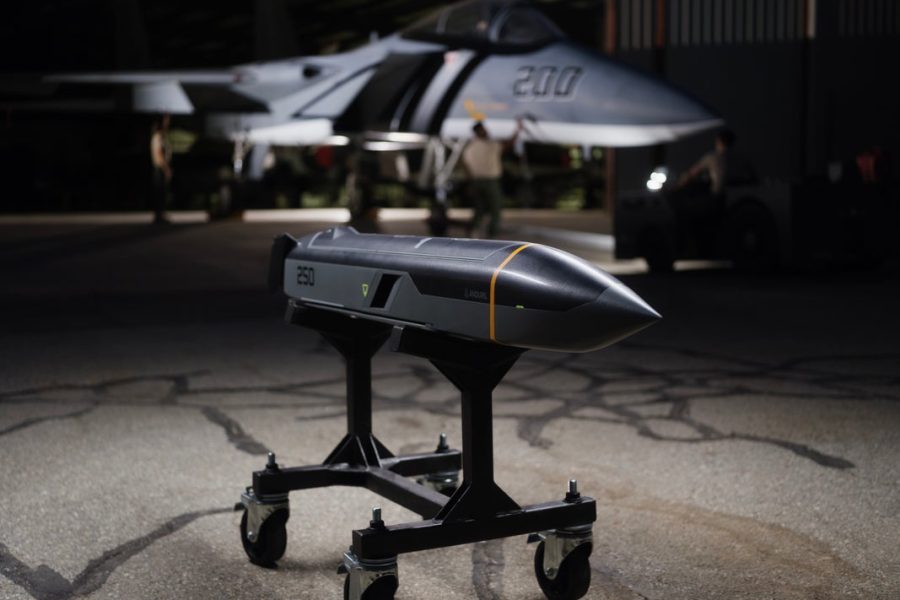
The Anduril-built Barracuda cruise missile recently received certification as the Air Force’s first large-scale production munition compliant with open systems architecture.
The certification clears the way for the new weapon, billed as a way for commanders to carry multiple tools in their belts, with options to swap payloads and other features once the missile is delivered to the Air Force.
“Barracuda’s open software architecture means that it can be equipped with a variety of different datalinks and communications modalities, unlocking integrations with a vast spectrum of different aircraft and other communications nodes,” an Anduril spokesperson told Air & Space Forces Magazine Sept. 25.
Anduril is slated to deliver its first Barracuda missiles to the Pentagon in early 2027.
The Air Force Research Laboratory’s Munition Open Architecture Test and Evaluation Laboratory, or MOATEL, oversees the Weapon Open System Architecture certification process. The lab’s engineers spent four days at Anduril’s California headquarters verifying compliance with open system architecture, known as WOSA, on Anduril hardware, an Anduril spokesperson said.
“This is showing that open architecture can scale beyond prototypes,” Jonathan Shaver, program manager and creator of WOSA at AFRL’s Air Warfare Directorate, said in an Anduril release. “Without that independent path from S&T to MOATEL, the industrial base cannot deliver new technology to the warfighter at the speed the fight requires.”
The certified modularity option for the cruise missile could give commanders a plethora of features to work with in the planned-for stockpile boost.
The Pentagon announced multi-year framework agreements for its Family of Affordable Mass Missiles program in July. Anduril, CoAspire, and Zone 5 Technologies were selected. The agreements call for the three companies to produce 8,000 missiles annually once production ramps up. That timeline targets 5,300 missiles in 2028, rising to 8,000 by 2031.
The MOATEL verification tested 14 WOSA domains: Mission Autonomy, Seeker, Inertial Measurement Unit, GPS, Air-Data Sensor, Propulsion, Airframe Control, Target State Estimator, Altimeter Aiding Navigation, Clock, Autopilot, Guidance, Navigation, and Munitions Data Bus.
“It’s easy to talk about modularity and open architectures in the abstract. Proving it through an independent assessment is harder,” Pat Morris, vice president of advanced effects at Anduril, said in the release.
With the MOATEL assessment, those munitions can be updated and upgraded as users need new technology or as mission requirements change.
Modular Munitions Options
Anduril has integrated four different turbojet engines into the Barracuda 500, giving the company flexibility in providing engines as it seeks to churn out missiles in the coming years.
The MOATEL assessment’s certification of the open-architecture software also clears the way to use the Barracuda with current and future communication systems.
So far, the company has built three base model Barracudas: the Barracuda 100, with a roughly 35-pound payload and a range of more than 120 nautical miles; the Barracuda 250, also with a 35-pound payload and a range of more than 200 nautical miles; and the Barracuda 500, with a greater than 100-pound payload and more than 500 nautical miles of range. The company spokesperson said the WOSA verification applies across the Barracuda variants.
During AFA’s Air, Space & Cyber conference last week, Lockheed Martin announced its new AGM-158 FLEX. The munitions provide modularity, including swappable nose and launch options for the precision-guided Joint Air-to-Surface Standoff Missile, known as the JASSM, and its companion Long-Range Anti-Ship Missile, or LRASM.
The Air Force Life Cycle Management Center at Eglin Air Force Base, Florida, posted a notice to industry seeking modular parts for its Extended Range Attack Munition in January 2025, signaling a push toward broader munitions options for the stockpile that the service and other branches are now building.