
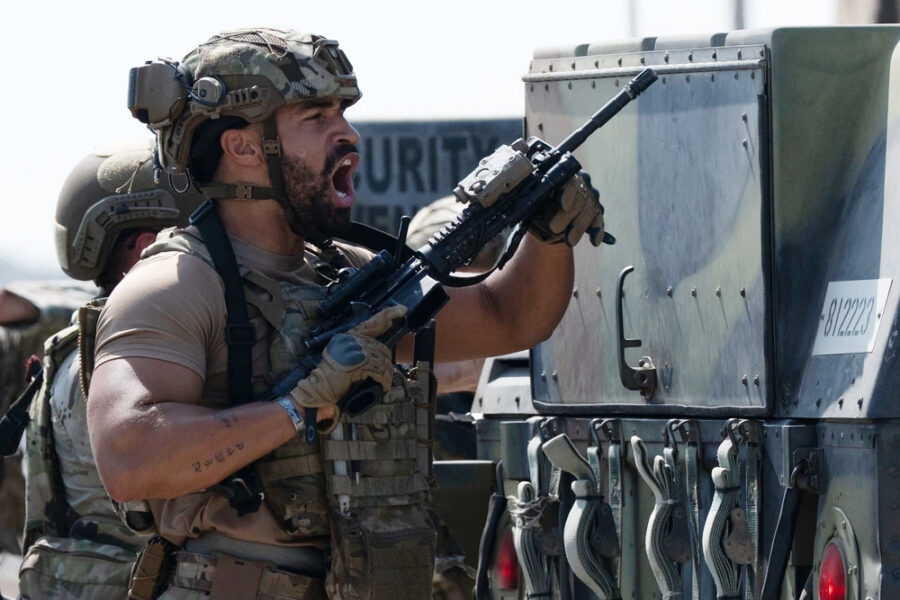
Around 8,000 Airmen and Guardians currently have medical waivers exempting them from shaving—thousands less than just a few years ago but still about half of all the waivers across the U.S. military. The revelation comes shortly after the Department of the Air Force started directing commanders to consider separating those who have had medical shaving profiles for too long.
All of the services are currently refining their policies to align with Defense Secretary Pete Hegseth’s September 2025 mandate that medical shaving waivers be limited to 12 months and those with permanent conditions be evaluated for separation.
Details on the number of waivers have been scarce to this point. But this week, Task & Purpose reported that “as many as 16,300” service members have these waivers. That includes 4,760 Sailors, 3,400 Soldiers, and 144 Marines.
The other 8,000 are Airmen and Guardians, a Department of the Air Force spokesperson confirmed to Air & Space Forces Magazine. These individuals have “an active temporary medical shaving waiver,” the spokesperson said. They did not immediately provide a breakdown of the waivers between the Air Force and Space Force.
The Air Force currently has about 495,300 Airmen, and the Space Force has roughly 10,400 uniformed Guardians—meaning about 1.6 percent of service members in the department have a waiver.
That’s down significantly from “historical averages” of 18,000 to 20,000 Airmen and 300 Guardians, the department spokesperson said. Military.com has previously reported that the number of medical shaving waivers in the Air Force went from 13,131 to 23,068 between 2021 and 2023.
The department spokesperson noted that the recent drop in waivers was due to “recent policy updates and clinical reevaluations.”
Still, the total number of shaving wavers in the Air Force and Space Force is disproportionally larger than the other services, a reality that could create manning challenges if a large number of those waiver holders wind up being involuntary separated in the future.
The medical shaving waiver total does not include Sikhs, Muslims, and other religious groups who have been permitted to wear beards and other facial hair in uniform under religious accommodations. Hegseth has directed that service members who wear beards under religious accommodations be reevaluated under the pre-2010 appearance standards that generally do not authorize facial hair waivers.
In early August, the DAF directed commanders to begin to consider separating Airmen and Guardians who have held shaving profiles for more than 12 of the past 24 months and who remain unable to conform to grooming standards.
Commanders must either initiate involuntary separation or submit a retention recommendation to their chain of command. Airmen and Guardians separated “solely on the basis of the condition” and not for deliberate disregard of the policy will receive an honorable discharge, the guidance states. Commanders should not use the new policy to separate members who otherwise would be separated for unsatisfactory performance or misconduct, according to the guidance.
In some cases, Airmen and Guardians with medical waivers unable to meet the new facial hair standards could be eligible for retention. Commanders have the option to submit retention recommendations to their chain of command, according to the guidance, which adds that approval could be granted on a “case-by-case” basis if there is a “compelling government interest” for retention, such as:
- Low manning and retention rates in the Airman or Guardian’s career specialty
- The Airman or Guardian has special experience or specialized training
- The cost and time required to replace the individual is extensive
- The Airmen or Guardian is close to retirement
Gas Mask Seal Test
In late August, the DAF also released instructions that gives all Airmen and Guardians until Dec. 31 to verify they can achieve a proper protective mask seal, a new requirement Hegseth announced last year as part his crackdown on service members with beards, goatees, and other facial hair.
All Airmen and Guardians must complete a CBRN Defense Foundations Course, an annual web-based course taken through DAF e-Learning. Then they have to achieve a proper protective mask seal by the year-end deadline. The test must be witnessed by a “mask fit validation monitor,” which will be appointed at the Air Force and Space Force squadron level.
Hegseth’s Sept. 30 memo states that “noncompliant personnel—due to refusal, exemption denial, or failed tests—will be flagged as nondeployable in the appropriate Military Service personnel system. Repeated noncompliance may result in administrative separation.”
The CBRN training and mask-seal validation are slated to become annual requirements for Airmen and Guardians.
