
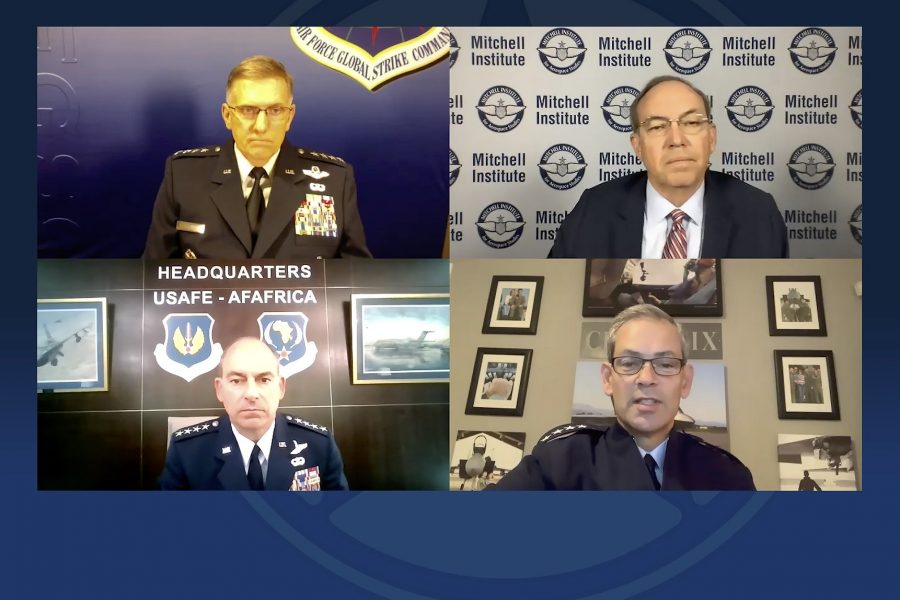
Clockwise from left, Gen. Timothy M. Ray, retired Lt. Gen. David A. Deptula, Gen. Kenneth S. Wilsbach, and Gen. Jeffrey L. Harrigian take part in a panel during the Air Force Association's virtual Air, Space & Cyber Conference. AFA video screenshot.
Watch: The Right Mix of Stand-in/Stand-off Capability, from AFA’s vASC 2020
Sept. 30, 2020
Share Article
Audio of this article is brought to you by the Air & Space Forces Association, honoring and supporting our Airmen, Guardians, and their families. Find out more at afa.org
Video: Air Force Association on YouTube
This video captures the panel entitled “The Right Mix of Stand-in/Stand-off Capability: A Mitchell Institute Session with Gen. Timothy M. Ray, Gen. Kenneth S. Wilsbach, and Gen. Jeffrey L. Harrigian that was held during the Air Force Association’s virtual Air, Space & Cyber Conference.
Audio of this article is brought to you by the Air & Space Forces Association, honoring and supporting our Airmen, Guardians, and their families. Find out more at afa.org
The use of a military counter-drone laser on the southwest border this week—which prompted the Federal Aviation Administration to abruptly close the airspace over El Paso, Texas—will be a “case study” on the complex web of authorities needed to employ such weapons near civilian areas and the consequences of agencies…
The Air Force has selected Collins Aerospace and Shield AI to develop the software Collaborative Combat Aircraft will use to fly missions alongside manned fighters, the service revealed Feb. 12—and drone-maker General Atomics was quick to announce it has already flown its YFQ-42A aircraft with Collins’ system.
The U.S. military is moving to restock its supply of the GBU-57 Massive Ordnance Penetrator bunker-busting bombs it used against Iran's underground nuclear facilities last June, according to Air Force documents.
The Air Force’s CV-22 Osprey fleet started receiving new proprotor gearboxes last month—and officials say they’re planning a comprehensive midlife upgrade for the V-22 to address concerns over its safety and reliability.
The Air Force is delaying deliveries of new C-130J Super Hercules aircraft amid problems with obsolete components and new communications equipment, industry and service officials say.
U.S. Air Force F-35A Lightning II stealth fighter jets were observed flying toward the Middle East on Feb. 11, the latest step in the U.S. military buildup in the region as the Trump administration weighs possible strikes on Iran.
When U.S. Special Operations Command and the Air Force first developed requirements for its Armed Overwatch program, planners envisioned a rugged, lightweight, low-cost combat scout aircraft capable of supporting counterinsurgency missions. Now that they've acquired OA-1K Skyraider II, however, the command and its prime contractor are looking to up-arm their modified Air Tractor cropduster to carry low-cost cruise missiles.
More stealthy U.S. fighter jets moved closer to the Middle East on Feb. 9, with a half dozen F–35A Lightning II fifth-generation planes landing at RAF Lakenheath, U.K., after crossing the Atlantic, flight tracking data and air traffic control communications show.
The first T-7A trainer jet touched down at Joint Base San Antonio-Randolph nearly two months ago to a welcome celebration filled with proclamations about the aircraft's future. Now, for the next 20 months or so 14 pilots and two weapon systems officers with the 99th Flying Training Squadron are mastering the T-7s every idiosyncrasy.
Subscribe to the Air & Space Forces Daily Report
The latest news from Air & Space Forces Magazine, as well as news from other leading publications, delivered right to your inbox every morning!
We’re sorry, there has been an error. Please review your input or try again later.