


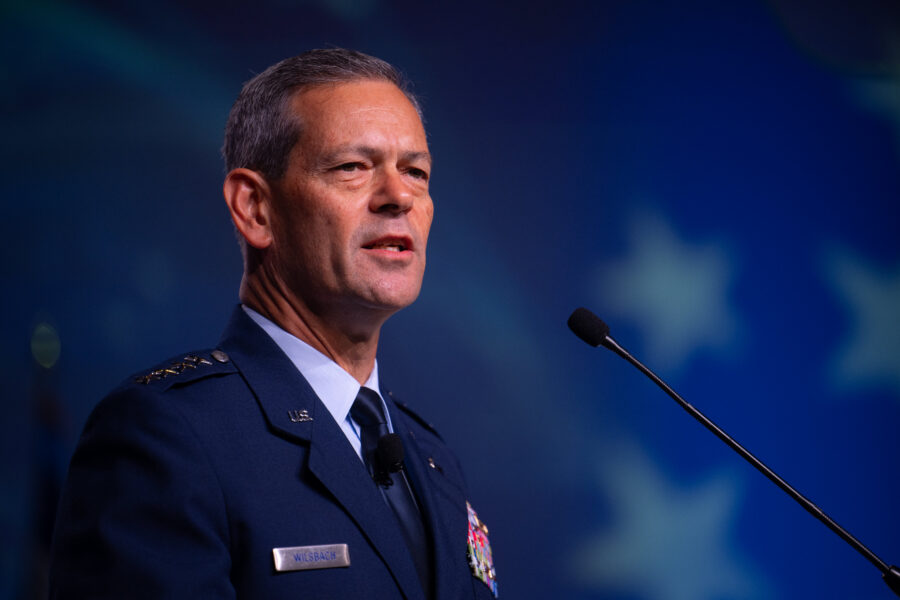
NATIONAL HARBOR, Md.—Ten Airmen received battlefield promotions for their roles in the daring rescue of DUDE 44, the crew of an F-15E Strike Eagle that was shot down over Iran this spring, Air Force Chief of Staff Ken. S. Wilsbach announced Sept. 14.
Wilsbach revealed the promotions—a rarity in the Air Force—and more details about Airmen’s actions during Operation Epic Fury in a keynote address at AFA’s Air, Space & Cyber conference.
Over the course of Epic Fury, which lasted from Feb. 28 until a shaky ceasefire in early April, the U.S. struck more than 13,000 military targets. In what was the biggest air campaign in a generation, around 500 combat aircraft executed around 250 sorties per day—10,000 sorties in 38 days, Wilsbach said.
American air bases in the Middle East went under “Alarm Red” conditions to take shelter, meaning there was an imminent threat of danger, 1,200 times. Wilsbach also said there were 48 airfield repairs and 420 “long lonely sweeps” to ensure that explosive ordnance was not left on the runway.
“That walk is exactly what the name suggests: one EOD technician, leaving a place of relative safety and approaching a suspected bomb or unexploded munition to render it safe for everyone else,” the chief said.
DUDE 44
Amid all these high-risk operations, the rescue of DUDE 44 in early April stood out as an example of the lengths the U.S. military was willing to go to save its service members.
In a recent interview with Air & Space Forces Magazine, Lt. Gen. Derek C. France, who was commander of Air Forces Central and the Combined Forces Air Component Commander for U.S. Central Command at the time of the mission and helped oversee the effort, said the rescue was one of his proudest moments in command.
“Watching 44 Bravo [the F-15E weapon systems officer] and getting the word that he was going to make it home and out of Iran with all the forces that were involved in that, knowing on Easter morning this guy was going to go see his family and call his wife for the first time in 48 hours was a high point, an emotional point for me having gone through that whole ordeal for the past 40-plus hours, and then recognized that we had got a win and got this guy back to safety,” France said.
For his part, Wilsbach singled out a particular battle manager—call sign “Peaches”—who coordinated the extraordinary search-and-rescue operation over 50 hours. To rescue the two-man crew, she and her team integrated the operations of 176 aircraft, including fighters, bombers, tankers, intelligence platforms, and special operations forces.
“Think about the complexity of that problem,” Wilsbach said. “Aircraft operating at different speeds, altitudes, fuel states, with different sensors, weapons, and responsibilities, while an adversary was actively trying to stop them.”
And that team was just part of the effort. Maintenance teams, Wilsbach said, generated additional fighters while tanker crews extended the force’s range and dwell time, and intelligence Airmen tracked threats.
“Every one of those Airmen was doing something different, yet all were contributing to the same mission,” Wilsbach said. That led to the 10 battlefield promotions, a rare occurrence when enlisted personnel are promoted for extraordinary performance of duties while serving in combat or under combat conditions.
“I had the distinct honor of promoting six of those heroes, ranging from staff sergeant to chief master sergeant, during a recent trip,’ Wilsbach said.
The dramatic rescue of the DUDE 44 crew began after an Iranian heat-seeking surface-to-air missile slammed into the two-seater fighter aircraft. Both crew members ejected. The pilot was rescued on the first day by a force that included A-10 Thunderbolt II attack aircraft, HC-130 Combat King IIs, HH-60W July Green II rescue helicopters, drones, and special warfare Airmen. That rescue operation was executed under close-range gunfire.
But the WSO, dubbed DUDE 44 Bravo, was not rescued for another day. He was injured in the fall, hitting the ground at a speed of 70 to 100 miles per hour after he struggled to unfurl a damaged parachute, according to an interview he gave to the CBS News program “60 Minutes.”
After landing five miles away from the pilot, DUDE 44 Bravo was suffering from a broken back, a broken arm, a broken shoulder, a sprained ankle, and cuts to his head and face. To elude capture, he scaled a 7,000-foot-tall ridgeline.
Airmen in Epic Fury
Wilsbach cited the work of Airmen across Epic Fury to emphasize his main directives for the service: be “ready to fight, built to endure, and integrated to win.”
The rescue of DUDE 44 was a prime example of integration, the chief said.
To illustrate readiness to fight, Wilsbach told the story of an unnamed base under attack from Iranian missiles.
“As missiles were inbound, Airmen sprinted toward bunkers,” Wilsbach said. “A missile struck nearby in a hangar, and the aircraft inside burst into flames. The bunker withstood the blast, but the force of the impact damaged the door so badly it wouldn’t open, trapping the Airmen inside.”
A security forces NCO used a pry bar to force the door partially open and spoke with the Airmen inside. But then the ejection seat on the burning aircraft ignited, “sending glass and metal fragments through the air,” Wilsbach said. At last, the Airmen were able to get the door open and run for cover. Finally, the door gave way, and the Airmen ran for cover.
Wilsbach also shared the story of an F-15E crew chief, Garrett, who stayed with the jets on the flight line until the last F-15E taxied and took off while others were running for cover. “When somebody later asked him why, his answer was simple: they needed those airplanes in the air,” Wilsbach said.
Hundreds of miles away, two Senior Airmen, Shanea and Nolan, tracked a swarm of enemy drones headed toward their base and, Wilbach said, achieved more than 10 surface-to-air kills.
Shanea and Nolan’s actions in particular show the need for the Air Force to advance point defense and make it a “core function of air and space power,” Wilsbach said; the Air Force can no longer be assured that it is safe from drone and missile threats, including at airfields in the United States.
“Don’t you think we ought to have them at every base?” Wilsbach said of a new field of Airmen specializing in point defense. “If every base is going to be threatened, we have to have somebody who knows how to defend it.
“If we had a more robust base defense, you know, perhaps those bases wouldn’t have been as damaged as they were,” Wilsbach added. “Look at Israel; they have a significantly layered, very robust defense of their country, and they didn’t take that many hits, very few, in fact. And that shows you what a good defensive system can do, which can help you to operate not quite with impunity, but almost, and you can just keep generating airpower, and your defensive systems take care of the incoming.”
To hammer home his point about endurance, Wilsbach told the story of a B-1 pilot, with the call sign Rocket, who coped with a harrowing refueling at night, in heavy clouds, and with jet fuel spraying across his cockpit windscreen.
The B-1 crew described the experience as “refueling by Braille,” Wilsbach said.
“A bomber pilot who couldn’t see depended on the tanker crew to guide them,” Wilsbach added, noting that the B-1 went on to complete a 34-hour mission.
Another example, the chief said, was an MQ-9 pilot, call sign Suit, who launched his drone while its airfield was under attack. The drone struck a target, then returned to base to conduct a damage assessment of the runway. That mission was one of many the MQ-9 conducted during Epic Fury, Wilsbach noted, with a remotely piloted aircraft striking more than 800 targets. It also played a key role in dynamic targeting and locations where the U.S. did not want to operate crewed aircraft. “Many more targets were hit because the MQ-9 found them and then passed them off to another platform,” Wilsbach said. “There’s a lot more than the 800 that they hit, and we were doing this in areas that were highly defended. And though we did decimate the Iranian Air Force and the Iranian Navy, and then we significantly attrited other capabilities that they have, it wasn’t easy. Iran’s not a pushover.”