


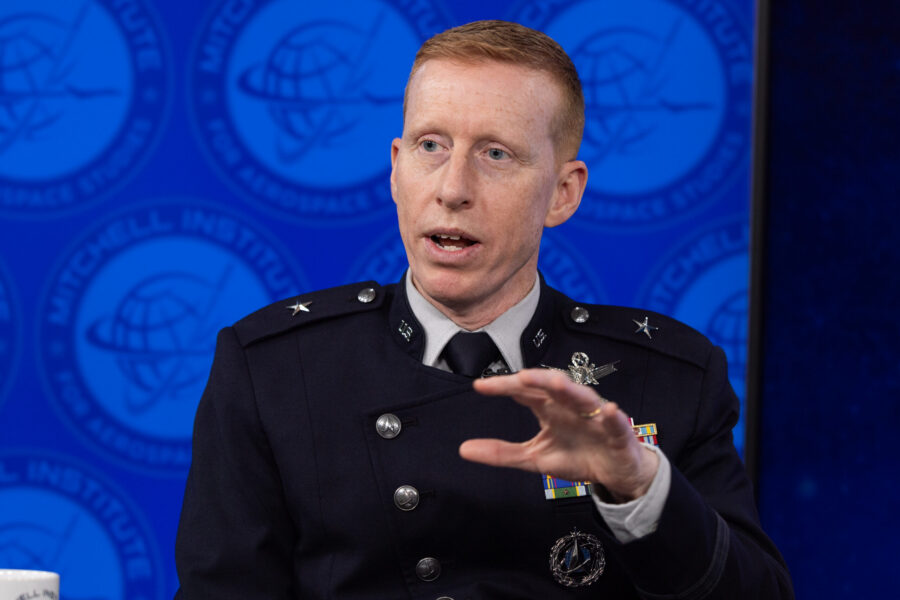
The general in charge of the Space Force’s component to U.S. Central Command said Oct. 19 he expects that in about three years his small team of Guardians will be five times the size it is today—growth he said is needed to meet the military’s demand for space capabilities in Middle East operations.
Space Forces Central was activated in December 2022 with a small staff of about 30 personnel split between Shaw Air Force Base, S.C., and Al Udeid Air Base, Qatar. Brig. Gen. Todd Benson, SPACECENT commander, said during an event at the Mitchell Institute for Aerospace Studies that while his team has had an outsized impact during operations against Iran, it needs to grow.
“It doesn’t matter what service you’re with or what component, the expectations are the same: You have to present combat-credible forces, and you have to lead joint forces in combat,” he said. “That takes size to do that. It doesn’t matter what service you’re with. So, we have to get to that point, and I think we will in the next few years.”
Benson declined to offer an exact number of personnel he wants to reach, but said his goal for the component is to have a “steady-state” headquarters staff that’s at least somewhat comparable to other service components—though he noted that even a fivefold increase won’t put SPACECENT in the ballpark of the others due to the smaller size of the Space Force.
“Our peers have thousands, so we would not be anywhere near that as a smaller service,” he said. “But I would expect that we’d be about fivefold the size we are today, which is not a large number, but that’s what we need to make sure that we have the requisite staff to do planning cycles, all the intelligence that we need.”
The Space Force today has components within every geographic combatant command and just this month added its newest component earlier, U.S. Space Forces Special Operations, or SPACEFOR-SOC. Each component is charged with presenting space expertise to commanders in the field, and that includes deploying to the front line to generate space effects like electronic warfare, satellite communications, navigation and timing, and missile warning.
Because the Space Force’s components are still small in size, balancing the day-to-day needs of their headquarters staff with their deployed forces is a challenge—particularly for SPACECENT amid ongoing operations in Iran.
Benson offered a glimpse into the component’s daily operations, which include daily planning sessions with headquarters staff and meetings with CENTCOM leadership. At the same time, SPACECENT is supporting 24/7 operations in the Middle East.
“There are no days off, really, downrange,” Benson said. “Everybody’s working as hard as they can, and just trying to deal with things like the elements of weather and ops tempo, making sure everything’s maintained.”
Benson said building SPACECENT’s team of intelligence professionals is a priority, especially when it comes to providing inputs into the joint force’s targeting processes, which involves inputs from the services components to select and prioritize military targets. At one point, SPACECENT had only two Guardian representatives in a process that includes more than 1,000 personnel.
Benson said operations over the last year have shown the need for more of everything, from personnel to space systems on the ground—like jammers—and on orbit. Also, having Guardians downrange and supporting from their home station has both cemented the importance of space effects and changed the way the joint force thinks about space in operations.
“Space will forever be a part of every military operation going forward,” Benson said. “There is no going backwards on that.”