
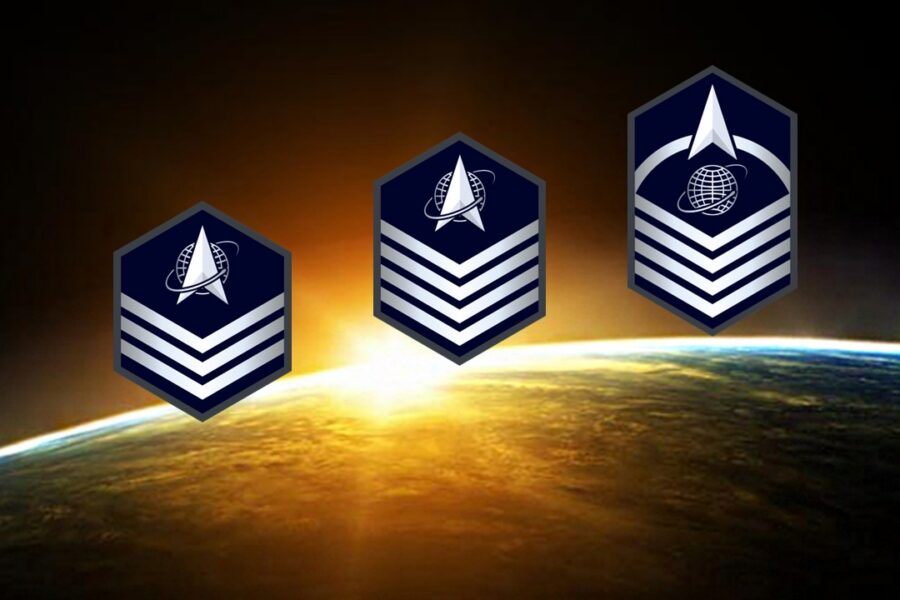
The Space Force announced three groups of enlisted promotions July 16—including the last cycle to use the old board format for sergeants, as the service transitions to a “fully qualified” method of selecting its junior NCOs.
Out of 424 eligible specialist 4s, 405 will promote to sergeant, a 95.52 percent rate. The selectees’ average time in grade was 1.07 years and 3.52 years time in service, according to an Air Force Personnel Center release.
That selection rate has held steady in the past three years after a rapid upward trajectory starting in 2024.
Space Force Sergeant Promotion Rate
Another 242 sergeants were tapped for promotion to technical sergeant out of 324 eligible, a 74.69 percent rate. That’s the highest in five years.
Finally, 196 of 530 eligible technical sergeants were selected for promotion to master sergeant, a 36.98 percent rate that’s also the highest in five years.
All these promotees will swell the ranks of an NCO-heavy enlisted force.
Space Force NCO 2026 Promotions
| Promotion rank | Eligible | Promotions | 2026 selection rate |
|---|---|---|---|
| Sergeant | 424 | 405 | 95.52 |
| Technical sergeant | 324 | 242 | 74.69 |
| Master sergeant | 530 | 196 | 36.98 |
All these promotees will swell the ranks of an NCO-heavy enlisted force. There are 10,478 Guardians in the ranks as of July 2026. Among them, 5,675 are enlisted while the remaining 4,803 are officers, for a 54 percent enlisted force. And among the enlisted, about 63 percent, or 3,594 of those enlisted, hold the NCO rank.
The growing NCO corps is part of an overall strategy to grow both the numbers of Guardians and the proportion of enlisted in the force. Chief Master Sergeant of the Space Force John F. Bentivegna laid out the plan in 2025 during an AFA Warfighters in Action event; over the next five years, the Space Force wants to double in size to nearly 20,000 uniformed personnel. And enlisted growth will outpace officer ranks, the CMSSF said.
Bentivegna has also piloted eight-year enlistments in the new force to build the technically proficient Guardians it needs.
“Historically, Guardians may spend the first two years of their contract in various training environments,” Bentivegna said in a July release. “A longer contract ensures ample time is available for operational use of that training, allowing Guardians to become more capable and confident operators. By incentivizing an eight-year enlistment, we are asking future Guardians to make a profound commitment to our mission. In return, we are building the enduring stability and deep technical mastery required to secure our nation’s interests in, from and to space for the long haul.”
Bentivegna’s predecessor, retired CMSSF Roger Towberman, applauded the initiatives not only for the NCO ranks, but overall, as a way to set the tone for what the Space Force needs – committed, qualified enlisted personnel.
“Having a competitive promotion system is good for recruiting; it’s good for Guardians,” he said. “If you promote people in the right way, then people doing the supervising, doing the training, take on those roles, so it kind of just goes from there.”
Retired Space Force Col. Charles Galbreath, now the director of the Mitchell Institute Spacepower Advantage Center of Excellence, said the service’s enlisted provide the core weapon system proficiency and depth of knowledge for the force.
“Unlike the Air Force, where officer pilots are the front-end warfighters, the Space Force has its enlisted Guardians at the front,” Galbreath said.
Fully Qualified
The move from a board system to the “fully qualified promotion policy” system has been in the works for a while.
“We’ve been working on a better promotion system that’s more suitable for the Space Force for a long time and so to see that start to happen is really good news,” Towberman said.
Bentivegna laid out the new approach at AFA’s 2025 Warfare Symposium, explaining that the new system would ditch annual caps on the number of E-4s to be promoted to sergeant and let commanders pick those whom they deemed qualified, regardless of any quota.
| Rank | 2026 rate | 2025 rate | 2024 rate | 2023 rate | 2022 rate |
|---|---|---|---|---|---|
| Sergeant | 95.52 | 96.03 | 95.66 | 72.08 | 66.91 |
| Technical sergeant | 74.69 | 68.16 | 63.87 | 34.97 | 33.23 |
| Master sergeant | 36.98 | 18.22 | 21.34 | 30.18 | 29.89 |
“If they’re qualified and ready and are doing the work, let’s make them an E-5, especially if they’re combat mission ready,” Bentivegna told reporters at the event.
Bentivegna has stressed in public comments that he sees promotions less as competition against fellow Guardians and instead on meeting established standards.
“We need Guardians who are subject matter experts, but we also need them to teach, to train, to mentor. So, there is no saying, ‘I will be a technical subject matter expert, I want to do operations, I don’t want to lead,’” Bentivegna said in a 2025 release. “There is no such thing. We all lead at our levels. We all have influence over others.”
The fully qualified system is already in use for E-1 to E-4 grades, a Space Force official wrote in an email to Air & Space Forces Magazine.
The Space Force convened the 2026 enlisted promotion board from June 15-26, using the “Mega Board” approach, which is a reference to the volume of records reviewed, the same official wrote. The boards are conducted separately for each rank.
The boards held for E-5 to E-7 since 2023 consist of a general officer, one colonel, and nine chief master sergeants.
For enlisted, a senior rater is the highest endorser in the Guardian’s rating chain, the official wrote. That rater is chosen by the field command, field operating agency, direct reporting unit or equivalent organization.
Senior raters must hold the rank of colonel or its civilian equivalent and serve as a delta commander, field command director, or equivalent.
Even with the fully qualified system, initially a centralized selection board will continue to start the process, but the service’s goal is to move that authority to the unit command, Air & Space Forces Magazine reported.
The End Goal
With all enlisted and officer ranks, the numbers tend to thin as careers progress. That’s why, Towberman said, finding and promoting lower ranks into the NCO corps will flow talent into the upper, senior enlisted as time passes.
Bentivegna rolled out the “World-Class Master Sergeant” framework in September, at AFA’s Air, Space and Cyber Conference.
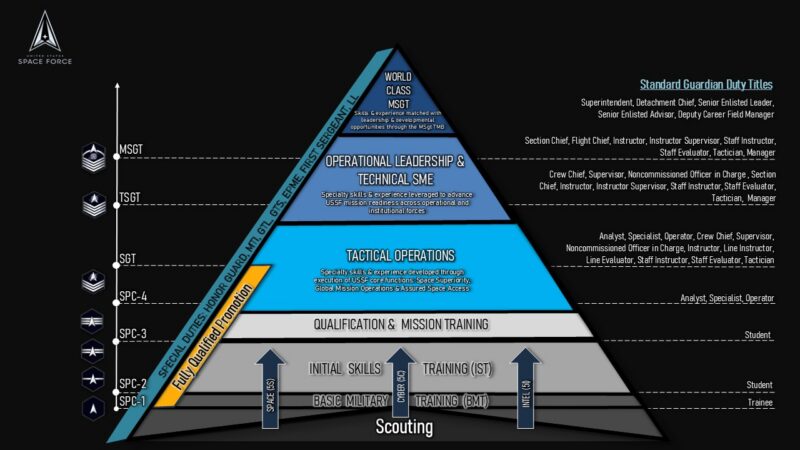
“If we focus on developing the right master sergeants … we’ll naturally have the right talent to create E-8s and E-9s,” Bentivegna explained. “There is a need for meaningful and challenging training to build a strong and cohesive team for the future of the Space Force.”
The master sergeant program actually begins at the E-1 and E-2 level, according to Bentivegna’s vision.
“And of course that’s what Chief Master Sgt. Bentivegna has been talking about for a long time is the concept of world-class master sergeants,” Towberman said. “We really need the end game for the Space Force to be, that E-7 [is] no kidding elite talent as a technician, as a tactician, and that’s across the board for all Guardians.”
