


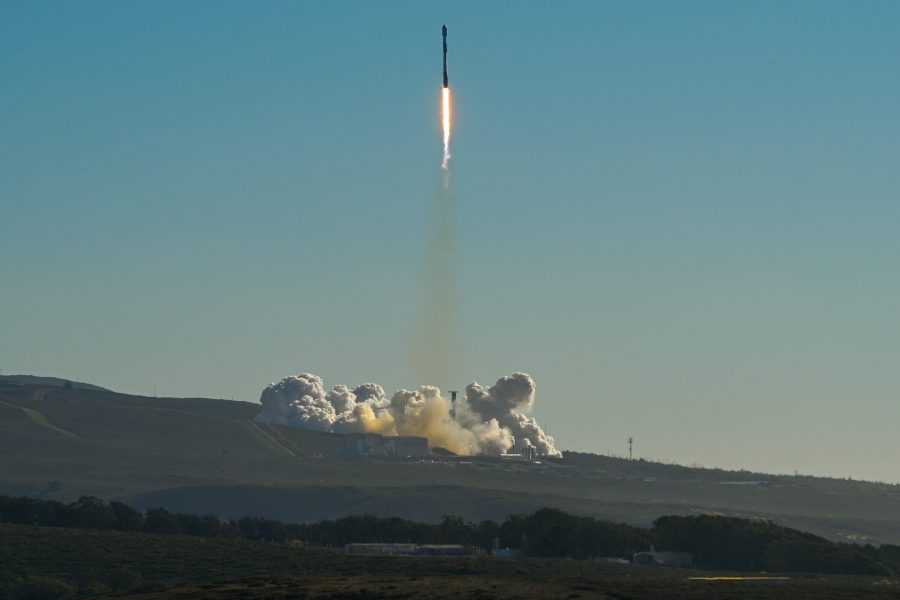
The Space Development Agency is on track to resume the launch campaign for its low-Earth orbit satellite constellation this week after a nine-month pause to fix hardware and software issues that arose on orbit with its first operational satellites.
The agency launched 42 satellites in September and October 2025, all built by York Space Systems and Lockheed Martin. At the time, officials said they were planning an ambitious schedule of a launch every month for 10 months for “Tranche 1” of the constellation, called the Proliferated Warfighter Space Architecture. But then the next launches were delayed, with leaders blaming supply chain issues, technical challenges, a government shutdown, and more.
Those delays are set to end July 16, when a SpaceX Falcon 9 rocket is scheduled to launch from Vandenberg Space Force Base, Calif., carrying 21 satellites built by York.
SDA Director Gurpartap Sandhoo told reporters July 14 that with three planes of satellites on orbit, the agency can start to deliver “real capability for the warfighter.”
But first, it needs to make contact with all the satellites and confirm they’re operating as intended—a challenge SDA faced soon after its first two launches and the major driver of the monthslong launch pause, Sandhoo revealed.
First, thermal readings on some satellites didn’t match with earlier models, indicating either a problem with the satellite’s thermal management system or an issue with the models. The satellites also weren’t connecting with ground entry points as frequently as needed, which slowed down the checkout process, Sandhoo said.
SDA has worked closely with both York and Lockheed to address the problems through software and hardware updates, Sandhoo said, and he anticipates this second round of York satellites should move more quickly through the checkout process.
“We expect this launch to be a lot smoother than the last one,” he said. “It’s just the reality of building complicated systems. . . . Our current schedule is that this checkout shouldn’t be as long as the first couple of launches were.”
After this week’s launch, it’s not clear whether SDA will resume its previous plan to conduct a launch per month. Sandhoo indicated his focus is on ensuring on getting satellites in orbit through the checkout process quickly rather than hitting a monthly cadence. If that requires more time on the ground to ensure a satellite is ready for orbit, then there could be more launch delays, he said.
“I would like to get to a nominal checkout,” he said. “I’d rather take the three-week launch delay versus the four-month checkout delay. That’s the kind of math we’re doing, but the goal is to get to operational as quickly as possible once you get on orbit.”
While the first two batches of satellites are starting to transition from the checkout phase to early operations—which requires a handoff from the vendor operations teams to SDA’s own ground operations centers—Sandhoo said there are some lingering concerns with the first two batches of Tranche 1 satellites. Some of the spacecraft had propulsion issues that prevented them from reaching the ideal orbital plane, and Lockheed has yet to make contact with one of its satellites.
Because SDA built redundancy into its constellation, the potential loss of that satellite shouldn’t impact its mission, Sandhoo said. Instead, the focus is on making sure the remaining satellites are operational.
SDA’s rapid development and fielding approach has drawn some criticism from government watchdogs who say the agency should incorporate lessons learned before designing and fielding the next batch of satellites and argue that its schedule may be too aggressive for the defense industrial base. A Government Accountability Office report from January called for more realism in SDA’s schedule and raised concerns that its strategy prioritizes speed over capability.
Sandhoo said he understands the concern but emphasized that SDA’s schedule is driven by operational realities, which does require the agency to accept some level of risk.
“When you find a problem, you stop, you fix it, and you continue on—but you can’t wait for the thing to end before you start the next one,” he said. That’s the kind of mindset we’re taking. That’s what I think the nation needs right now to face the threat that we are in.”