


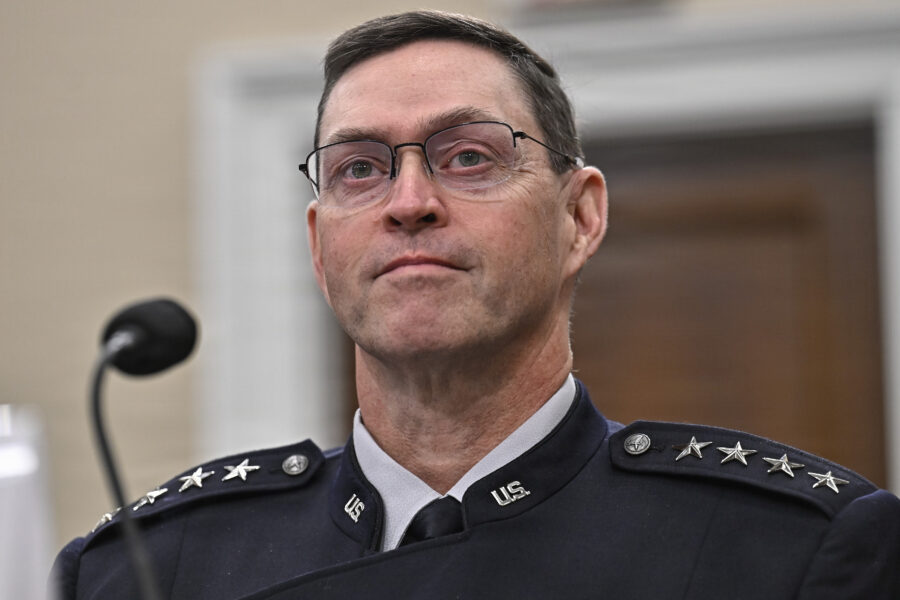
LONDON–Gen. B. Chance Saltzman, in his final major public address as Chief of Space Operations, said a nonpartisan military has a vital role to play in a period of sharp partisan differences and could help steady America’s democracy in the years ahead.
“With partisan politics creating divisions between a multitude of stakeholders, I remind myself that military institutions in our democracies, particularly military leadership, serves as the ballast in the ship,” Saltzman said at the Global Air and Space Chiefs Conference here July 15.
“While it may feel like the ballast slows progress as the ship of state attempts to quickly move towards its goals, the ballast creates stability when the inevitable storms arise,” Saltzman told an audience of senior military officials from around the world. “We as military leaders in our democracies must remember our roles, think long term, offer our military experience to decision-makers, and do what we can to provide a stability and be a calming presence.”
The relationship between military and civilian officials has become a prominent issue during the Trump administration, which has publicly dismissed many high-ranking officers. Speaking to reporters after the address, Saltzman did not comment directly on those firings but instead emphasized the military’s procedures as a way to make sober decisions on defense issues.
“It’s more of a reminder that deliberate planning is sometimes the fastest way to move forward,” he said at a media roundtable.
Saltzman also framed his comments on the role of the military in society as a multinational issue, not just an American one.
Speaking in an auditorium in a stately building along the River Thames, Saltzman told his fellow military officers that “we must all commit to using the credibility that comes from that experience to provide realistic expectations, stabilize decision-making processes, strengthen our partnerships, and focus on our unique roles and deterrence. After 35 years of reflection, I believe this is the best contribution that we can make to international peace and stability.”
Saltzman also stressed the importance of alliances, particularly in space operations.
“We are stronger as a team of nations than any one of us is individually,” Saltzman said. “ I believe space is the ultimate team sport because the orbits that we rely on do not adhere to national boundaries. And while each of us looks up from our specific parts of the globe and can individually characterize part of the space domain, together we can cover far more.”
Since becoming CSO in late 2022, Saltzman has marshaled support for the Space Force—which was created by President Trump during his first term—across the aisle and across administrations, winning over skeptics in the process. He has also worked hard to get America’s allies to step up their space capabilities and has been an unabashed advocate for the service’s growth back home.
“Alliances are as much a political animal as they are a military animal, and so as we pursue our objectives inside that alliance, we have to make sure, from a military perspective, that I attend to the military functions that are a part of that alliance,” Saltzman said. “So again, it’s just about making sure that we’re all attentive to where we can add the most value collectively and in sovereign ways to our own individual national interests. And if we don’t pay attention, sometimes you can try to take on too much.”
Saltzman was less diplomatic when discussing the threats the U.S. and its partners face in space, which he said should be concerning to all nations because conflict in space would disrupt international commercial and government functions.
“Whether we want to be in the combat zone or not, orbital mechanics will put all of our space capabilities in a space war zone,” he said. “We will share the consequences. Therefore, we should share the responsibility for a safe, secure, and stable space domain.”
He cited China as a “substantial” threat, and later offered a similar assessment of Russia. Both countries have tested novel space capabilities that could threaten American satellites.
“I generally characterize space control as covering six basic categories of weapons technologies,” Saltzman said. “Three that are ground-based, and the same three can be on-orbit-based, and it is: directed energy, [radio frequency interference], and kinetic, meaning one thing hitting another, like missile technology. And the Chinese are rapidly developing capabilities in all six.”
Saltzman added that Russia posed a similar concern.
“Why say one’s more than the other? I think they are both concerning because of how fast they have developed their capabilities and their intent to use them and how they intend to use them,” he told reporters.
Reflections
Saltzman opened his final public address by quoting the Robert Frost poem “The Road Not Taken” to reflect on his decision decades ago that led him unexpectedly to his role as the head of the Space Force. He is set to retire in August. Lt. Gen. Douglas A. Schiess, Deputy CSO for operations, has been nominated to succeed Saltzman and will have a confirmation hearing with the Senate Armed Services Committee on July 16.
“This poem is not about taking a less traveled path,” Saltzman said. “It’s about decision-making and being brave enough to make the decision and move forward when you’re not exactly sure where that decision will lead you. And over the last four years, as we established the U.S. Space Force and worked tirelessly to meet the challenges of a contested space domain, I and many others have had to make countless decisions with imperfect information and uncertainty about precisely where those decisions might be in our service.
Saltzman said that the complexity of modern warfare makes binary choices more difficult.
“What I wouldn’t give in those moments to be able to see two clearly diverging paths and be faced with the simple choice of picking which one to follow. But the strategic pathways that we need to navigate remain opaque to our best capabilities in forecasting,” he said. “So my thesis question today for this accomplished group of military leaders: Are we bold enough to make the decisions that need to be made? Do we know which decisions must be made, right or wrong? …. Are we committed to mastering space as a warfighting domain? Clearly, I have more questions than answers. But the first step, I believe, is to ensure we’re asking the right questions, since the right answers to the wrong questions are irrelevant.”