


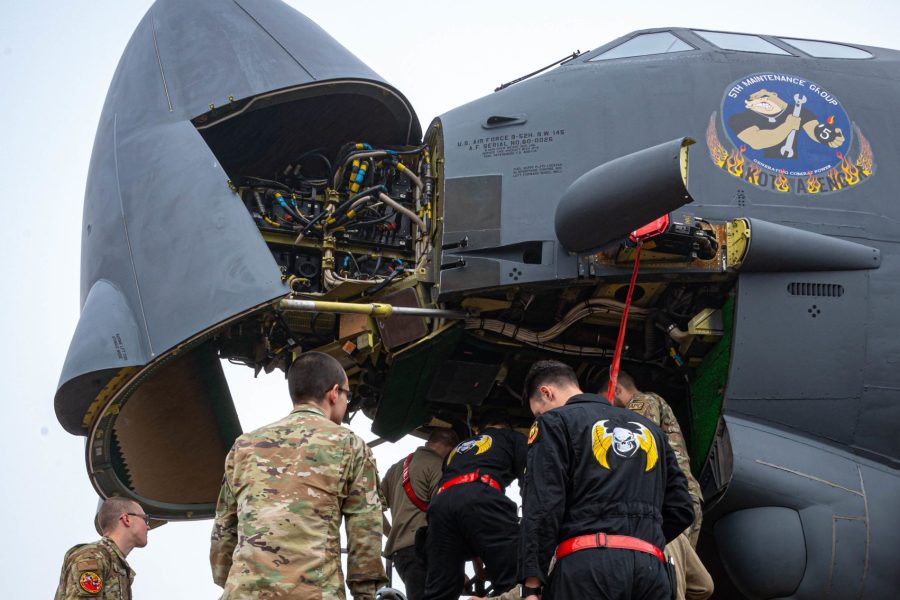
The Pentagon on Aug. 25 announced a pair of Air Force contracts to Raytheon and Boeing, totaling more than $766 million, for advance work on adding new radars to the B-52H Stratofortress.
The bigger of the two deals went to Raytheon Technologies as an indefinite-delivery, indefinite-quantity contract worth up to $603 million to equip B-52s with new AN/APQ-188 radars.
Boeing’s contract is for $163 million to build and deliver bomb rack modernization system kits to support the B-52’s Radar Modernization Program. That deal is a cost-plus-incentive fee, cost-plus-fixed fee cost-reimbursement, and firm-fixed-price delivery order, under the existing IDIQ contract for B-52 production and sustainment.
The Radar Modernization Program is meant to replace the legacy mechanical AN/APQ-166 radar with a modern active electronically scanned array radar and is a critical part of a large-scale upgrade of the Cold War-era B-52. That modernization, which is so extensive that B-52Hs who get it will be redesignated as B-52J models, will also include new engines, avionics, cockpit displays, weapons, communications, and other key systems.
Raytheon’s AN/APQ-188 is derived from the active electronically-scanned array radars now flown in the F-15 and F/A-18 fighters, and is intended to be able to better navigate and target in all weather conditions.
Raytheon’s work on the AN/APQ-188 radar will be performed in Forrest, Miss.; El Segundo, Calif.; McKinney, Texas; and Warner Robins, Ga., the contract announcement said, and is expected to be done by August 2031.
The Boeing work will be done in San Antonio, Texas, and should be finished by December 2028, the Pentagon said.
A B-52 outfitted with the APQ-188 flew from Boeing’s San Antonio, Texas, facility to Edwards Air Force Base, California, in December 2025, to carry out flight tests of the new radar. But tragedy struck in June, when that B-52 crashed at Edwards shortly after takeoff for a test sortie, killing all eight crew members aboard.
Air Force officials in July told reporters that a second B-52 was being modified with another APQ-188 to continue the radar’s testing, and that upgrade work was expected to be done by the end of the year. The June loss of the first test B-52 has put testing of the new radar on hold, likely for several months, while the newly upgraded bomber is still in the works. Officials at the Life Cycle Industry Days conference in Dayton, Ohio, said the Air Force’s B-52 modernization team may adjust its strategy and schedule as a result of the June crash.