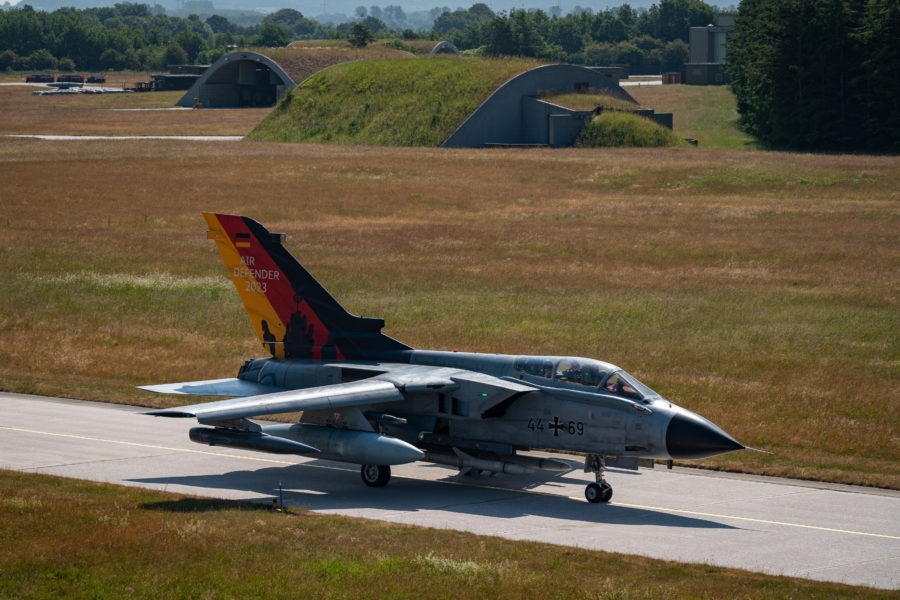
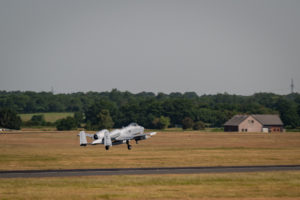
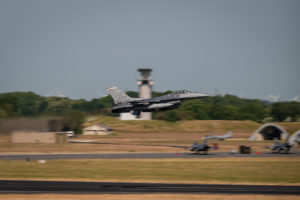
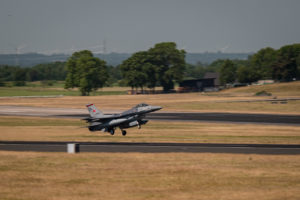
A German Panavia Tornado aircraft taxis down the flight line at Jagel Airfield, Germany, on the kickoff day of exercise Air Defender 2023. June 9, 2023. U.S. Air National Guard photo by Tech. Sgt. Sarah M. McClanahan
Audio of this article is brought to you by the Air & Space Forces Association, honoring and supporting our Airmen, Guardians, and their families. Find out more at afa.org
The OCCASUS alliance, composed of the Eastern nations of Murinus, Plumbeus, Griseus, and Cinereus, have invaded Germany, and are “trying to push north to the Baltic Sea,” the German military, or Bundeswehr, said in a release. To do so, the alliance is relying on a mix of sabotage operations and special forces supported from by airpower. In response, NATO has triggered Article V, calling for the collective defense of Germany.
All of this is fictional. But it is the premise of Air Defender 23, a massive air exercise led by Germany and taking place across Europe that kicked off June 12. All told, 25 nations are participating in the nearly two-week exercise.
The exercise has been years in the planning—well before the full-scale invasion of Ukraine ordered by Russian President Vladimir Putin in February 2022. But the need for NATO to bolster its military might is clear to its members, whose defense ministers will gather later this week in Brussels. Germany has pledged a dramatic change in defense policy and increased spending. NATO has reinforced its eastern flank. Air Defender will test out the alliance’s ability to defend itself with airpower.
All told, some 10,000 personnel and 250 aircraft from NATO nations and Japan are participating. Nearly 100 aircraft of those aircraft are American, almost all from the Air National Guard.
According to the ANG, Air Defender is “NATO’s largest airpower exercise since its inception.”
More than 40 Guard units are participating. Their aircraft include F-35s, F-15s, F-16s, A-10s, MQ-9s, C-130s, KC-135s, C-17s, and KC-46s. Active-Duty F-16s from Spangdahlem Air Base, Germany, will also join in. European air forces are bringing fighters and other aircraft such as Eurofighters, Tornados, Gripens, and American-made export model F-16s and F-18s.
Because the exercise focuses on a threat from the east and a combined response, aircraft are also operating from forward locations in the Czech Republic and the eastern flank countries of Estonia and Latvia.
The German and U.S. militaries say the exercise encompasses far more than aircraft flying together, but real-world simulated combat, as officials previously detailed to Air & Space Forces Magazine. The scale is large enough that some portions of German airspace will close to civilian aircraft temporarily.
But airpower isn’t the only factor in Air Defender as “the conflict in the imagined scenario is far more complex, also encompassing the political, economic and media levels,” the Bundeswehr says. “The core of the large-scale exercise is to test the military’s ability to react and act in the air in a resilient manner and to be able to protect the population from medium-range missiles, for example.”
“I would be pretty surprised if any world leader was not taking note of what this shows, in terms of the spirit of this alliance, which means the strength of this alliance,” Amy Gutmann, the U.S. ambassador to Germany, told reporters. “That includes Mr. Putin.”
Audio of this article is brought to you by the Air & Space Forces Association, honoring and supporting our Airmen, Guardians, and their families. Find out more at afa.org
A new think tank report calls for a buildup of U.S. drones and munitions needed for a potential fight against the Chinese military over Taiwan, thought other experts argue the report is missing some nuance in the munitions equation.
A misaligned vane in an F-16 engine that field-level maintainers cannot see to inspect caused one of the U.S. Air Force's Thunderbird jets to crash last December, a new report concludes. The same problem led another F-16 to crash 20 months earlier.
A U.S. Air Force F-16 Fighting Falcon crashed on a local mission in Germany on Sept. 22. The pilot ejected safely and is receiving medical care, Air Force officials said. The fighter was assigned to the 52nd Fighter Wing at Spangdahlem Air Base. The jet went down on base property…
The Massachusetts Air National Guard’s 104th Fighter Wing received its first F-35A Joint Strike Fighter on Sept. 13, becoming the latest unit to get its hands on the new fifth-generation jet.
The rollout of new hardware to replace an old, troubled maintenance and logistics system for the F-35 Joint Strike Fighter is complete, a Lockheed Martin spokesperson told reporters Sept. 14, and software upgrades are next.
Air Force depots are not typically meant for quick repair jobs, but during Operation Epic Fury, the service moved some of its stateside heavy maintenance capability forward to fix battle-damaged aircraft closer to the fight.
The 55th Wing officially retired the EC-130H Compass Call aircraft in a ceremony Sept. 18 at Davis-Monthan Air Force Base, Ariz., while the 355th Wing there retired its final A-10 Warthog, another major transition for the base.
As the threat of Iranian-made drones grew, the Air Force rushed last year to equip F-15E Strike Eagles in the Middle East with a cheap, cost-effective way of defeating them. The service fielded the new capability in roughly a week.
An F-16 Fighting Falcon assigned to the Texas Air National Guard’s 149th Fighter Wing crashed during a training mission in Michigan on Sept. 17. The fighter's sole pilot ejected and is in stable condition at a local hospital.
✓
Thank You!
Check your inbox to verify your email address and finish setting up your AFA account.
★
Welcome Back!
An account with this email already exists. Please log in to continue.
Subscribe to the Air & Space Forces Daily Report
The latest news from Air & Space Forces Magazine, as well as news from other leading publications, delivered right to your inbox every morning!
We’re sorry, there has been an error. Please review your input or try again later.