
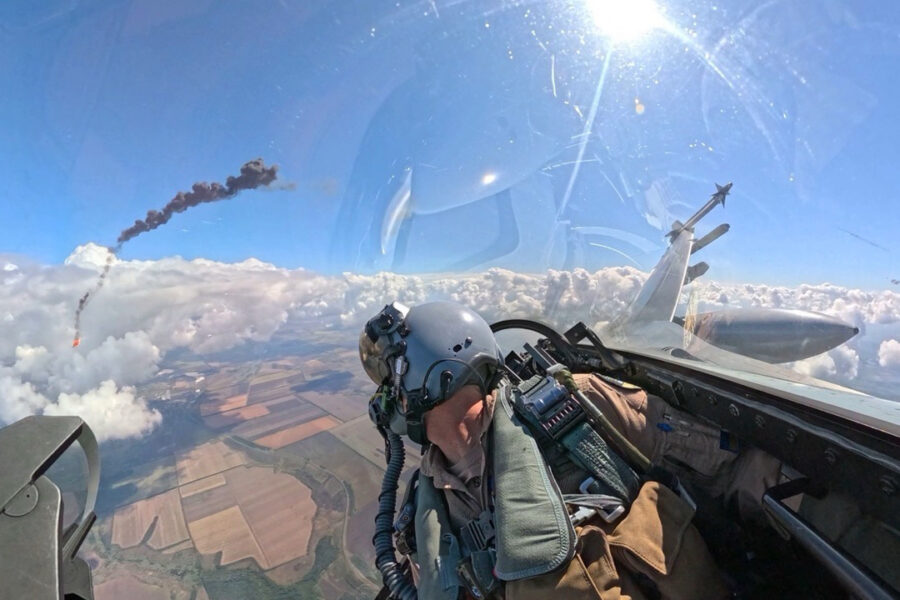
A remarkable cockpit photograph released by Ukraine last week captures far more than the destruction of a Russian Geran jet-powered attack drone. It illustrates both how far the Ukrainian Air Force has come—and the gap between the force it has today and the one it would need to become a major European air power in the future.
This is important because the future of Ukraine’s ability to defend itself does not depend on getting a few more F-16s, but rather on its ability to build an air force capable of the challenge.
The photograph is extraordinary. Taken from the cockpit of a Ukrainian F-16 during a Russian mass air attack on Sept. 10 and released a week later, the image shows a Geran drone falling from the sky, trailing smoke. According to my sources in Ukraine, it was the pilot’s third gun kill of the sortie.
Think about that for a moment.
An aircraft designed during the Cold War and transferred to Ukraine after decades of service in Western Europe, is being flown by a pilot with the Ukrainian Air Force against Russian cruise missiles in an air war unlike anything NATO has previously experienced. And the pilot is shooting them down with the F-16’s 20mm cannon.
On the night of Sept. 9-10, Russia launched 149 Shahed-type cruise missiles, along with decoys and other unmanned aircraft, against Ukraine. According to the Ukrainian Air Force, 128 were destroyed or suppressed. Roughly half of these were Gerans, which are jet-powered variants of the Shahed.
The photograph is not only a terrific advertisement for the ingenuity and skill of airmen in Ukraine, but also a warning to those drawing the wrong conclusions about airpower from this conflict.
Ukraine’s success with the F-16 does not mean these aircraft are sufficient for its long-term needs.
The F-16 Ukraine Has Is Not the F-16 of Today
The European aircraft originally provided to Ukraine are principally F-16AM/BM Mid-Life Update aircraft. They began life as older Block 15 F-16 fighters and subsequently received substantial avionics and weapons upgrades. They remain capable airplanes, and they have been modernized with capabilities comparable to later F-16C/D models. But there is an important distinction between an upgraded aircraft conceived more than 40 years ago and what the F-16 has become today.
The newest F-16 Block 70/72 aircraft are equipped with the APG-83 active electronically scanned array radar, enhanced mission computers and electronic warfare capabilities, advanced datalinks, updated cockpit displays, infrared search-and-track integration, and compatibility with a wide range of modern weapons. Its upgraded airframe is rated for a 12,000-hour structural service life.
The APG-83 is derived from the AESA radars used in the F-22 and F-35, providing pilots greater situational awareness, electronic protection, and the ability to search and track targets more effectively in a complex electromagnetic environment. That matters enormously over Ukraine.
The Ukrainian Air Force is not confronting a single threat. Its pilots face an extraordinarily complicated mixture of slow propeller-driven drones, faster jet-powered Gerans, cruise missiles, Russian fighters, long-range surface-to-air missile systems, electronic warfare, and dense ground-based air defenses.
A modern fighter must therefore do much more than fly fast and carry missiles. It needs to find, identify, prioritize, share, and engage multiple threats while surviving in a heavily contested electromagnetic environment. That is fundamentally an information problem—and modern sensors, electronic warfare and networking are what increasingly determine success.
Shooting Gerans Is Only One Mission
A second lesson from this photograph is the means the pilot used to dispatch the threat. Using the F-16’s gun preserves scarce air-to-air missiles. Ukrainian Air Force officials have acknowledged the pace of Russian air attacks imposes significant pressure on Ukraine’s missile inventories
Ukraine’s air force must perform several missions simultaneously: defend cities and critical infrastructure against cruise missiles; deter or engage Russian air forces; suppress enemy air defenses; conduct precision attacks into Russia; protect Ukrainian ground forces; and contribute to the broader intelligence and command-and-control picture. That requires both highly capable aircraft and scale.
Ukrainian President Volodymyr Zelenskyy said in 2024 that Ukraine needed 120 to 130 F-16s to challenge the number of Russian aircraft committed to the war—many more than they currently possess. That was Ukraine’s stated requirement, not an independent assessment, but it illustrates the difference between possessing F-16s and operating a combat air force of meaningful size. Aircraft numbers by themselves, however, can also be misleading.
A force of 100 fighters is inherently smaller than it seems. At any given moment, some are undergoing maintenance while several must be earmarked for training. The aircraft left must be dispersed, protected, and repaired. Pilots must get enough flying hours to remain proficient. Weapons, engines, spare parts, and ground support equipment must be continuously available.
Airpower depends on a system—not simply an inventory of airplanes.
Building an Air Force, Not Donating Aircraft
One of the more consequential developments in Western assistance to Ukraine is largely unseen, but vitally important. The Air Force Capability Coalition has gradually moved beyond simply transferring F-16s to Ukraine toward creating a Western-style aviation ecosystem encompassing combat aircraft, pilot and maintainer training, weapons, logistics, protected infrastructure, command and control, and airborne early warning.
Ukraine’s future force architecture also includes French-built Mirage 2000s and Swedish Gripens alongside U.S.-made F-16s.
This is the correct way to think about airpower: A modern fighter becomes dramatically more effective when it is properly supported. Airborne early-warning aircraft that can see hundreds of miles, ground-based sensors, secure datalinks for sharing targeting info, and commanders able to assemble those inputs into a common operational picture all enhance operational performance.
There are legitimate questions about cost, training capacity, sustainment, competing aircraft types, and the rate at which any fighter force can realistically be expanded. Discussion about offering newer F-16s miss the point that doing so would not eliminate the need for ground-based air defense, inexpensive drone interceptors, or other cost-effective ways of defeating mass attacks. No country can economically afford to use its most sophisticated weapon against every inexpensive threat.
But the strategic distinction is important. The F-16s flying over Ukraine today began as an emergency wartime capability. Ukraine’s Defense Ministry now describes the broader effort as a transition from its Soviet aviation inheritance toward a modern, networked Western model. That transition will ultimately be far more consequential than any individual aircraft transfer.
The image released this week captures the beginning of that story: A pilot in the Ukrainian Air Force maneuvering an F-16 over Ukraine while the wreckage of a Russian cruise missile falls toward the earth. The next chapter is about whether Ukraine’s wartime collection of fighters evolves into the sustainable, technologically modern, and fully integrated air force it needs, with the capacity to defend its airspace for decades—and carry the fight to the aggressor if required.
That is the difference between providing Ukraine airplanes and helping Ukraine build a credible air force.
