
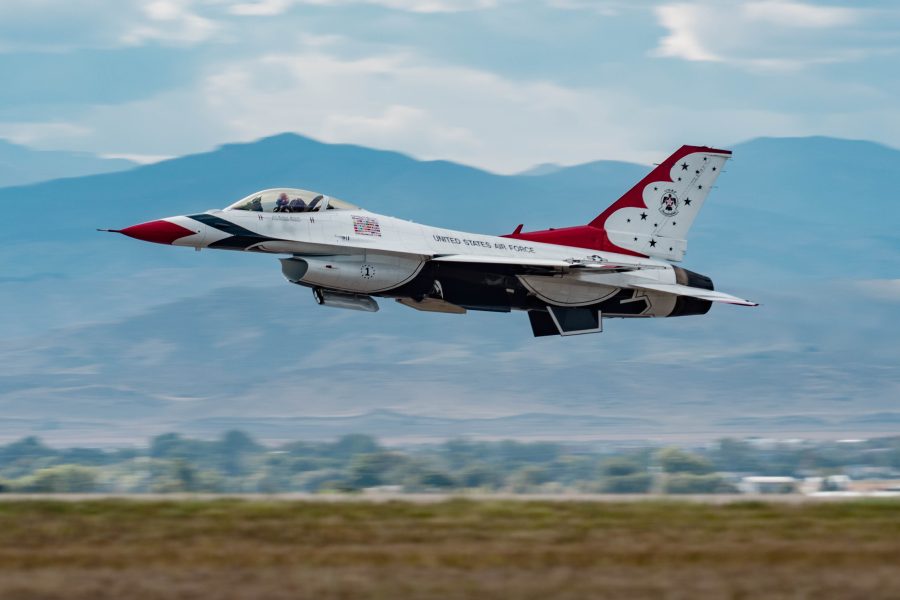
A misaligned vane in an F-16 engine that field-level maintainers cannot see to inspect caused one of the U.S. Air Force’s Thunderbird jets to crash last December, a new report concludes. The same problem led another F-16 to crash 20 months earlier.
The pilots ejected in both cases, escaping with minor injuries, while both jets were total losses. Separate Air Force Accident Investigation Boards came to similar conclusions.
The report on the Dec. 3, 2025, Thunderbird crash in the California desert was released Sept. 21. The report on the prior crash, on April 30, 2024, near Holloman Air Force Base, N.M., was released months before the Thunderbird crash, in February 2025.
The latest investigation report valued the loss of the Thunderbird F-16 at $33.5 million.
Both accidents were blamed on turned variable vanes deep in the Pratt & Whitney F100-PW-220 engine’s high-pressure compressor. Investigators determined that one or more vanes were turned and misaligned, creating “abnormal aerodynamic forces” and “irregular wake patterns” as air flowed through the engines. The resulting stress on compressor blades caused vanes to break or crack, casuing the engines to “catastrophically” fail.
The Thunderbird investigation report cited three known instances where compressor blades fractured due to turned vanes, but it did not specify a third instance. Besides the Holloman crash in 2024 and the Thunderbird crash in 2025, no publicly released Accident Investigation Board reports from the last decade mention fractured compressor blades in the F100-PW-220.
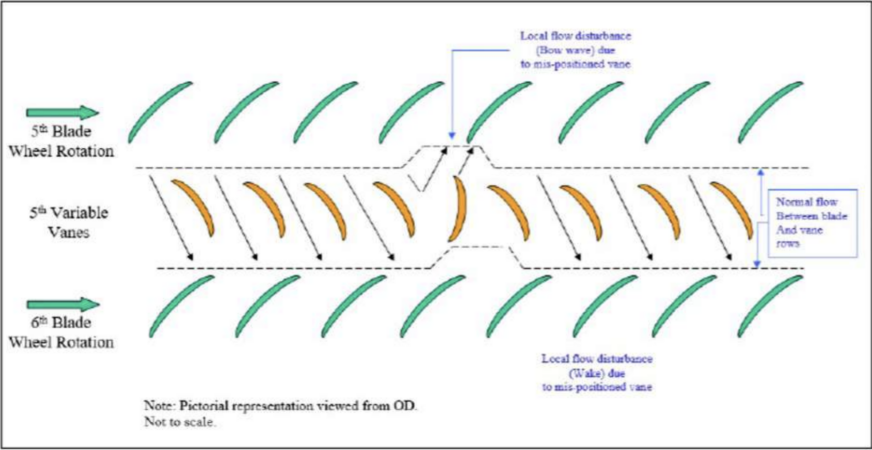
In both the Holloman and Thunderbird cases, field maintainers failed to catch the misaligned vanes. While some stages can be inspected with a borescope, the fifth stage of the engine core cannot be seen in the F100-PW-220 without completely disassembling the engine core.
Notably, both F-16 engines in question had experienced foreign object debris, or FOD, events in the years prior to the crashes. The Thunderbird jet engine’s FOD event occurred in October 2021, and the Holloman F-16’s FOD event happened in August 2022. In both cases, maintainers noted damage to early stages of the inlet fan but found no issues with the fourth, seventh, or eighth stages, which they could inspect using a borescope.
The Air Force’s technical orders for the F-16 do not require maintainers to remove and disassemble the engine core to inspect those stages after a FOD event if no damage is found in the surrounding stages. It’s unclear if the FOD events caused the vanes to turn, however, so cannot be clearly blamed for triggering the events.
The accident investigation board for the Holloman F-16 crash noted that Pratt & Whitney’s analysis determined the FOD event was the probable cause of the vane turning, but expert opinions varied when asked if it was possible for damage to occur to a later stage if no damage was observed in the ones before it. That left the cause inconclusive.
Similarly, the board for the Thunderbird crash noted that it was “impossible to conclusively determine” what caused the turned vanes. It did, however, note that the lack of inspection for the fifth and sixth stages after a FOD event “substantially contributed to the mishap.”
“The post-FOD event guidance contains an inherent inability to inspect these specific sections of the engine core. Additionally, the core of the engine is only inspected during scheduled maintenance when a core component reaches its overhaul threshold, leaving time for potential damage to progress undetected,” the report states.
A spokesperson for the Air Force Life Cycle Management Center did not immediately comment on whether the technical guidance might be changed to require complete inspections following a FOD event or to trigger other steps to prevent similar mishaps. In February 2025, after the report for the Holloman crash was released, the spokesperson said the center’s F-16 program office “is looking at this issue and is working closely with the Air Force Life Cycle Management Center’s Propulsion Directorate, the engineering authority for the engine, to correct any deficiencies.”
‘Ejecting Was Ultimately the Only Option’
In addition to detailing the engine issues, the Thunderbird report detailed how the pilot did everything possible to save the jet.
An experienced instructor pilot with nearly 1,400 flight hours, the pilot was on a routine training flight working on loops and rolls and flying from the Thunderbirds’ famed “delta formation.” The mishap pilot had planned to peel off from the formation during the loops to avoid exacerbating a stiff neck, then rejoin the formation for the rolls. But as the pilot waited to rejoin, the engine stalled. It felt “like the jet just … stopped midair,” the pilot told investigators.
Seeking to recover, the pilot sacrificed speed to gain altitude, then tried a secondary engine control. When that didn’t work, the pilot attempted an engine restart. “It sounded like things were grinding,” the pilot reported later. Finally, more than four minutes after the engine stalled, the pilot chose to eject.
The Accident Investigation Board concluded that “ejecting was ultimately the only option which provided a favorable outcome.”
Yet the ejection wasn’t flawless—the F-16’s ACES II ejection seat has two hoses that transfer hot gas from the ejection initiators to the sequence valves, and they’re supposed to disconnect automatically during an ejection. One of the hoses in the Thunderbird F-16 didn’t disconnect properly but ripped from the violence of the ejection.
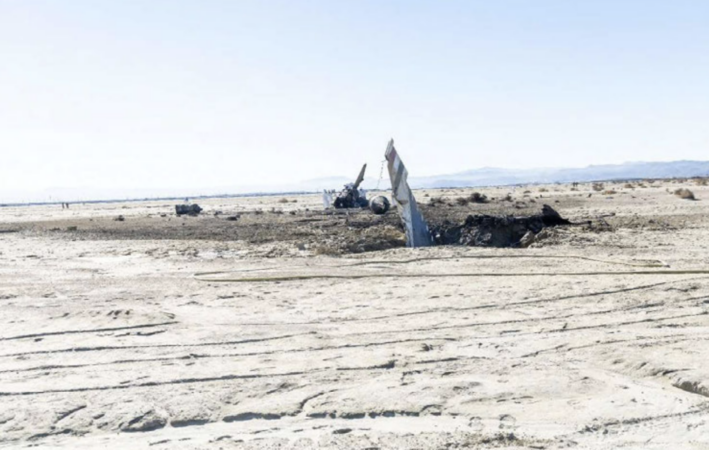
The plane went down near Trone, Calif., a small desert community near Death Valley. Upon impact, debris scattered up to 750 feet away. A local civilian who saw the crash got to the pilot first, and Navy search and rescue responded within minutes to transport for medical care. The pilot was discharged the same day.
