
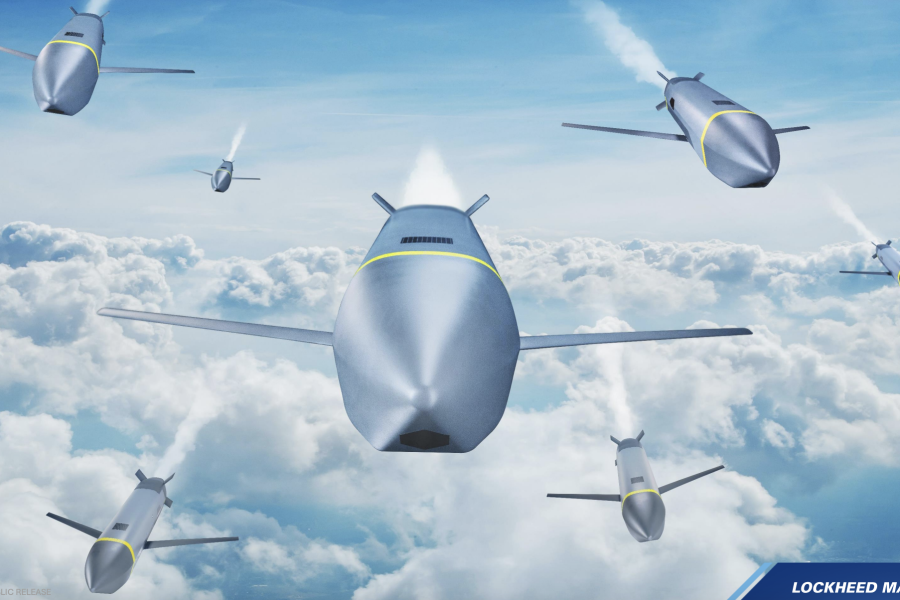
A new think tank report calls for a buildup of U.S. drones and munitions needed for a potential fight against the Chinese military over Taiwan, though other experts argue the report is missing some nuance in the munitions equation.
The Center for a New American Security’s report, “Drones, Missiles, and the U.S. Munitions Shortage: The Role of Affordable Mass in a Taiwan Conflict,” released Sept. 18, makes the case for increased long-range weapons to strike Chinese military targets to thwart a takeover of Taiwan.
The report, authored by Philip Sheers and Stacie Pettyjohn, notes a gap between the number of targets the U.S. would need to strike and its diminishing stockpiles, given the ongoing use of such weapons in the conflict with Iran.
“In a U.S.-China conflict over Taiwan that is likely to become protracted, the inventory depth and disruption that lower-cost systems can provide will be invaluable to reversing U.S. disadvantages and stopping China from achieving its operational objectives,” Sheers and Pettyjohn write.
To close the gap, the report recommends both stockpiling high-end missiles and massing cheap drones and munitions to overwhelm a Chinese attack. Other recommendations include:
- Multiyear funding and contracts so manufacturers can expand weapons production capacity and the Pentagon can rebuild long-range missile stores
- Funding for cheap, long-range anti-ship and land-attack weapons to quickly fill inventory gaps.
- Standardized shared components across airframes to lower costs and scale production.
- Pairing inexpensive drones with advanced missiles to drain enemy air defenses.
- Prioritizing easily built designs rather than over-engineering
- Routine updates and briefings to Congress on these issues
The White House and Pentagon have taken steps to boost munitions production this year, especially low-cost weapons.
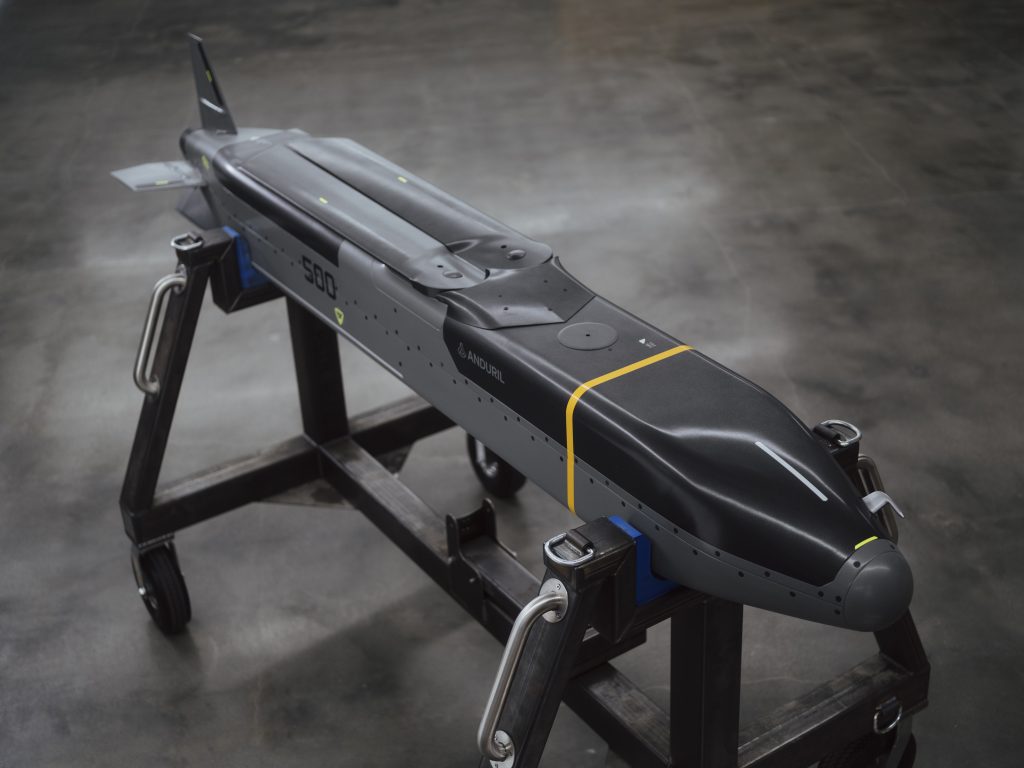
In July, the Pentagon announced multiyear framework agreements with Anduril, CoAspire, and Zone 5 Technologies to mass-produce missiles for the Air Force, followed by a Sept. 17 announcement that Lockheed Martin would expand production of the AIM-260 Joint Advanced Tactical Missile.
The former announcement is part of USAF’s Family of Affordable Mass Missiles program, unveiled in the fiscal 2026 budget with plans to ramp up such production to hit 5,300 missiles a year by 2028 and reach nearly 8,000 missiles a year by 2031.
The current projected five-year budget for FAMM is more than $12 billion for nearly 27,000 missiles.
Retired Air Force Col. Mark Gunzinger, now with AFA’s Mitchell Institute for Aerospace Studies, told Air & Space Forces Magazine that the CNAS report’s call for more munitions is necessary. But he cautioned that the report’s focus on making weapons affordable needs to be tweaked.
“It should not be about buying cheaper weapons; it should be about how to optimize cost per effect in the battlespace,” Gunzinger said.
The Air Force must fight asymmetrically and maximize the effect of each strike, regardless of munition or platform, and there’s a middle ground for weapons and platform development and procurement, Gunzinger argued.
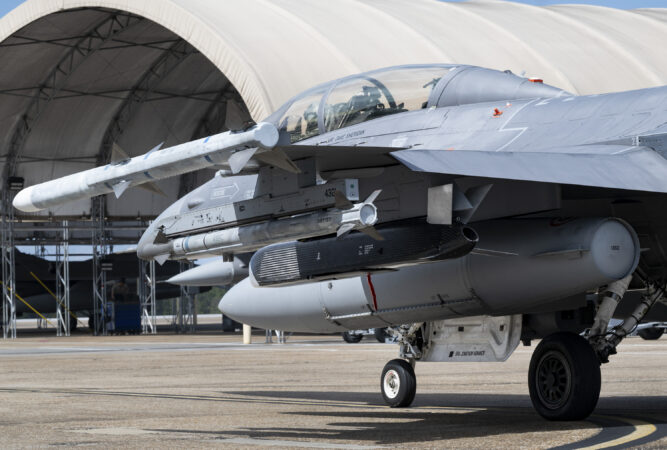
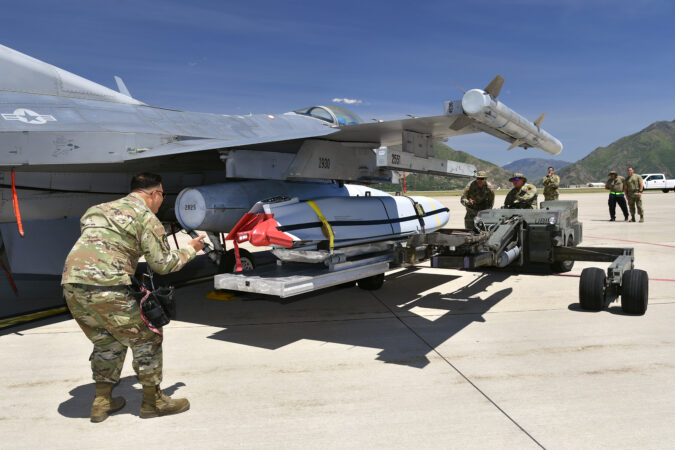
Precision-guided, specialized weapons such as the Long-Range Anti-Ship Missile and the platforms that deliver them are pricey, and lower-end, short-range munitions for stationary targets have their place, but Gunzinger said defense planners can often make too much of a tradeoff if they focus too much on price to the detriment of capability.
“Now you’ve got something that, ‘OK, you hit a price point, but is it going to survive long enough to do its mission?’” Gunzinger said. “Is it going to be able to shoot its weapon before it dies?”
A Numbers Game
The CNAS report’s operational and tactical focus is countering a People’s Liberation Army attack on Taiwan with strikes against PLA ships—destroyers and amphibious assault ships—and hitting airfields on the periphery of the country, close to the Taiwan Strait.
But it does not include a plan to hit the Chinese mainland interior.
“The paper focuses on denying a PLA joint island landing campaign without considering strategic attacks to deny sanctuaries to the PLA and collapse China’s ability to maintain the offensive,” Gunzinger said. “This risks reducing a conflict with the PLA over Taiwan to a force-on-force math problem, like how many weapons and aircraft are needed to attack PLA forces located in the Taiwan Strait and coastal China. It risks becoming a numbers game.”
Because striking mainland China in a Taiwan invasion scenario might be required, Gunzinger said the current 500-nautical-mile limit of most affordable strike options undermines the CNAS report’s conclusion that more mass will equate to victory.
“China has the capability to project outer and inner rings of airborne and sea-based air defense sensors and shooters to defend its cross-Strait forces and operations,” Gunzinger said.
And using nonstealthy drones to approach the Chinese coastline to then launch affordable missiles doesn’t work either, he said. “This would likely result in losses of the aircraft and their weapons.”
“We win part of the battle,” Gunzinger said. “They win the war.”
Breaking a Stalemate
The numbers-on-numbers approach is what has led to a stalemate in the Russia-Ukraine War, said retired Navy Cmdr. J. Michael Dahm, now a senior fellow for aerospace and China studies at Mitchell.
“Just because you can generate mass doesn’t mean that you’re going to achieve your effects,” Dahm told Air & Space Forces Magazine. “You may be able to keep your adversary off balance, but if you’re not going to then judo throw him into what you want him to do, you’re just engaging in this kind of protracted, endless warfare.”
Throughout the history of the modern Chinese military, it has mostly been defense-oriented, Dahm said. The PLA has airfields dotting its landscape and hardened sites to pull and rotate forces from, as well as a layered air defense network.
What could overwhelm the Chinese defenses, however, is what the U.S. has seen poke through its defenses recently in the Middle East, Dahm said. Iranian air attacks have used a combination of low-end munitions and cheap drones with more expensive and capable missiles fired from various angles, locations, and at varying rates of speed to confuse and defeat air defenses.
This aligns with one of the report’s recommendations—for the Pentagon to develop new operational concepts that pair cheap and high-end weapons for mixed attacks.
“Using low-cost drones in the opening wave to identify air defenses, consume interceptors, and relay targeting data to follow-on missiles offers a promising and sustainable way to create repeated air base disruption,” according to the report. “High-end weapons should be preserved for more challenging targets, while affordable mass should be integrated into strike plans to service soft targets and to saturate air defenses.”
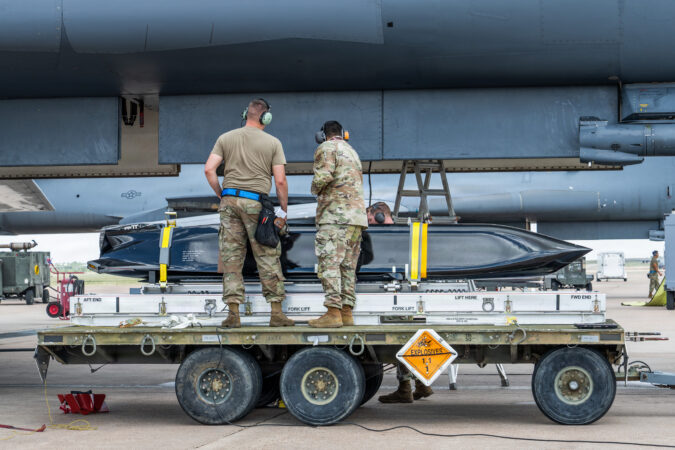
“The Iranians have figured out how to be effective: … send a whole bunch of slow-moving drones with a couple of cruise missiles and a couple of ballistic missiles,” Dahm said.
That’s because modern air defenders must set their systems to track certain ranges, altitudes, and speeds of whatever is in the airspace. And they can’t track everything effectively all at once.
“I don’t want a flock of birds showing up on my radar, so I set the speed gate for higher speed, but how high do I set it for? 100 knots or do I set it for Mach 3? What am I looking for? Range. How far am I looking? Altitude. Am I looking high? Am I looking low?” Dahm said.
Those factors mean an air defense system can’t stop everything.
“The way you overwhelm even the most sophisticated air defense system is you send some slow stuff, you send some medium stuff, and then you send these ballistic missiles that are screaming in from the upper atmosphere at Mach 3-4-5,” Dahm said. “It is hard for any modern air defense system to deal with all those inputs.”
While Iran is using that method against the U.S., Dahm advocates the U.S. use the same strategy in a Taiwan scenario against the PLA.
“That is absolutely what we should be doing,” Dahm said.
For example, to strike a Chinese military ship, such as a cruiser, Dahm said U.S. or coalition countries wouldn’t only send the same type of missile from one direction. They would simultaneously target the ship from air, land, sea, and subsurface platforms with a variety of projectiles at varying speeds and ranges, though the centerpiece of the assault might be an LRASM.
“You might send two LRASMs, but you need to accompany that with some of these more cost-effective missiles,” he said. “It is the reason we need the cost-effectiveness and the affordability, because we shouldn’t have an expectation that all of those weapons are going to work.”
