


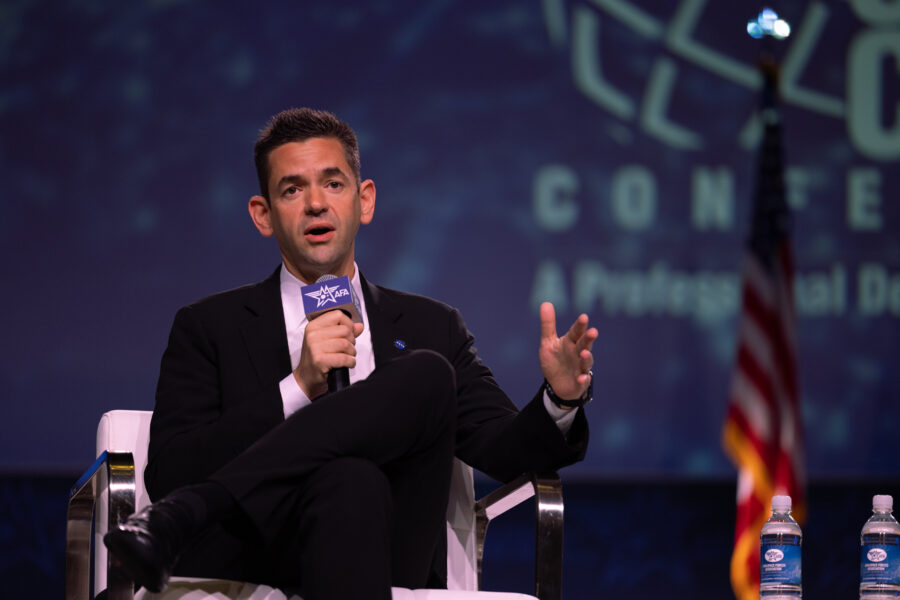
NATIONAL HARBOR, Md.—NASA is pushing hard to get astronauts back to the moon by 2028—and the urgency is driven in no small part by the national security implications of doing so before China does, Administrator Jared Isaacman said Sept. 15.
Speaking at AFA’s Air, Space & Cyber conference, Isaacman said collaboration between his civilian agency and the Pentagon, which are distinct from each other, is important and radically different from the the People’s Republic of China’s lunar ambitions, which does not clearly distinguish between military and civilian operations.
“Success in this endeavor will be measured in months, not years,” Isaacman said. “Our allies and adversaries are watching. So is every nation deciding whose technology to buy, whose standards to adopt, whose security relationships to deepen, and whose vision of the future to follow.”
The Chinese government is targeting 2030 for a manned lunar mission. The U.S. is currently targeting 2028, but that timeline has fluctuated and is considered ambitious. That two-year advantage, Isaacman acknowledged, could easily vanish.
“They have an achievable two-launch architecture to put their Taikonauts on the moon,” Isaacman said, referring to plans to launch the crew and their lander separately. “They have demonstrated reusability with their rockets. They have the expertise, and history has shown they could even be early—and we could easily be late.”
There are immediate, obvious advantages to being first. The moon’s south pole is both rich in resources and a harsh environment that could act as a proving ground for future Mars missions.
But there are “limited parking spots,” as Isaacman put it. “It creates an urgency, and we must, because the Chinese are going to the exact same locations,” he said.
American prestige and dependability in the eyes of the world is also at stake, he suggested.
“If we come up short, if we fail in this regard, and the Chinese are able to get there … It causes all our allies to question whose security guarantees again do you trust? Whose technology should I follow? Whose standards should I adhere to?” Isaacman said. “These are real implications.”
The U.S.’s victory in the first space race against the Soviet Union made an impact on national security, he argued: “I’d love to think July 20, 1969, sent a message to all our adversaries around the world: ‘I wonder what else America is capable of achieving, and maybe I should think twice before I encroach on their interests.’ And I absolutely believe the inverse is true, and it invites encroachment if you fail.”
The Soviet Union never made it to the moon, but Isaacman made clear he doesn’t expect the PRC to falter.
“China will accomplish what the Soviets never could,” he said.
More X-Planes?
The PRC doesn’t draw a line between its military and civil space efforts, Isaacman noted, so any moon base the Chinese establish could have national security implications.
NASA has always been dedicated to the peaceful exploration of space, having been established explicitly outside of the Defense Department. But working together is hardly unusual, Isaacman said, noting that NASA and the Pentagon have long shared knowledge and resources, and must continue to do so in the years to come.
“We should absolutely be collaborating, especially as we think about the cislunar environment, on areas that benefit our civil ambitions, our scientific breakthroughs that we are pursuing, but also enhance our national security footprint farther out into space,” he said.
As an example, he cited both organizations’ work on nuclear power in space. If NASA and the Pentagon pursue separate projects, the resources each can devote to it will be cut, reducing the odds of success, Isaacman said.
NASA and the Air Force have collaborated in the past on aeronautics research, and Isaacman said the agency is re-devoting itself to that field after years of neglect. As things stand, he said, NASA has devoted its aeronautics budget to helping industry squeeze more efficiency out of mature engine technologies.
“That is not what your NASA’s aeronautics budget should go to,” Isaacman said. “Very unapologetically, we are absolutely pivoting away from that.”
Instead, Isaacman wants the agency to focus on “game-changing” technologies, building he said. Right now, NASA has just one experimental “X-plane,” the X-59, meant to explore supersonic flight without loud booms.
“That will change,” Isaacman said, promising more X-planes are in the works.