


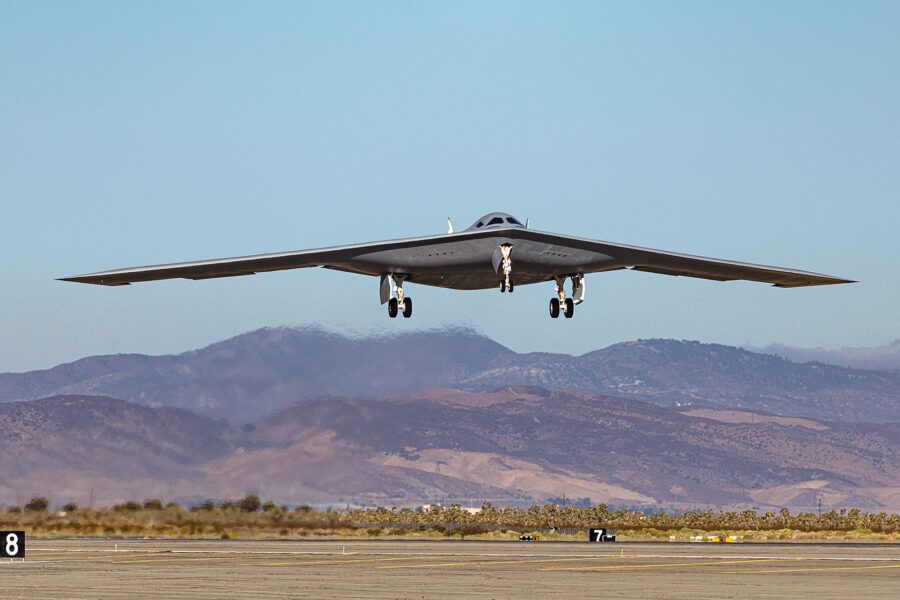
The Air Force’s future strategy for fighting wars could include arming bombers with air-to-air strike capabilities, the service said in a new report to Congress.
The report, titled “Long-Term USAF Fighter Force Structure” and submitted to lawmakers Oct. 16, said that “developing air-to-air capabilities on bombers” is being considered as a way to expand the service’s combat capabilities.
In the report, which was briefed to reporters Oct. 20 and obtained by Air & Space Forces Magazine, the Air Force estimates it will need 1,509 combat-coded aircraft by 2035 to meet the demands of the National Defense Strategy at moderate risk, with about 40 percent of its fighter fleet consisting of F-35A Joint Strike Fighters. That’s up from the 1,288 combat-coded fighters the service has today.
The Air Force is working on ways to procure as many Lockheed Martin F-35As, Boeing F-15EX Eagle IIs, and Boeing F-47 sixth-generation fighters as possible, the report said. However, the report acknowledges that hitting its fighter procurement targets may not be achievable due to “fiscal realities and industrial production limitations.”
Other recapitalization options could include acquiring an entirely new fighter, relying more on semi-autonomous drone fighters known as Collaborative Combat Aircraft—and giving air-to-air roles and capabilities to bombers, the report said.
Air Force fighters have long carried out air-to-ground strikes, but bombers have not traditionally performed air-to-air missions.
However, with the Air Force’s fleet constrained by slow procurement of new fighters and the retirement of aging ones, the service has been looking for new ways to accomplish its missions.
Former Air Force Chief of Staff Gen. David Allvin signaled an openness to the B-21 Raider stealth bomber carrying out a greater role in the service’s air dominance plans in an October 2024 discussion with reporters in Washington.
At the time, the Air Force had put its F-47 program—then called Next-Generation Air Dominance—on hold amid concerns about its potential costs. The Air Force was reviewing its approach to air superiority to try to figure out ways to get the job done, potentially without the plane that would become the F-47.
When asked if the air superiority review could lead to a more prominent role for the B-21, Allvin said “We have not taken that off the table.”
A year later, in September 2025, sources told Air & Space Forces Magazine that the Air Force was studying whether a large flying wing-type stealth aircraft—potentially based on a B-21—armed with dozens of air-to-air missiles could be an element of its future air superiority force.
In its latest report, the Air Force wrote that it is “committed to the full modernization and recapitalization of its legacy fighter fleet, while placing an enormous effort into our newest fighter, the F-47.”
CCAs are also rapidly advancing and likely to at least meet, if not beat, the program’s schedule, the report said. But the Air Force said CCAs aren’t yet ready to change how the service plans for its future fighter fleet, though that day will come.
“There is absolutely a world in which the incorporation of CCAs into the force will mitigate the requirement for the number of fighters,” Lt. Gen. David Tabor, deputy chief of staff for plans and programs, told reporters Oct. 20.
The report also said it will be “essential” to modernize its current cadre of older F-15s and F-16s into a fleet of “advanced fourth-generation capability” jets—planes that do not have stealth capabilities but can still operate in highly contested environments, often with the aid of advanced sensors and electronic warfare weapons.
But it would take more than a decade of investments in the Air Force’s current depot infrastructure to modernize enough jets to increase the Air Force’s aircraft availability, the report said, calling that approach “insufficient, as it perpetuates reliance on a fleet averaging 30+ years in age.”
Aside from upgrading existing fighters, the service could also buy new advanced fourth-gen jets like the F-15EX and, potentially, a new version of Lockheed Martin’s F-16 Fighting Falcon, dubbed the F-16G. Tabor said the service has not yet made any decision on buying new F-16s, “and we’re not in a position where that decision has to be made immediately.”
In its report, the Air Force said it has to pursue a two-track strategy of modernizing existing aircraft to meet immediate operational requirements, while recapitalizing its legacy fighters at the same time.