


Fresh off Boeing’s victory in the competition to build the Navy’s sixth-generation F/A-XX fighter, CEO Kelly Ortberg on Oct. 27 expressed confidence that the darkest days of the company’s beleaguered defense sector are in the past.
A year ago, Boeing expected its Defense, Space, and Security division to see revenue growth in the low single digits, Ortberg told investors in an earnings call. Now, the company is projecting defense revenue growth in at least the mid-single digits or higher.
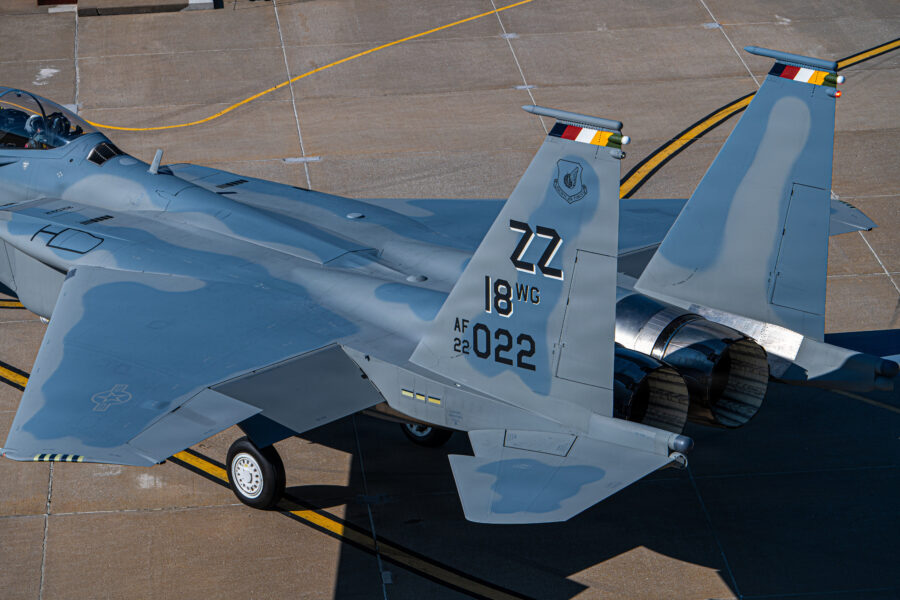
Ortberg pointed to Boeing’s Sept. 29 win of both the $20 billion F/A-XX contract and a $2.38 billion Air Force contract for 22 more F-15EX Eagle II fighters as examples of the tailwinds boosting Boeing’s defense portfolio. The F/A-XX win followed the Air Force’s March 2025 selection of Boeing to build its F-47, putting both the U.S. military’s sixth-generation fighter programs in its portfolio.
In the first three quarters of 2026, Boeing’s defense sector brought in $23 billion in revenue, with earnings of $710 million. That’s up from $19.8 billion in revenue and $379 million in earnings a year earlier.
Ortberg also said the company’s decision to swear off risky contracts—such as the fixed-price contract for Boeing’s KC-46 Pegasus program, which has lost the company billions—has helped put its defense sector back on course.
“The important part is, all these programs are also being underwritten with the right contract type,” Ortberg said. “So not only are we booking more orders, we’re booking more orders that won’t result in some of the challenges we’ve had.”
The F-47 contract is a cost-plus deal, Ortberg said. He declined to identify what type of contract Boeing signed for F/A-XX, but said it is “an appropriate contract type.”
In 2022, Boeing put executive Ted Colbert in charge of its defense sector, who pledged to not agree to further fixed-price contracts with the Pentagon. A few months into the job, Colbert told reporters in London that Boeing had passed on competing for the Air Force’s Survivable Airborne Operations Center, or SAOC, in part because it would have required agreeing to fixed-price elements in the contract.
Colbert also said fighters remained an important part of the company’s business, even though the firm then had not landed a contract to create an entirely new fighter in years. Later in 2022, Colbert reorganized Boeing’s defense sector in an effort to stop it from bleeding revenue and fix persistent quality problems.
Two years later, Boeing Defense appeared increasingly troubled. Financial losses piled up, and the company fired Colbert in September 2024. Labor troubles between Boeing and its machinists led to a massive strike in 2024, and a smaller one a year later, further complicating the firm’s outlook and slowing its F-15EX delivery pace.
But this year, Ortberg said he saw more reasons for optimism. Boeing’s T-7 Red Hawk trainer for the Air Force and MQ-25 Stingray for the Navy both achieved their Milestone C approvals and moved into low-rate initial production this year as well, which Ortberg said was a positive sign for the company.
“We’re not done with the development programs until we’re done,” Ortberg said, adding that the defense team is “doing a really good job of finding win-win scenarios with our customers to get these projects moved forward.”
“So the outlook is strong, our products are in strong demand, and the budget supports additional growth,” Ortberg said. “I think our defense portfolio is a little bit of a sleeper.”