


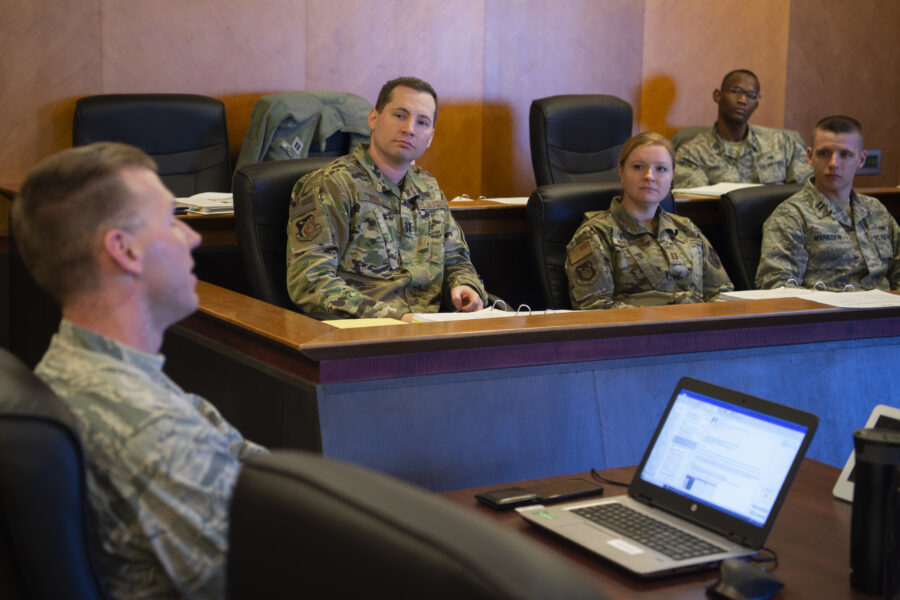
The Senate Armed Services Committee wants the Pentagon to study whether the unique legal issues arising from operations in space demand that the Space Force have its own lawyers.
The committee’s draft of the fiscal 2027 National Defense Authorization bill, if passed, would direct the Secretary of the Air Force and the Chief of Space Operations to determine if the Space Force’s legal needs are fully met by Air Force lawyers, who do that work today. The bill would require a report by December 2027.
“The committee recognizes that operational demands in the space domain have grown, including reliance on commercial integration, allied and partner cooperation, and dual-use technologies,” the proposed legislation states. That raises concerns “that current legal, policy, and institutional structures within the Department of Defense may not have kept pace with the complexity of space operations.”
The Air Force declined to comment on the proposed legislation.
Since being established in 2019, the Space Force has relied on the Air Force to provide a variety of services, from base operations and security to medical, legal, chaplain, and public affairs needs. The model is similar to that of the Marine Corps, which similarly leans on the Navy for many of those functions—but not for public affairs officers or lawyers.
Retired Space Force Col. Charles Galbreath, now the director of AFA’s Mitchell Institute for Aerospace Studies’ Spacepower Advantage Center of Excellence, says the unique legal issues in space makes it an important, emerging field of law.
“The topic of space law has been a very niche specialty, with only a handful of practitioners,” Galbreath said. “As the Space Force grows and space operations play an increasingly decisive role in military operations, there will need to be more space lawyers.”
The Senate committee’s proposed study would:
- Inventory legal personnel supporting space operations, including training, experience, and organizational alignment;
- Identify gaps, if any, in legal readiness related to international space law, operational employment, commercial and civil partnerships, dual-use technologies, and industrial base considerations;
- Provide options for establishing a dedicated legal organization within the Air Force, Space Force, or U.S. Space Command;
- Review requirements for advanced, domain-specific education and professional military education in space law; and
- List opportunities to expand academic and research partnerships to support training, workforce development, and legal research relevant to national security space operations.
New Areas
A recent Mitchell Insitute report cited the lack of clarity around how to define space conflicts as among the unresolved legal issues that need to be addressed. “There isn’t a clear and agreed definition of what constitutes a space attack,” Galbreath said.
Chris Johnson, a lecturer at the International Institute of Space Law, said space lacks international boundaries, and therefore requires understanding of international law. In an email, he said studying international law will “inform their understanding of the geopolitical context and consequences of American actions in space.”
Another challenge is the increasingly intertwined nature of commercial and military space systems, Galbreath said. “There is an inability to cordon off sections of space for military or civilian activities,” he said. “They are all up there at the same time sharing the same orbital domains.”
Retired Air Force Maj. Gen. Charlie Dunlap, a former Air Force deputy JAG, said legal needs for the military branches evolve over time. “While I think studying the issue is very appropriate, I would not reflexively say that an increase [in legal officers] is needed,” Dunlap said in an email. “A reallocation might suffice. Let’s keep an open mind and get the facts before deciding anything.”
Now a professor at Duke University School of Law, Dunlap said trends suggest an overall decline in military justice actions and litigated cases and increased use of computerized legal assistance. That could free up manpower or positions to work on space-specific legal concerns, he said.
“I think there may be other areas that are no longer the responsibility of the JAG corps or are not as manpower intensive,” Dunlap said.
Former Air Force Secretary F. Whitten Peters, a lawyer who also served as DOD principal deputy general counsel, said he sees little need for a unique Space Force JAG corps.
“USAF Space always has exceptional JAG counsel who were recognized as national experts on space law and at least one went on to teach space law and national security space at a major university after his retirement,” Peters wrote in an email.
Retired Air Force Col. Todd Pennington, who was the Space Force’s first Staff Judge Advocate, wrote in an article for “The Space Review,” that increasing space activities and growth will “probably expand the scale and complexity of legal support for space operations” and that the service “will need more legal support for operations, and less legal support for military justice.”
Pennington, now a fellow for Space Strategy and Policy at National Defense University, wrote that the Air Force JAG corps must adapt to these changes. “Because military justice will be in decline as the Space Force grows in size and relevance, it will not be military justice discipline that creates demand for a legal career field in the Space Force,” Pennington wrote.