
JB Charleston Gets a New Name
By Chris Gordon
CHARLESTON, S.C.—
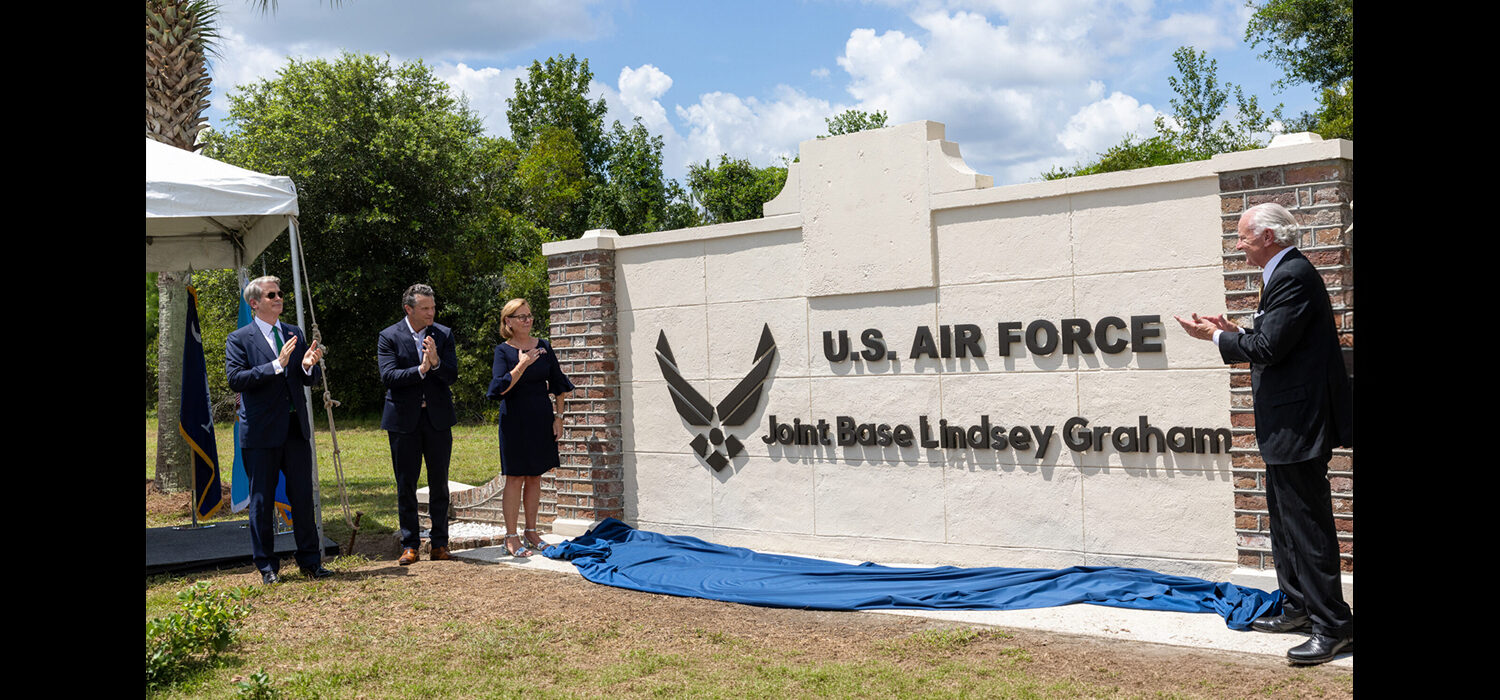
A major East Coast military base that serves as a key Air Force logistics hub was renamed after the late Sen. Lindsey Graham Aug. 10 in a ceremony led by Secretary of Defense Pete Hegseth and Graham’s sister, Sen. Darline Graham.
The new name of Joint Base Charleston is Joint Base Lindsey Graham in honor of South Carolina’s former senior senator, who died July 11 in Washington, D.C., at 71.
Darline Graham unveiled a sign for the base alongside Hegseth, South Carolina Gov. Henry McMaster, and Treasury Secretary Scott Bessent.
Darline Graham was appointed by McMaster to fill her brother’s seat for the remainder of his term, which is entering its final months. She is now running for a full six-year term in the Senate with President Donald Trump’s support. The ceremony occurred one day before the Republican primary.
Lindsey Graham, a 33-year Air Force veteran, was one of the most influential Airmen ever to serve in Congress. He served as a judge advocate general on Active-duty from 1982 to 1989, in the South Carolina Air National Guard until 1995, and in the Air Force Reserve until 2015. He retired as a colonel.
“Senator Lindsey Graham dedicated his life to serving this state and serving the armed forces of the United States. He served this nation both in uniform and in both houses of Congress,” Hegseth told the crowd that included members of Congress, local leaders, Airmen, and other service members. “But in both capacities, it was always the same mission. He knew the timeless truth that to ensure peace, we must be prepared for war.”
Graham was elected to the House of Representatives in 1994, where he served four terms before winning his Senate seat. He was approaching the end of his fourth six-year term when he died. He briefly ran for President in 2016, when he was a harsh critic of Trump, but he later became one of the President’s closest allies in Congress.
The installation—formerly Charleston Air Force Base before it merged with nearby Navy facilities in 2009—is the largest C-17 Globemaster III base in the world, forming a critical part of the U.S. military’s enterprise for moving materiel and people around the globe. Its C-17s carry a blue tail flash with the state’s palmetto flag design. Now, they will say “Graham” on the aircraft, according to the officials speaking at the ceremony.
“I believe that he will continue here and around the world to inspire Airmen for generations to come. And I say around the world, because … those gray tails that say ‘Charleston,’ now, when they land in far-flung places, will say ‘Graham.’ The world will remember that name,” Hegseth said, putting it up with the namesakes of other South Carolina bases and units:
- Shaw Air Force Base is named for 1st Lt. Ervin David Shaw, a pilot who died in World War I;
- McEntire Joint National Guard Base is named for Brig. Gen. Barnie McEntire, the first commander of the South Carolina Air National Guard, who went down with his F-104 in Pennsylvania to ensure it did not crash into populated areas; and
- The 169th Fighter Wing of the S.C. Guard is nicknamed the Swamp Foxes for Francis Marion, a famed Revolutionary War commander.
Before his death, Graham was the chairman of the Senate Budget Committee and supported the Trump administration’s $1.5 trillion proposed budget for fiscal 2027. The Pentagon’s budget remains in limbo in Congress.
Hegseth enlisted Graham’s memory to advocate for increased spending and the passage of a party-line reconciliation bill. The prospect of the funding getting through even a Republican-controlled legislature is murky. Hegseth said Graham wanted to increase the Pentagon’s budget even more than its $1.15 trillion base budget request and $350 billion reconciliation package.
“He looked at me and said, ‘How’s $355 billion sound to you?’” Hegseth said. “He wanted to give even more than $350 [billion]. He wanted to ensure our military was as equipped as humanly possible, because he was thinking of places like this one right here,” Hegseth said. “This department pays tribute to Lindsey Graham in the naming of this space. But there could be no greater tribute than Congress could give than to invest in our warriors for the full $1.5 trillion. … Fully funding our warriors would be one last great accomplishment for Col. Lindsey Graham and a major part of his legacy.
“He believed in mission success. He believed in the troops. He believed in giving the troops everything they needed,” Hegseth added.
Bessent, a South Carolinian, also said Graham “believed that the first obligation of the federal government is to keep its people safe,” though he did not directly address the budget. Bessent said, “Joint Base Graham is the backbone of our Air Force’s C-17 fleet,” which is a “reminder that Senator Graham was America’s workhorse.”
During his visit, Hegseth recognized service members, particularly from the base’s 437th Airlift Wing, who operated under fire during Operation Epic Fury against Iran, including Airmen who took cover from missiles around two dozen times and helped evacuate the planes from more vulnerable bases such as Al Udeid Air Base in Qatar.
“I’ve been watching. I read the reports of how you iterate, do things faster, in congested logistics. It’s incredible, the backbone of what you have enabled in the theater,” Hegseth said. “The secret sauce of any successful mission—whether it’s Epic Fury, Southern Spear, Midnight Hammer, Absolute Resolve, Hawkeye Strike, you name it—are the logistics behind it.”
“All of it is enabled by all of you,” Hegseth told Airmen and other service members after the renaming ceremony.
Graham’s Story
While Graham’s domestic policies shifted over time, he remained a foreign policy hawk, pressing for tough U.S. policies toward Iran and Russia. He was also a strong supporter of Ukraine in its war with Russia. As part of that support, he was pushing for a sweeping sanctions bill on Russia at the time of his death. The Senate has since passed it in his honor.
Graham was the last surviving member of the Three Amigos—the other members were Sen. John McCain (R-Ariz.) and Sen. Joe Lieberman (I-Conn.)—who supported the invasions of Iraq and the continued presence of troops there and the surge of troops in 2007.
Graham’s parents ran a pool hall, but both died while Graham was on an ROTC scholarship. To stay near home, Graham attended the University of South Carolina as both an undergraduate and for law school. He joined the Air Force Judge Advocate General Corps, deploying to Iraq and Afghanistan, and often traveling on official congressional delegations to war zones and other locations around the world.
Hegseth recalled meeting Graham roughly 20 years ago as a first lieutenant in the Army National Guard, and later as a captain while they were deployed to Afghanistan.
“That man had a schedule like nobody else,” Hegseth said. “But he was there to hear from us because he wanted his ear to the ground from the troops on what was actually happening in the war in Afghanistan.”
“Lindsey loved the Air Force,” said Darline Graham, who became her brother’s legal dependent after her parents’ death. “He loved its mission. He loved wearing the uniform of his country. His interest in foreign affairs and national security started with his service in the Air Force.”
Graham first came to prominence in the mid-1980s when he exposed errors in the Air Force’s drug testing, leading to an appearance on CBS’ “60 Minutes.” Graham left Active-duty in 1989. He then joined the South Carolina Air National Guard and was activated to support Operation Desert Storm. After his national political career started, Graham joined the Air Force Reserve and deployed during America’s conflicts in the Middle East. He was promoted to colonel in 2004 before retiring in 2015 after 33 years in the Air Force.
“It was sometimes hard to tell if Lindsey was a senator who happened to serve in the Air Force or an Air Force lawyer who happened to serve in the Senate,” Darline Graham said. “Such was his love for both. That’s the man this base is named after—a man who loved his country, loved his state, and loved the United States Air Force. I could not be more honored or humbled for him to be recognized in such a fashion for his lifetime of service.”
Permanent Task Force Takes Over Cartel War
By Todd South
As U.S. Southern Command shifts its counter narcotics mission to a permanent task force, the Air Force piece of the larger war on cartels in Latin America and the Caribbean is likely to grow.
SOUTHCOM Commander Marine Corps Gen. Francis Donovan announced Aug. 3 on X.com and official video releases that the command had ended the temporary Joint Task Force-Southern Spear and Operation Southern Spear. The command, he said, would shift its mission to the Joint Task Force-Western Hemisphere.
“Joint Task Force Western Hemisphere is SOUTHCOM’s action arm for confronting threats across the hemisphere,” Donovan said.
He called the task force a “purpose-built and task-organized” headquarters that “brings together tailored military capabilities and trusted partnerships to increase total systemic friction, operational tempo, impose sustained pressure on criminal organizations, and strengthen the security of the United States and our partners.”
Donovan did not specify which forces would comprise the tailor-made task force, which will be commanded by Marine Maj. Gen. Kevin Jarrad, who has most recently led humanitarian relief efforts in Venezuela.
The task force will work with 18 partner nations, members of the 5-month-old Americas Counter Cartel Coalition, which includes El Salvador, Ecuador, and Honduras. Notably, Mexico and Colombia, both centers of cartel influence and drug production, are not included, even though Mexico is part of U.S. Northern Command.
The White House referred questions to the Pentagon, which deferred to SOUTHCOM, where a spokesperson said via email that the new task force “represents an evolution” from Southern Spear, reinforcing a “whole-of-government, multinational approach to defending the homeland and bolstering regional partnerships.”
The shift from a temporary task force and operation to a permanent, broader-ranging structure within the command came as no surprise to experts on the region and its military mission who were interviewed by Air & Space Forces Magazine.
“This is going to be an ongoing, large-scale type of operation to support the strategic desires of the President,” said retired Lt. Gen. Norm Seip, U.S. Air Forces Southern commander from 2006 to 2009.
That is likely to mean some more prioritization of assets for the SOUTHCOM commander, Seip said, and his air component lead—the 12th Air Force commander.
The 12th Air Force, out of Davis-Monthan Air Force Base, Ariz., played a key role in Southern Spear and will continue that work with JTF-WH.
“Our focus during Operation Southern Spear has been to provide rapid air mobility, comprehensive air domain awareness, and essential logistical support to joint forces, ensuring the overall success of the operation’s strategic objectives in the region,” an AFSOUTH spokesperson said in an email response.
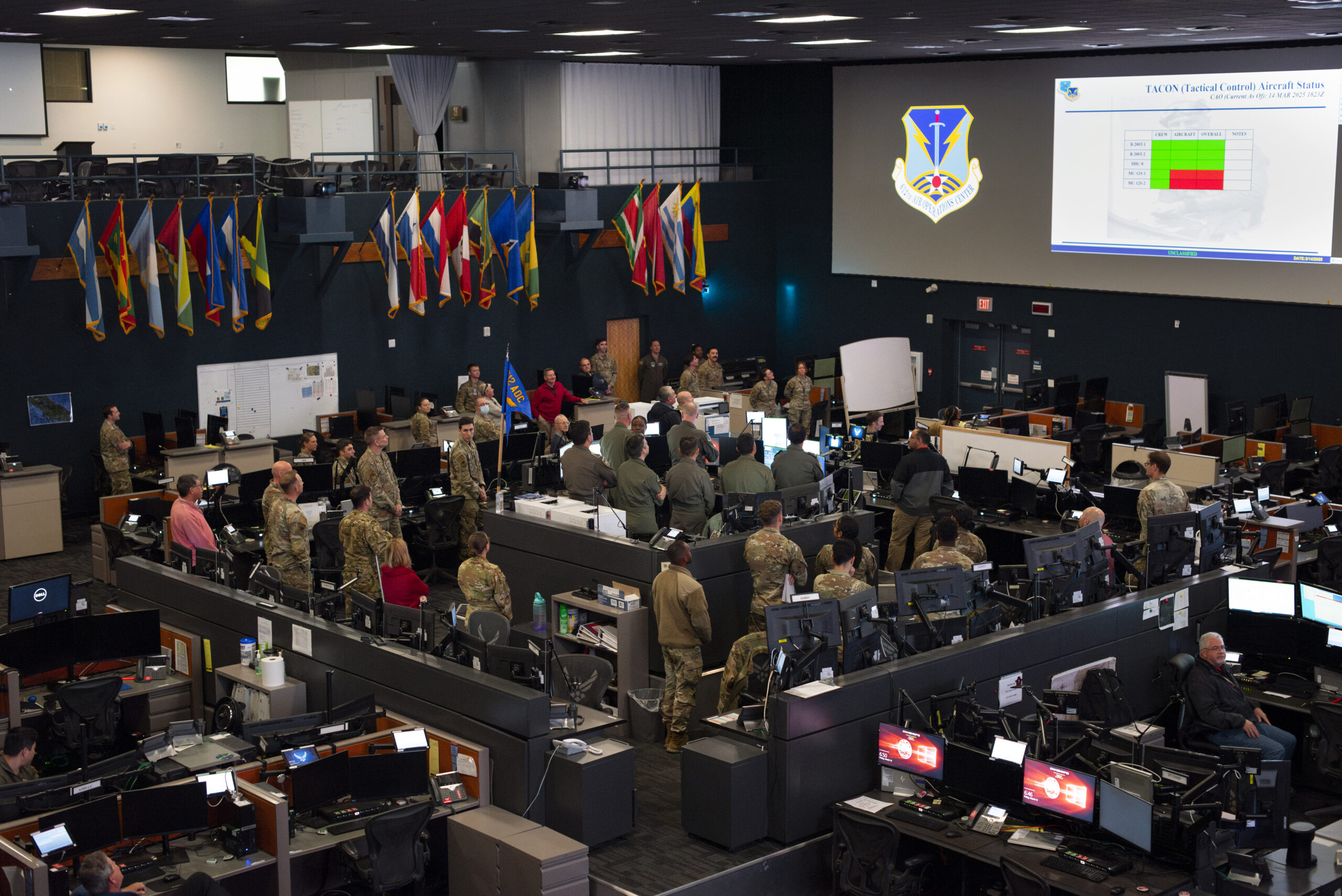
The 12th Air Force executed 1,700 sorties, including transporting 27,000 tons of cargo and more than 4,500 personnel during the operation’s 10-month duration, the spokesperson wrote. They conducted that work largely through the 612th Air Operations Center, also at Davis-Monthan, the “never center” for all things air in SOUTHCOM.
That included a mix of airlift, air refueling, command and control, ISR, rotary wing, strike and tiltrotor aircraft to sustain operations.
At the peak of the operations, AFSOUTH oversaw 2,800 Airmen and 80 aircraft across seven operating locations. As the joint forces air component, the 12th had operational control over 150 aircraft across 15 separate land bases.
With the JTF-WH, AFSOUTH is integrating air, space and cyber capabilities to support the task force’s mission and provide agile combat support, ISR and interoperability with regional partners, the spokesperson wrote.
While components of Southern Spear’s work have included counter-maritime operations and drone strikes conducted by U.S. Special Operations Command assets with SOUTHCOM, a significant part of both the counter-cartel operation and overall tracking in the area depends on intelligence, surveillance, and reconnaissance platforms and personnel provided by AFSOUTH.
Those platforms, either in the fleet or assigned to SOUTHCOM missions, include the E-3 Sentry, the RC-135VW Rivet Joint, the MQ-9 Reaper drone, and the KC-135 Stratotanker for aerial refueling of the air assets needed to cover about 15 million square miles of territory.
“The number one thing we need in Latin America and the Caribbean is ISR, and air and space assets are absolutely critical for that,” Henry Ziemer, a fellow with the Americas Program at the Center for Strategic and International Studies, told Air & Space Forces Magazine.
Partner and allied nations in the region, such as Chile and Ecuador, have limited ISR capabilities, he said.
“So, if your partner forces can’t necessarily flag things for you, they are often relying on the U.S. to provide that intelligence or go out and spot some of the trafficking or illicit activity themselves,” Ziemer said.
The CSIS fellow identified space assets as additional pieces of the larger ISR puzzle.
U.S. Space Force’s space component of SOUTHCOM became operational on Dec. 1, 2025, about a month before the Jan. 3 raid to capture Venezuelan President Nicolás Maduro, Air & Space Forces Magazine previously reported.
“This new organization reaffirms our commitment to address local threats of all shapes and sizes, ranging from malign state actors to violent extremist organizations and to transnational criminal organizations,” Chief of Space Operations Gen. B. Chance Saltzman said at a Jan. 21 ceremony marking the component’s activation.
That space piece helps SOUTHCOM address its burgeoning responsibilities in counter-cartel work through the new task force. Seip didn’t always have immediate access to satellites and other ISR assets when he led 12th Air Force and was jockeying for assets in SOUTHCOM while the wars in Iraq and Afghanistan drew much of the DOD’s operational resources.
At the time, his ISR assets were often assigned on a temporary basis for counternarcotics missions, said Seip, who now serves as president of the nonprofit American Security Project. That might change with a more robust task force and focus by the administration.
“It’s certainly a different world in SOUTHCOM than when I was there, based on force protection, security of the Western Hemisphere,” Seip said. “It was not written in the [National Defense Strategy] as it is now.”
The new task force and broader mission could help the command, which has historically ranked last in the Pentagon’s budget priorities for Unified Combatant Commands.
“SOUTHCOM is underresourced,” Seip said. “It’s getting better resourced now that there’s such a focus on that area of the world.”
And the command is always competing with other global theaters such as U.S. Pacific Command and U.S. Central Command.
Operation Southern Spear is estimated to have cost $820 million between September 2025 and June, according to government reports.
Operation Epic Fury, by contrast, is said to have cost $29 billion between March and mid-May, according to Pentagon figures, though other reports suggest the operation’s real cost could be much higher, between $50 billion and $110 billion so far.
A Growing Mission
During his first term, President Donald Trump launched the Enhanced Counter Narcotics Operations deployment, which bolstered regional counter-narcotics enforcement.
The first reported strike on a suspected drug boat in international waters occurred on Sept. 5, 2025. In November, Secretary of Defense Pete Hegseth announced the formation of JTF-SS and Operation Southern Spear.
From the outset, the strikes received bipartisan rebuke, but efforts in both the House and Senate to curtail the President’s military actions in the region failed.
“What’s notable about Southern Spear is that it begins right on Sept. 5, 2025, with a U.S. strike in international waters,” Ziemer, the CSIS fellow, said. “There’s no coalition. There’s no notice, as far as we can tell, to our partners in the region.”
Trump then released his National Security Strategy in December, shifting security focus to the Western Hemisphere as alleged drug boat strikes continued. On Jan. 3, during Operation Absolute Resolve, a separate but outgrowth of Southern Spear initiatives, U.S. forces captured Maduro and extradited him to the United States to face criminal charges of leading a decades-long conspiracy to flood the United States with cocaine.
The watercraft strikes continued under Southern Spear, resulting in at least 67 vessels struck, killing at least 221 people between September 2025 and June 2026, according to a July DOD Inspector General report.
