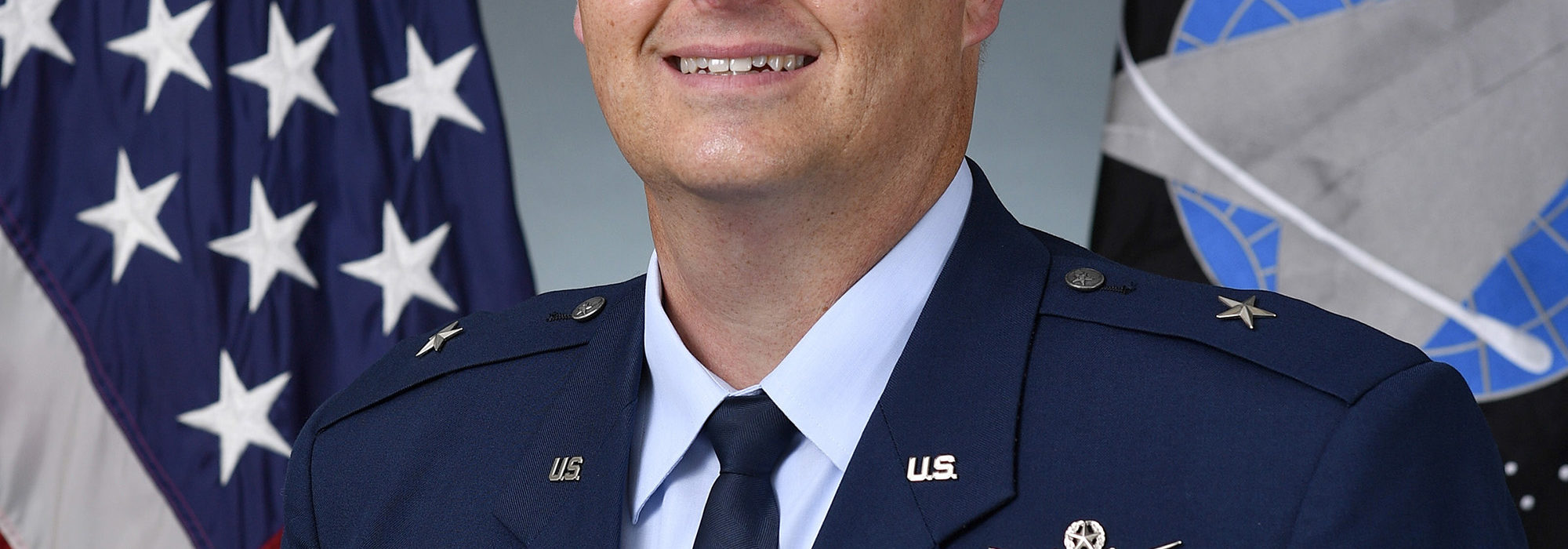
Brig. Gen. Steven Whitney will head the space acquisitions office until an assistant secretary for space acquisition and integration is named. Eric Dietrich/USAF
Photo Caption & Credits
Space Force Shakes Up Acquisition Again in Effort to Achieve Efficiencies
Audio of this article is brought to you by the Air & Space Forces Association, honoring and supporting our Airmen, Guardians, and their families. Find out more at afa.org
The Space Force confirmed that it will reorganize space acquisition and space policy authorities starting Oct. 18 in an effort to streamline decision-making in line with Air Force Secretary Frank Kendall’s plan announced in August.
As first reported by Breaking Defense on Oct. 15, the Department of the Air Force described a plan to break out space policy from the as-yet unnamed space acquisitions chief. The move would reduce the number of personnel required to sign off on policy decisions by transferring space policy to the Chief of Space Operations and the Secretary of the Air Force.
In August, Kendall described his plan to consolidate the Space Acquisition Directorate from the Office of the Assistant Secretary of the Air Force for Acquisition, Technology, and Logistics, or SAF/AQ, into a new organization, Space Acquisition and Integration, or SAF/SQ. Space acquisition policy remains within SAF/SQ, while broader space policy moves to Space Force and responsibility for international affairs shifts to the deputy undersecretary of the Air Force for international affairs, or SAF/IA.
Kendall in August named Brig. Gen. Steven P. Whitney to head the space acquisitions office until an assistant secretary for space acquisition and integration is named. Whitney has managed the reorganization pending the appointment of that new civilian leader.
Congress has for months railed against the slow pace of space acquisitions reform and the absence of a civilian chief. In a July report, the House Appropriations Committee claimed the Air Force was dragging its feet.
“The committee remains concerned that the Air Force has not taken more aggressive action in addressing long-standing space acquisition issues,” the report read.
Lawmakers also said the Air Force had “made little progress in defining what the Space Force will be doing that is fundamentally different than when it was a component of the Air Force.”
On Sept. 20 at the Air Force Association’s Air, Space & Cyber (ASC) Conference, both Kendall and Chief of Space Operations Gen. John W. “Jay” Raymond expressed confidence in the reorganization of space acquisition, even though an assistant secretary had not yet been named.
“We’re actually interviewing people right now for the space acquisitions assistant secretary position,” Kendall said at the ASC media briefing, foreshadowing the office reorganization and personnel movement. “So, it’s moving forward. I’m reasonably happy with the pace.”
Audio of this article is brought to you by the Air & Space Forces Association, honoring and supporting our Airmen, Guardians, and their families. Find out more at afa.org
All of the U.S. military services are pursuing capabilities to complement GPS amid concerns that the constellation is increasingly vulnerable to interference, but a new government watchdog report calls for better coordination and prioritization among those efforts to avoid delays and duplication.
The Space Force has finished transferring the last of the Air Force Reserve and Air National Guard members covered by the Personnel Management Act that created a hybrid full-time/part-time force.
Northrop Grumman has broken ground on a major new production facility for the B-21 Raider, the company and the Air Force announced Oct. 6. The construction comes as a top service official said testing on the bomber is going well in the lead up to its planned introduction into the…
After scrapping a long-delayed program to build a next-generation GPS ground system earlier this year, the Space Force and prime contractor Lockheed Martin are pushing toward delivery of the capability in time to support the first launch of the newest GPS satellites, currently planned for 2028.
The Space Force is looking for industry feedback on its plans to create a new “Mission Development Zone” at Vandenberg Space Force Base, Calif., to support launch providers with space for additional payload processing capacity, test and assembly facilities, and potentially rocket and spacecraft manufacturing infrastructure.
Northrop Grumman’s Talon Blue YFQ-48A Collaborative Combat Aircraft took its first flight Oct. 3, heightening the competition for the Air Force’s future combat fleet.
The Space Development Agency is set to launch 21 Tranche 1 data transport satellites on Oct. 5—its fourth Tranche 1 mission since last fall and the first to carry Northrop Grumman-built satellites.
The Air Force adjusted its fiscal 2026 recruiting goal down by a few hundred enlisted Airmen due to higher-than-expected retention and the number of available training slots—but it is aiming high in fiscal 2027 with its biggest goal for the Active-Duty Air Force in nearly 25 years, and the Space…
Some lawmakers in the Senate are advocating for a more bipartisan approach to paying for the Pentagon’s $185 billion Golden Dome missile defense project, arguing that the effort’s goal of bolstering homeland defenses has support across ideological lines but the process for funding it has been politically charged—leaving the program’s…
✓
Thank You!
Check your inbox to verify your email address and finish setting up your AFA account.
★
Welcome Back!
An account with this email already exists. Please log in to continue.
Subscribe to the Air & Space Forces Daily Report
The latest news from Air & Space Forces Magazine, as well as news from other leading publications, delivered right to your inbox every morning!
We’re sorry, there has been an error. Please review your input or try again later.