
AIR FORCE ACADEMY, Colo.—
It’s 0459, and Cadet 1st Class Abigail Anderson is already outside the door, hands poised, ready to pound. Up and down the hallway, at every door, other cadets mirror her stance.
As 0500 hits, the yelling and pounding begin. “Get up! Rise and shine! Shave your face! Make your bed!”
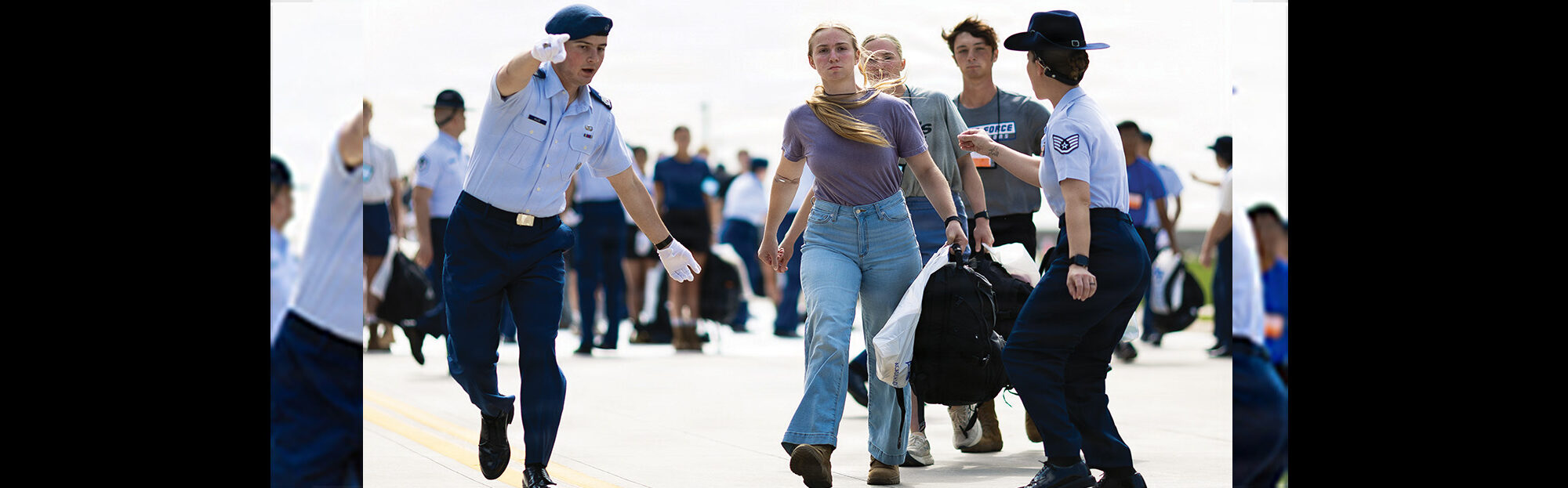
It’s morning at the U.S. Air Force Academy, and Basic Cadet Training (BCT) is underway.
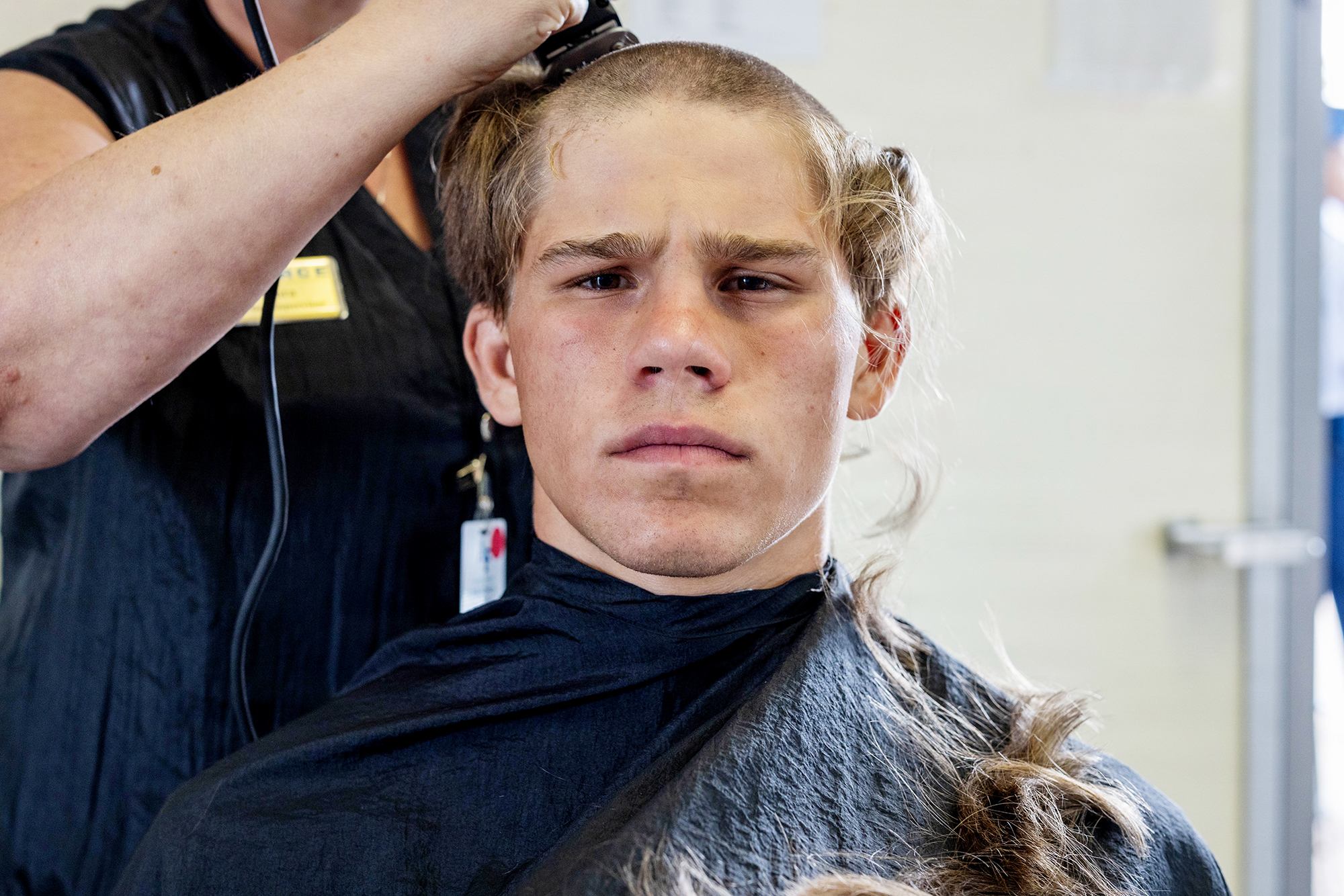
Inside the dorm rooms, 1,163 members of the Class of 2030—17- and 18-year-olds just a few weeks out of high school—scramble to make their beds, wash themselves, and don blue workout shorts, gray T-shirts, red caps, and CamelBaks. Their elder cadets—cadre in USAFA parlance—keep up their harangue until all the newbies are assembled in flights of 20 to 30 before them.
Some basic cadets woke up early to get a head start before the chaos, but with cadre always on the lookout, such resourcefulness can be costly. Knowing sleep is a precious resource, they sometimes confiscate the basics’ watches to ensure they sleep.
With the flights formed, cadre launch into correcting cadets’ appearance and issuing instructions for the day ahead. When the BCT commander and cadet group commander pass in review, each basic cadet must yell in turn “Good morning, Col. Sarah J. Brehm! Good morning, Cadet 1st Class Sarah M. Price!”
Every error prompts a correction: Price blasts one cadet for not having his socks pulled up properly; Brehm notes a flight got her middle initial wrong.
DISCIPLINE AND FITNESS
The first half of BCT is about discipline: early wakeup calls, PT, march and drill, customs and courtesies, and the bureaucracy of distributing uniforms and equipment.
The second half, at the Jacks Valley complex a few miles away, tests the basic cadets physically and mentally through a series of crushing obstacle courses and scenarios famed among Academy grads. The six-week program ended Aug. 5 with the Acceptance Day Parade, when the basics are formally accepted into the Cadet Wing and become cadets fourth class.
“Our mission is to turn all … of these basic cadets from civilians into military members. That is a daunting feat.”
—Cadet 1st Class Sarah Price, BCT commander
BCT is Basic Military Training for cadets, a rough equivalent to the training given to the enlisted force. Indeed, military training instructors from BMT actually roam BCT’s morning formation, and BCT cadre visit Joint Base San Antonio-Lackland, Texas, to observe the instructors in their element at BMT.
And like BMT, BCT is an institution unto itself. Many in the “Long Blue Line” fondly recall memories from their time as basics, the trauma-bonding that forges deep friendships with their classmates and the common bond of overcoming the same challenges as their forebears. Many of the cadre who spoke to Air & Space Forces Magazine cited their own experiences in BCT as their motivation for returning to help lead it.
“Our mission is to turn all … of these basic cadets from civilians into military members,” Price said. “That is a daunting feat. It is also a great responsibility, because we are teaching them on military standards, teamwork, knowledge, and truly getting them to appreciate what our profession of arms is.”
Yet BCT is not static. Price and other cadet leaders have been working for months to craft their specific vision for this summer’s program, a vision informed by larger Air Force changes.
After the 0500 wakeup, cadets assemble on the Academy’s “Terrazzo,” divided into eight squadrons: Aggressors, Barbarians, Cobras, Demons, Executioners, Flying Tigers, Guts, and Hellcats. Each has five flights, designated alpha, bravo, charlie, delta, and echo.
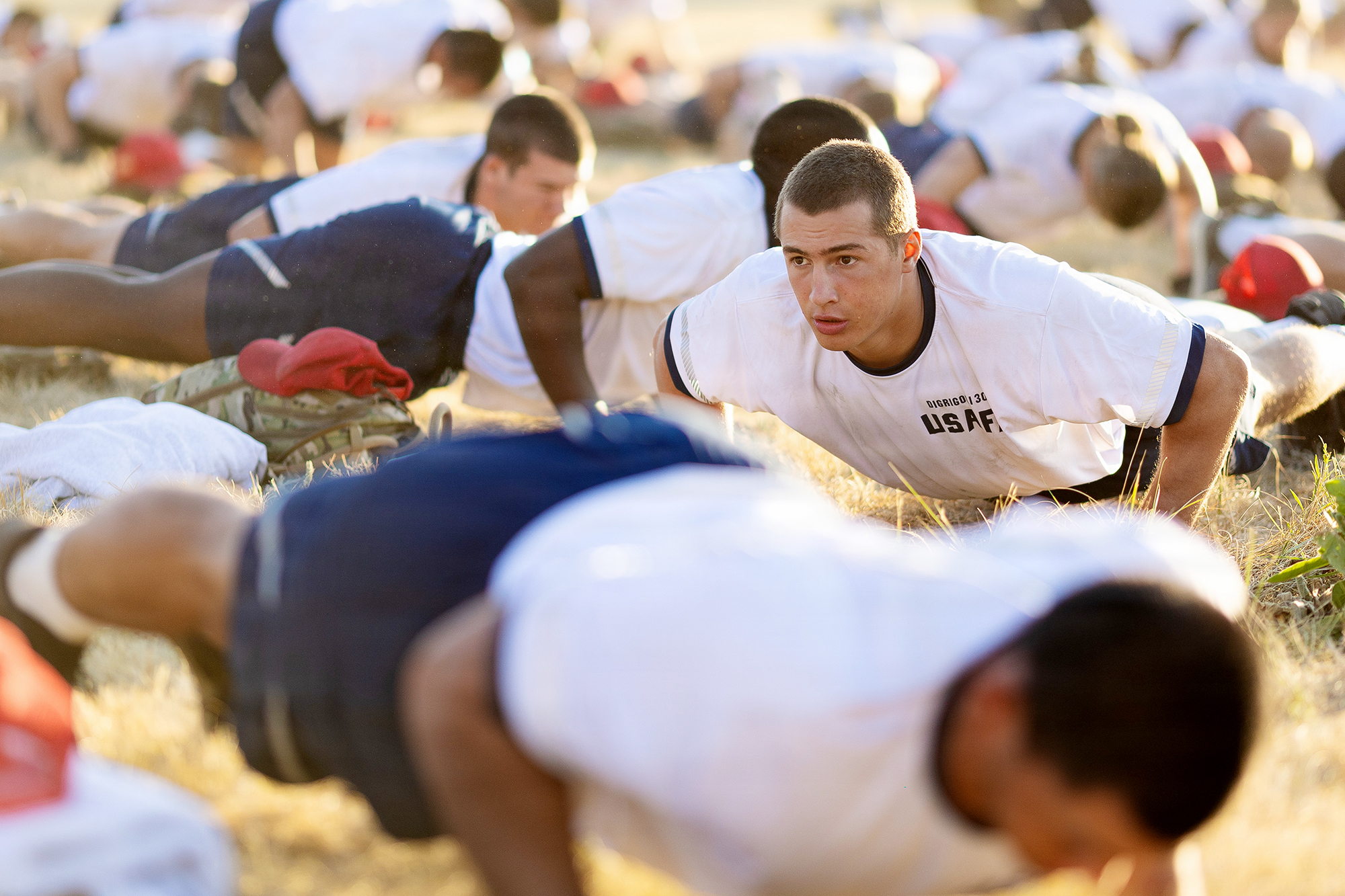
After a brief inspection and the raising of the flag, warmups begin. This year, PT time was extended from 60 to 90 minutes per day—matching BMT.
“We’ve increased our PT duration and intensity to try to align with some of that broader military intent coming from the Secretary of War, our superintendent, all the way down to us,” Price said.
But more time doesn’t mean more situps or pushups. Cadets go through a series of detailed exercises led by instructors and cadets from the Academy’s Physical Education Department—among them All-American gymnast Maggie Slife.
More warmups, recovery time, and sophisticated exercises are becoming hallmarks of Air Force PT, with the aim of minimizing injuries. Cries of “Hydrate!” punctuate the morning workout.
Price and Brehm join one half of the cadet group as they embark on a multilap run around the Academy’s parade grounds, cruising past the junior cadets who are still adjusting to the thin mountain air—7,200 feet above sea level. Calling out, they urge the basics to keep moving.
WARRIOR SPIRIT
“Our main charge is to up the intensity,” Brehm said of her summer training mission.
Price added that the work started months ago. “We looked at the incoming classes that we’ve seen, and we asked ourselves what we think we need,” Price said. “What we believe we needed as a vision was re-grounding ourselves in our Air Force and Space Force core values.”
The team came up with “enhanced” evaluations to imbue uniform standards and customs and courtesies, and added a new requirement that newbies learn the Constitution, Price said. And to keep the basic cadets from getting too comfortable, the cadre swap out halfway through BCT, shaking things up.
Commandant of Cadets Col. Brandon Tellez, who arrived this spring, said the key is to maintain intensity without letting it become destructive.
“My number one job right now, as I’ve been going around and watching everything, is to look at the attitude and the intent of all of our cadre and how they’re approaching the engagements with these young basic cadets, making sure that you don’t fall into the ‘payback mode’ or ‘this is what happened to me,’ kind of thing—and make sure we never get close to that,” Tellez said. “Thankfully, I can tell you, we’re not. … Folks grab this as a marked experience in their cadet career, and want it to be as significant, if not more, for these new arrivals.”
FORWARD, MARCH!
On a mid-July march, Price, deputy commander C1C Natalie Rupp, and Cadet Group Chief of Staff C1C Simeon Rate lead the basic cadets in camouflage uniforms, marching with rifles to Jacks Valley.
This training spot some 4 miles from the main cadet area has played a key role in BCT since 1966. Today, Jacks is one part expeditionary base, equipped with tents, CONEX boxes, and low-slung metal buildings, and one part summer camp from hell. Cadets must overcome a series of courses designed to stress them both physically and mentally.
If their first weeks of BCT gave them a taste of military life, this second part will acquaint them with using those newfound skills in a harsher environment, said Lt. Col. Dexter Webb, commander of Jacks Valley.
“We’re pivoting from, ‘Hey, now you’ve gotten a few weeks under your belt of this is what it means to be in the military,’ to ‘Now let’s go apply those lessons,’” Brehm added.
There’s a “confidence course” to push basic cadets to overcome their fear of heights and an obstacle course to test their endurance. There’s a “leadership reaction course,” where teams of cadets must work together to maneuver through scenarios, and a chamber where cadets are exposed to tear gas in chemical, biological, radiological, and nuclear defense training.
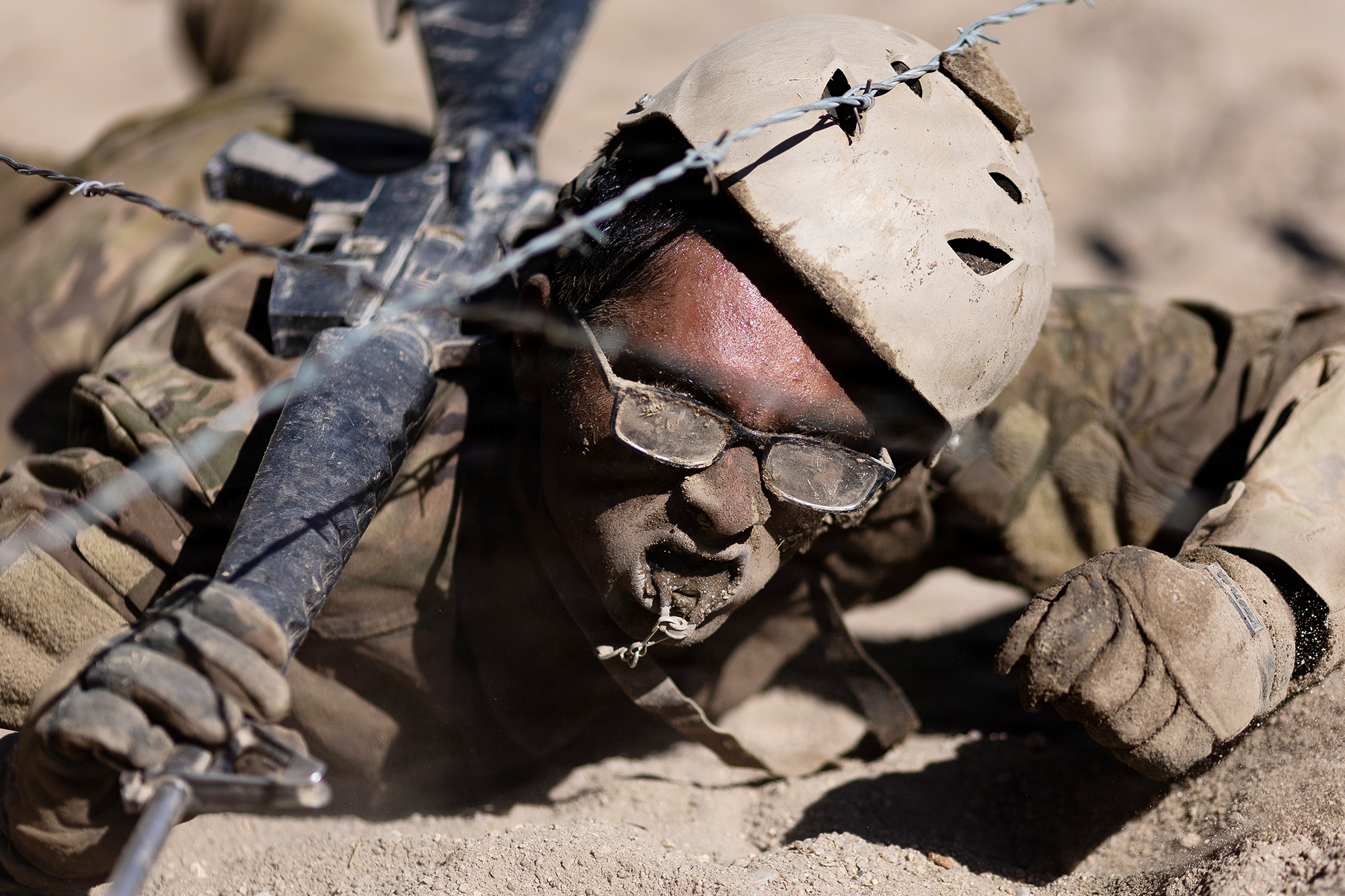
Finally, there’s the famed “assault course,” complete with mud, barbed wire, “air cannons going off, [and] smoke grenades,” Webb said. The Academy features images from the assault course in its promotions, highlighting exhausted basic cadets caked in grime in front of a red sign declaring “ONLY THE STRONG SURVIVE.”
The grueling Jacks Valley courses are enduring, many of them the same challenges generations of cadets have overcome.
“Jacks Valley is kind of that great equalizer—to most of the alumni as well,” Webb said. “Everybody remembers their Jacks experience because probably it’s one of the hardest things they will ever do.”
That does not mean it’s all static: This year, Price said, basic cadets must “complete nearly 100 percent of those courses to pass and enter our cadet wing.” That’s a stricter standard than in recent years, she said.
The Combat Arms Training and Maintenance course requires cadets to qualify on the M4 carbine as well as the M18 pistol—the first time the Academy has required basic cadets to qualify on two weapons.
“That’s all part of getting us forward into the operational skills that we may need in combat,” Price said.
A 24-hour Foundational Expeditionary Skills Training course introduced recently pushes basic cadets to learn how to establish and defend a bare-bones base—similar to tasks given to trainees at BMT.
A “culminating exercise” introduced last year mirrors the Academy’s schoolwide “CULEX” event, making them apply lessons learned over the prior weeks in a series of challenges. Basic cadets awakened that morning with a surprise at 5 a.m., “air cannons and whistles, and a bunch of what you could expect if you were just getting shelled,” Webb said. “Put them in that warrior mindset of ‘all right, it’s real now, you’re disoriented, now you’re going to have to respond, get to your firing positions.’”
Drones flying overhead and simulated red force attackers force them to react and defend their positions while caring for combat casualties.
“This is really cementing the foundation for that warrior ethos for the rest of their time here,” Webb said.
COMBAT SKILLS
On a sunny morning, camouflaged cadets walk in formation across scrubby brown grass when the cry goes out: Get down, there’s a drone! The cadets scatter, ducking behind bushes, and burying themselves in the grass.
Then a bearded contractor from veteran-owned Touchpoint delivers a lesson: The drone is overhead, so look up—and next time, hide yourself more strategically.
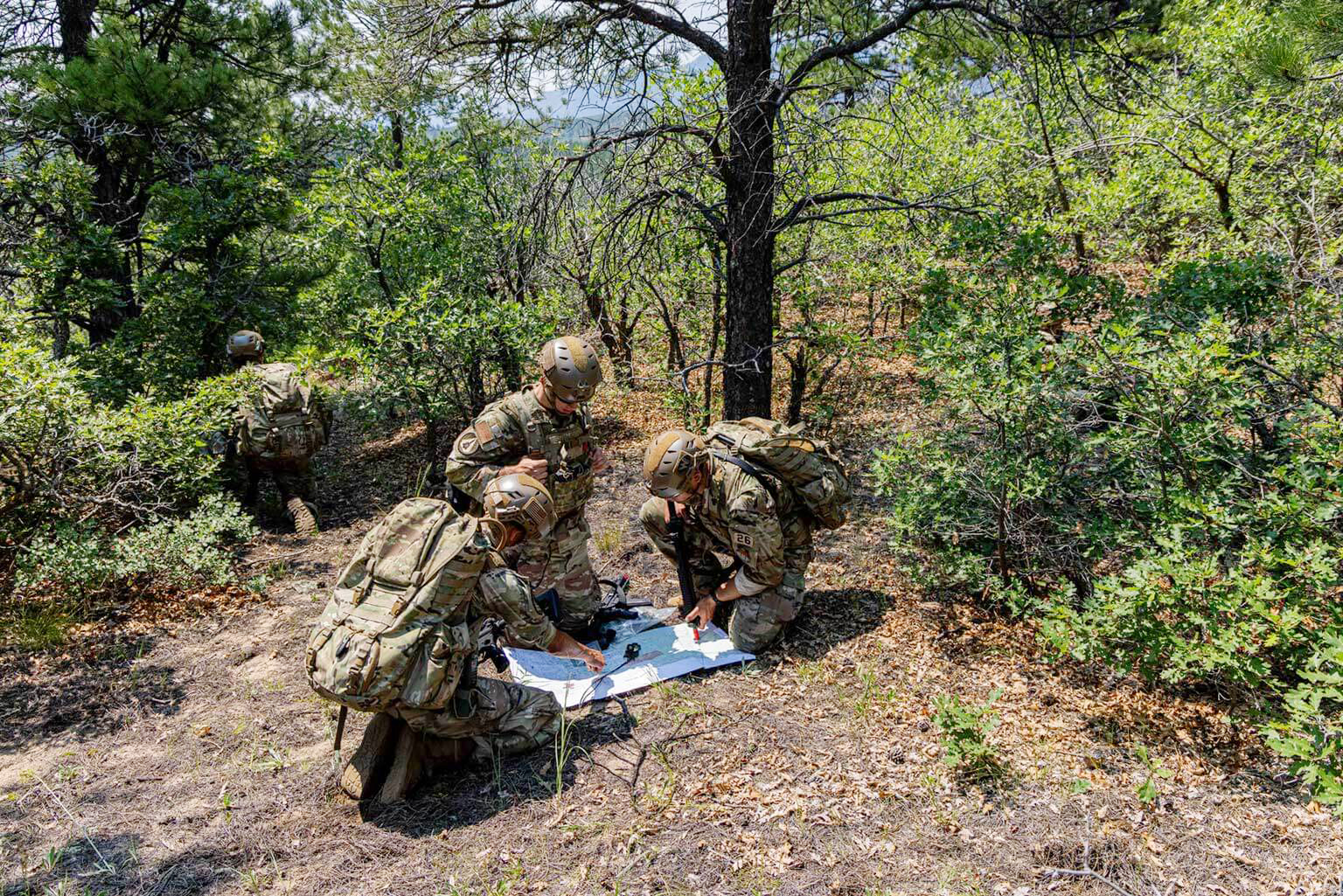
A new Combat Skills Group now imparts the basics of survival, evasion, resistance, and escape (SERE) training to cadets, along with combat-casualty care; small unit movements and tactics; and countering small drones.
Former USAFA Superintendent Lt. Gen. Tony D. Bauernfeind, who retired Aug. 7, at the end of the summer training period, explained the objective: “We’re not trying to create Soldiers,” he said. “We’re creating joint warfighters.”
Giving all cadets a taste of combat fundamentals gives them more perspective on how to support and lead ground operations, said Tellez.
“It’s really wild that this is now bread-and-butter experience that these guys are getting,” said Tellez, a 2001 Academy grad. “When they walk into the larger service—not just the Air [Force] and Space Force, but how that integrates into the joint force—the vocabulary we are giving them, layered with the experiences to actually bring those words to life is immeasurably valuable,” said Tellez.
The newest of the combat skills courses is the Cadet Warfighter Advanced Course, required for all rising sophomores (cadets 3rd class). CWAC replaces the former Combat Survival Training class, which taught cadets the basics of SERE. The new program is richer.
“They get to go out and spend five days in the field, where they sleep overnight,” explains C1C Kaleb Abouelghar, the cadet commander of the Combat Skills Group. “They’re given three MREs, and they have to survive, basically.”
It’s an introduction to the privations aircrew could face in combat, as in April when an F-15E crew dubbed “DUDE 44” was shot down over Iran, requiring rescue.
“They were using the exact skills that we’re teaching now,” Abouelghar said. “In order to survive and get home, they are using ridge lines and different isolated personnel techniques in order to stay low-observable and to stay alive.”
The course includes combat search and rescue, using the AN/PRC-163 Multi-channel Handheld Radios to call in airstrikes, and dealing with mass casualty events.
Contract instructors—typically former military special operators—help oversee the training but most of the oversight is led by cadets in another course: the Cadet Warfighter Instructor Course (CWIC). Launched last year with the help of Active-duty Army Green Berets, CWIC is a next-level version of the “basic warfighting” skills course known as CWAC. Reinforcing those skills, it also teaches upperclassmen how to be instructors and how to staff a Tactical Operations Center (TOC), including briefing, commanding, and controlling all the action necessary to make CWAC work.
Previous classes weren’t exposed to these challenges, Tellez said. “I was a very successful, aggressive fighter pilot, leader, joint warfighter for a decade and a half,” Tellez added. “It wasn’t until I was a junior major that I could even spell TOC.”
Cadets who complete CWIC earn an “instructor” tab. In addition to helping to guide CWAC, it will also help shape the military training cadets get during the academic year, Abouelghar said.
Between running a TOC or teaching a small unit, the idea is that cadets will gain a better understanding of how they can fit in and lead joint forces, regardless of where their career takes them.
“A lot of our cadets are going to work in career fields where they’re working with our other forces, and that’s one of the things that makes us so strong,” Abouelghar said. “And so instead of having to learn on the job and figure out what all these different things mean for joint functions, they’re able to learn now, so that way they have a better understanding when they commission.”
A third Combat Skills Group course, the Special Warfare Orientation Course, is for cadets interested in special warfare careers with more exposure to the skills they will need in those fields.
In addition to the “shoot, move, and communicate” basics and combat-casualty care, another combat skill USAFA wants every cadet to develop is drone operations.
“Our goal is to get every single cadet to have hands-on [experience with] as many drones as we can,” Abouelghar said. “We have about 60 to 70 drones that we’re flying nonstop, that we’re making sure that our cadets are all getting their hands on and getting experience with them.”
Cadets can learn to fly the small, inexpensive quadcopters in a day or two and then quickly demonstrate to other novices. Controlled using digital tablets, the drones are easy to fly and increasingly familiar to a generation that’s grown up with similar tech.
How cadets use these drones in the Combat Skills Group’s courses will evolve, leaders say. Automation will eventually be introduced, and CWAC Commander Maj. Edgar D. Acosta and Abouelghar expect the training will improve each year as cadets experience the classes and graduate into leadership roles, where they can refine the courses over time and build on their own experiences.
FLYING HIGH
The Air Force Academy has operated gliders since the 1950s, and today boasts the largest glider program in the U.S., with more than 15,000 flights annually—almost entirely led and managed by the youngest instructor pilots in the Air Force. And now it’s getting bigger as USAFA aims to get every one of its cadets serious time in the air.
The new push echoes the “Soar-for-All” program in the 1970s, when every cadet got time in a glider. More recently, about half of every class—500 to 600 cadets—has gotten to take basic soaring, according to Lt. Col. Curtis Holtman, commander of the 94th Flying Training Squadron here.
USAFA also has a powered flight program, flying T-53A Kadett IIs; in recent years, about two-thirds of cadets participated in one or the other.
To get everyone airtime is the aim of “Airmanship for All.”
“Three years ago, we were sitting right around 300ish cadets coming through,” Holtman said. “We’ve incrementally scaled that over the last two years to we’re heading into fiscal year ’27, we’ll push over 500 to 600 cadets through our basic soaring program.”
Changes to the syllabus helped, as did “access to cadet time, operating hour increases,” Holtman said. “We can absolutely get to the 800 to 1,000 cadet throughput mark. If we can get to Airmanship for All through the soaring program, that is our end state objective.”
Each participating cadet gets eight flights—what study shows is needed for cadets to get comfortable in flight.
Those who go on to be instructors get far more. After completing basic soaring, some 70 to 80 percent apply to be instructors, a process that includes an interview and requirement that they demonstrate their teaching style. Here, anything goes: One cadet taught the board to change a diaper; another how to use a yo-yo.
Out of hundreds, the best 60 are selected to earn their “G” wings—gliders who can pull 5Gs or more in certain maneuvers—and over the course of their careers they will fly hundreds of times. C1C James Callaghan estimates he has made more than 300 glider flights to date.
To get every cadet flying time, Holtman said USAFA will need to increase its ranks of IPs (instructor pilots) by at least 10. IPs get more than air time. They get a real taste of squadron operations, rotating through leadership positions and conducting morning safety briefs, running the step desk, and more.
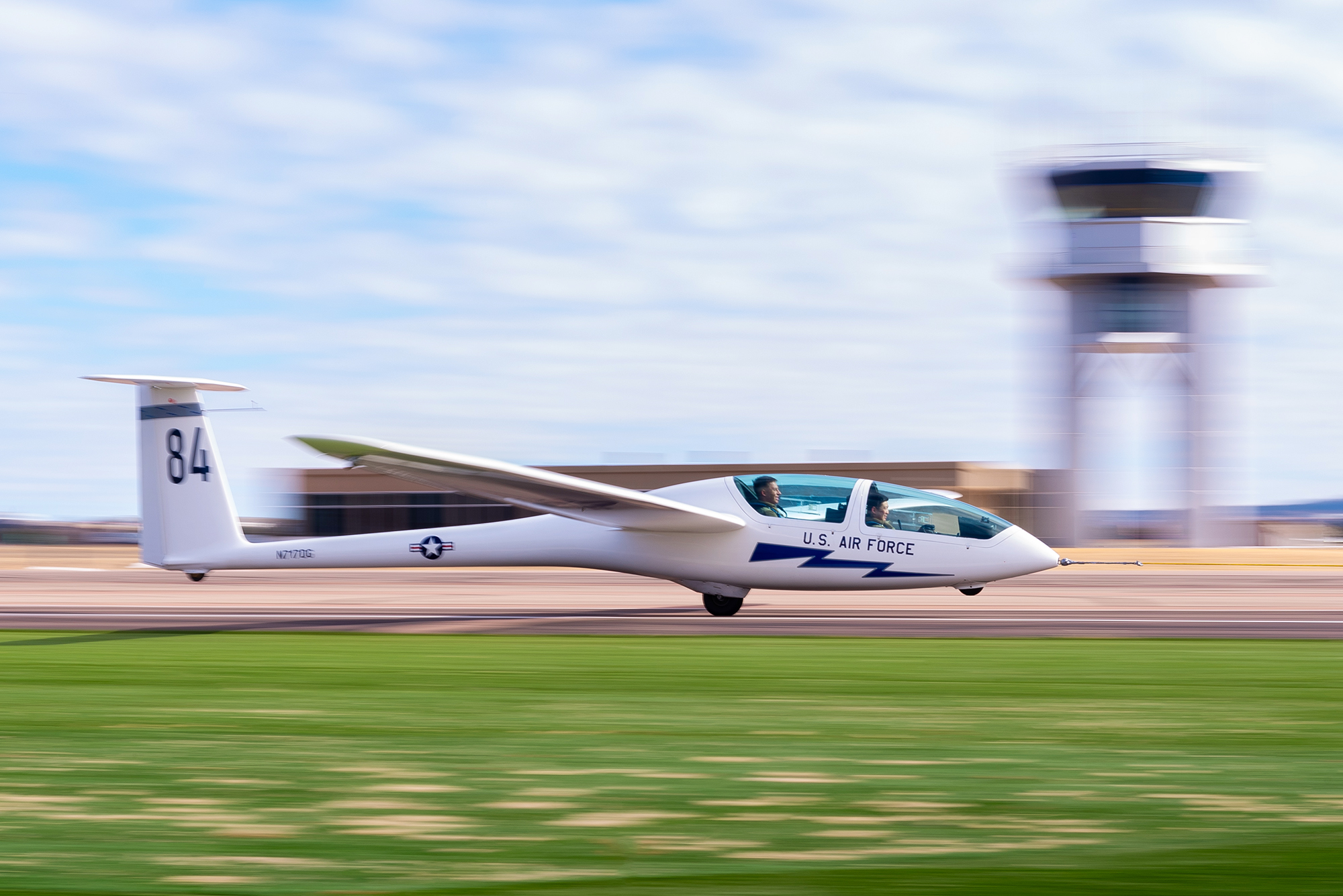
“Everything you see in this facility is what they are going to go see as soon as they go fly gray tails,” Holtman said.
Simulator time is another standard. The simulators here are the same immersive trainers used in undergraduate pilot training, incorporating virtual-reality headsets and controls that mimic the real cockpit.
AIRMANSHIP
Academy instructor pilots go on to bigger things. The 94th Ops Building halls display memorabilia from glider fliers who went on to become Thunderbird pilots, general officers, and astronauts. The skills they develop there can last a lifetime.
“I think gliders are unique in that they really do build situational awareness and energy management, which are things that we’re going to use throughout a career, no matter what platform we end up flying on when we graduate,” Callaghan said. “Those are values that take practice to build, and my bubble for both of those has increased exponentially. And then, on top of that, being an instructor pilot and being able to talk through your flying and get someone that has never touched an airplane before to basically learn how to fly has really helped with my communication skills.”
Not that flying a glider is the same as a powered aircraft, C1C Joseph Fitzsimmons said, but flying demands “soft skill and hard skills,” and gliders give cadets a jump start on the soft skills.
“The air awareness, the air-mindedness, the task management skills, all of those are baked into us now, and we will be able to carry that into whatever experience we have in the Air Force, whether it’s aviation or just leading Airmen,” Fitzsimmons said.
Adding glider time won’t solve the number of aircraft the Air Force has or change the number of pilots it can train. There are only so many slots for pilots, air battle managers, and combat systems officers. USAFA’s class of 2026 sent 53 percent to rated career fields, and 47 percent to nonrated roles.
Regardless of their future careers, what they get out of flying gliders is unique, Callaghan said. “I would argue that it is the most pure form of flying,” he said. “Truly, you feel every bump of air, every input of the stick, every move of your rudder—you feel everything.”
On the windy edge of the Rocky Mountains, handling the glider requires vigilance and constant adjustment—even flying while attached to the tow plane requires focus and touch.
Soaring in the thin air, it’s silent—no engine roar, no ear-splitting whine—and endless opportunity for maneuver. Glider fliers don’t just pull Gs, they learn to perform aerobatics, with some going on to compete nationally. USAFA cadets regularly bring home national championships.
The aerobatics lessons figure in at the tail end of the eight sorties in the basic program—as do sick bags, which are there just in case for cadets (and visiting reporters) who can’t quite stomach 5 Gs.
“You feel everything about flying and build such an intimate connection with aviation,” Callaghan said. It’s “flying in its purest form.”
END OF SUMMER, NEW YEAR
Summer officially ended at USAFA on Aug. 1, with all cadets required to report to campus by 7 p.m. The next nine-plus months will be a whirlwind of classes, studying, athletics, and extracurriculars.
Summer is a unique time to focus almost entirely on military training, unconstrained by competing academic, sports, and extracurricular priorities, many cadets said. But military training never stops. On “Silver Saturdays,” cadet squadrons hold training events, and two major exercises—a “Validation Exercise” in the fall and a “Culminating Exercise” in the spring—incorporate the entire cadet wing.
Bauernfeind, a few weeks before his retirement ceremony, said in an interview that a central goal during his tenure was to inject more of the summer’s intensity into the academic year.
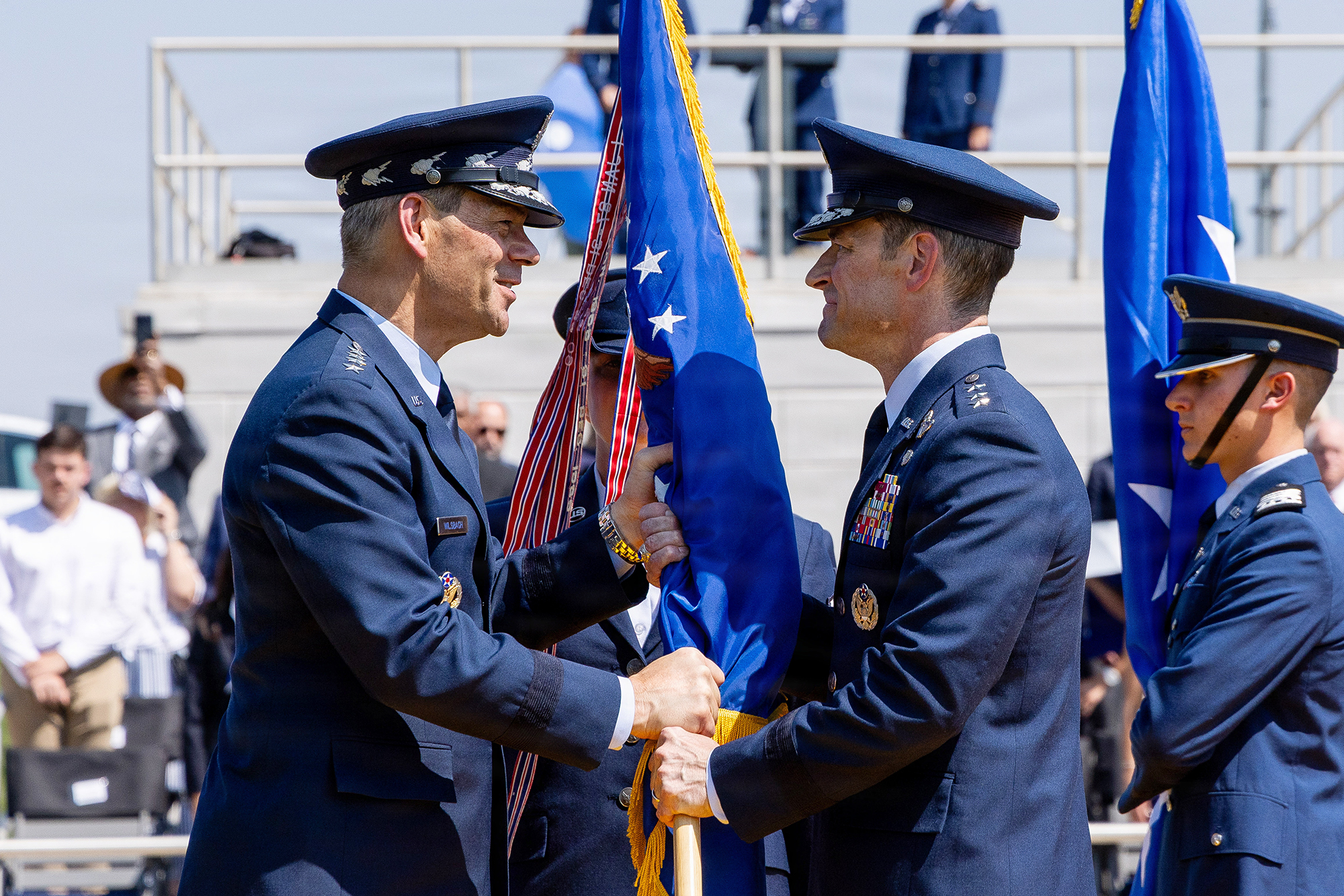
“Our goal is to empower cadets to take ownership of year-round military training,” he said. “Our cadets are not only up to the task, but they are actively hungry for even more responsibility. In some cases, we’ve actually had to temper their enthusiasm a bit because their drive to lead is so strong.”
Bauernfeind retired a few days into the academic year, succeeded by Lt. Gen. Paul D. Moga, who previously led military training at USAFA as Commandant of Cadets. In that role, Moga reinstituted Combat Survival Training, which eventually grew into the CWAC, and started the “culminating exercise,” the
CULEX, that Bauernfeind expanded to include the entire wing.
At the change of command where he became USAFA’s 23rd Superintendent, Moga pledged to “honor our history and our heritage—while ruthlessly preparing our graduates for the future fight.”
