
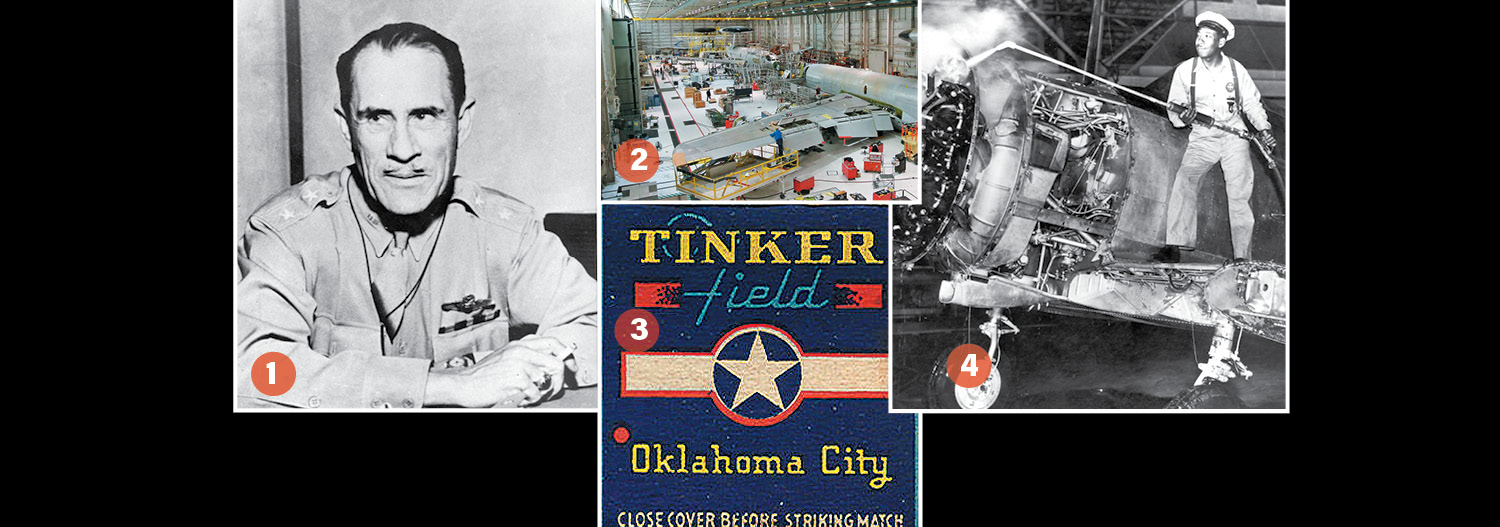
Osage Air Warrior
For a military airman, Clarence L. Tinker’s life was unusual. He was born not in a US state but in the Osage Nation, closer—in time—to Custer’s last stand than to Kitty Hawk. He didn’t receive his wings until age 33.
Even so, he became a an illustrious American general, played a key role in World War II, and died a heroic airman’s death.
Tinker’s birthplace—Pawkhuska—is in modern Oklahoma. In 1887, it was part of Indian Territory. Young Clarence, one-eighth Osage, was raised Osage and spoke the Osage language.
An admirer of Osage scouts in the US Cavalry, Tinker entered Wentworth Military Academy. He graduated in 1908 and joined the Philippine Constabulary. In 1912, he was commissioned into the US Army, serving in infantry units in the Southwest.
For Tinker, World War I showed the future lay in aviation. In 1919, he began flying lessons. In 1920, he transferred into the Air Service. He was awarded his wings and entered flight duty in 1922.
The newly minted air officer steadily advanced. He became assistant military attaché in London (where he saved a pilot from a burning aircraft), a member of the Air Corps Chief’s staff, commandant of Air Corps Advanced Flying School in Texas, and Chief of Aviation, National Guard Bureau, in Washington, D.C.
In the 1930s he commanded pursuit and bombardment units in California, Louisiana, and Florida. His style was described as “tough, taciturn, quietly humorous, and deeply earnest.”
Tinker, promoted to brigadier general on Oct. 1, 1940, anticipated war in the Pacific and devised plans for the defense of the Panama Canal. After the Dec. 7, 1941, attack, the Army sacked the head of Hawaiian Air Force (HAF) and installed Tinker.
The new man immediately forced a rapid reorganization of HAF for defense of the islands and offensive operations against Japan. In early 1942, Tinker pinned on his second star, thus becoming the first Native American ever to attain that rank.
Tinker always contemplated using HAF bombers offensively against Japanese naval forces. For six months—from Pearl Harbor to the Battle of Midway—he worked to acquire aircraft and personnel for the task. This preparation played a key role in the decisive US victory at Midway, June 3-7, 1942.
The last day of that battle saw Tinker take command of a bomber mission to Japan-occupied Wake Island. Shortly after takeoff from Midway, Tinker’s LB-30 Liberator spun out of control and plunged into the ocean, killing all 11 crew members. No bodies were recovered.
In an unprecedented move, the Army almost immediately renamed Oklahoma City Air Depot “Tinker Field.” This was at the personal request of Gen. Henry H. “Hap” Arnold, commander of US Army Air Forces.
Today, Tinker is home to USAF’s Oklahoma City Air Logistics Complex, the largest of three depots in Air Force Materiel Command. It provides the depot-level maintence for B-1B and B-52 bombers, KC-135 tankers, and E-3 AWACS aircraft, among other types.
Clarence Leonard Tinker
Born: Nov. 21, 1887, Pawhuska, Osage Nation, Indian Territory
Died: June 7, 1942 (MIA), near Midway Island
College: Wentworth Military Academy, Missouri
Services: Philippine Constabulary (1908-12); US Army Infantry (1912-22); Army Air Service (1922-26); Army Air Corps (1926-41); Army Air Forces (1941-42)
Occupation: US Military Officer
Main Era: World War II
Years Active: 1908-1942
Combat: Pacific Theater
Final Grade: Major General
Honors: Distinguished Service Medal (posthumously); Distinguished Flying Cross (post.); Purple Heart (post.); Soldier’s Medal
Tinker Air Force Base
State: Oklahoma
Nearest City: Oklahoma City
Area of Main Base: 8.6 sq mi/5,500 acres
Status: Open, operational
DesignatedMidwest Air Depot: March 21, 1941
Opened/Renamed Oklahoma City Air Depot: March 1, 1942
Renamed Tinker Field: Oct. 14, 1942
Renamed Tinker Air Force Base: Jan. 13, 1948
Current Owner: Air Force Materiel Command
Former Owners: Air Force Logistics Command (and predecessor organizations)