
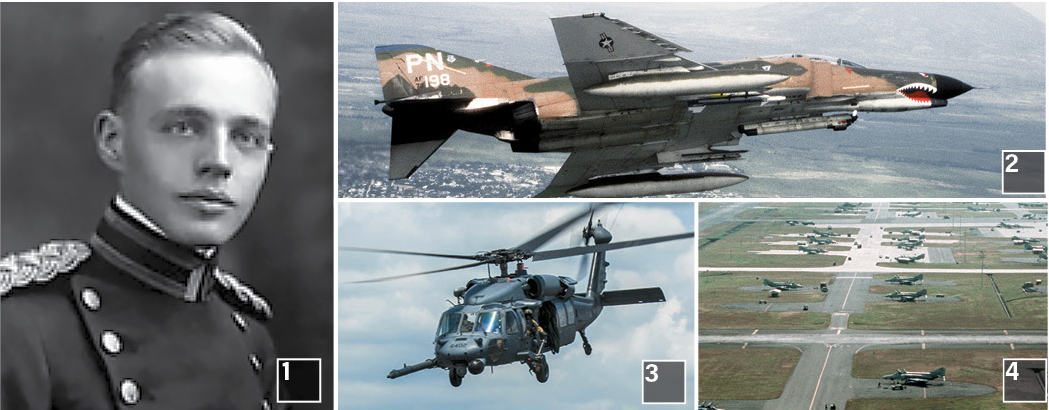
Wings Over Hawaii
Had history taken a logical course, there never would have been a Clark Field in the Philippines. It would have been built in Hawaii. Sometimes, though, history isn’t logical.
Take the case of Harold Melville Clark, born in St. Paul, Minn., to a family of deep military traditions. Clark’s own father, Charles, fought Spanish forces in the Philippine Islands in the Spanish-American War of 1898. At war’s end, however, he did not go back home. He stayed to seek his fortune.
Successful business ventures brought him wealth and prestige. In 1904 he moved his entire family to Manila. Harold graduated from American High School in 1910 and returned to the States.
In 1913, the younger Clark entered the Army and was commissioned a second lieutenant of cavalry. Clark was restless, however, and he soon sought a transfer into the Aviation Section of the Signal Corps, formed in 1914.
Clark’s request was granted, and in 1916 he began flight training at North Island Flying School in San Diego. He received a rating of Junior Military Aviator in 1917. Clark joined the pioneering 1st Aero Squadron in Texas. He flew missions from Columbus, N.M., Kelley Field, Texas, and Fort Sill, Okla.
It was in Hawaii that Clark made his mark. On March 13, 1917, 6th Aero Squadron arrived at Fort Kamehameha under the command of Capt. John Brooks. Clark was part of the 6th and soon became its commander and chief aviation officer of the Hawaii Department.
In Hawaii, Clark focused intently on learning all he could about its unpredictable and trecherous winds. On March 15, 1918, he flew round trip between Fort Kamehemeha and Molokai, about 110 miles over open ocean—the first inter-island flight in Hawaii.
On May 9, 1918, Clark and his mechanic, Sgt. Robert Gray, chalked up another historic flight. They flew from Fort Kamehameha to Maui and then on to the “Big Island” of Hawaii. There, Clark crashed in dense fog. Two days later, the two aviators walked out of the jungle unhurt, having completed the first three-island flight in Hawaii.
At the time, Clark’s accomplishments seemed miraculous.
Clark was recalled to the US and took command of a pursuit wing. He was reassigned to Panama, where his career—and life—ended. He died May 2, 1919, in a seaplane crash in the Miraflores Locks, Panama Canal Zone. He was buried in Arlington National Cemetery.
The Army designated a part of Fort Stotsenberg, near Manila, for aviation usage. In September 1919, it was named “Clark Field.” The reason isn’t obvious, given that Clark was far more closely associated with Hawaii than he was with the Philippines.
For decades, Clark Field (later, Clark Air Base) was the nation’s largest and most famous overseas air facility. It played a vital role as a USAF fighter base in the Korean and Vietnam Wars. The eruption of nearby Mount Pinatubo and Filipino nationalism forced the US to withdraw all of its forces in 1991. Today, it is the site of Clark International Airport.
Harold Melville Clark
- Born: Oct. 4, 1890, St. Paul, Minn.
- Died: May 2, 1919, Panama Canal Zone, US Territory
- Education: American High School, Manila, Philippines
- Service: US Army, US Army Signal Corps (Aviation), US Army Air Service
- Occupation: US Military Officer
- Main Era: World War I
- Years Active: 1913-19
- Combat: None
- Final Grade: Major
Clark Air Base
- Nation: Republic of the Philippines
- Nearest City: Manila
- Area of Main Base: 14.3 sq mi/9,152 acres
- Status: Open (Filipino control)
- Opened: (as Ft. Stotsenburg) Sept. 1, 1903
- Renamed: (Clark Field)Sept. 1, 1919
- Renamed by Japan: (Mabalacat Field) Jan. 10, 1942
- Renamed by US: (Clark Field)Jan. 30, 1945
- Renamed Clark Air Base: May 1949
- Closed by USAF: Nov. 21, 1991
- Current Owner: Republic of thePhilippines
- Former Owners: US Army, USAAC, Pacific Air Forces