Courage in the face of danger.
On March 4, 1976, President Gerald Ford presented the Medal of Honor to the parents of a remarkable hero.
Lance Sijan was born in Milwaukee in 1942. He was big, brash, handsome, and self-confident. In high school he played football (tight end), was a Boy Scout, and starred in two school plays. He received an appointment to the Air Force Academy in Colorado Springs, Colo., and quickly accepted.
As a cadet he continued to play football but never made first string. Moreover, academics were a challenge, so he gave up playing during his senior year to focus on grades. After graduating in 1965, he moved on to pilot training, eventually learning to fly the F-4 Phantom, after which he was posted to Da Nang Air Base in Vietnam. In those days, the F-4 was crewed by two pilots, and newbies like Sijan took the rear seat. It was not unusual for GIBs (“guys in back”) to serve a combat tour, upgrade to the front seat, and then stay for another tour.
On his 52nd combat mission Sijan was flying with his squadron commander, Lt. Col. John Armstrong. Their target on Nov. 9, 1967, was along the Ho Chi Minh Trail in Laos. His Phantom rolled onto the target to release its six bombs, but immediately after the drop a large explosion engulfed the plane. Sijan ejected. Armstrong’s remains were never found.
Sijan came down in rugged triple canopy jungle and karst—limestone rock formations. He had a cracked skull, a compound fracture of his left leg, and a seriously injured right hand. He had two water bottles, but no food. Sijan would later say he was certain the bomb fuzes had malfunctioned, and that his plane had been downed by its own ordnance.
On the ground, Sijan turned on his survival radio beeper and friendly aircraft immediately moved toward the site. Sijan established voice contact with those overhead and was told choppers were inbound. The HH-3 “Jolly Green Giants” were the rescue choppers, manned with pararescuemen, who when over a suspected site would lower a PJ on a penetrator, secure the downed Airman, and hoist him to safety. At the same time fighter aircraft would orbit overhead dropping ordnance on enemy forces in the vicinity. This was always dicey—the enemy knew the Americans would expend great effort to rescue Airmen, so they waited in ambush. Twenty aircraft sent to rescue Sijan were hit by enemy fire over the next two days, one of them going down.
Sijan heard the aircraft overhead, but due to the jungle canopy he could not see them—or vice versa. The Jolly dropped a penetrator, but Sijan was unable to crawl to it. He insisted they not send down a PJ to find him—it was too dangerous. The following day the batteries on Sijan’s radio died, and he was unable to communicate. It was assumed he had been captured.
He had not. The rugged karst was sharp and cut his body to shreds as he tried to crawl. In addition, the ground was covered by thorny vines. He would attempt to cut the vines above his head using his survival knife and then scoot backward a foot. He did this for 46 days. Finally, he managed to crawl onto a muddy road, where he was discovered by an enemy patrol.
He was barely alive. Taken to a local camp, he was fed, given water, and had his clothes changed. Astoundingly, Sijan had no intention of being a prisoner so feigning that he needed help. He lured a guard over to check him, knocked him out, and crawled into the jungle. He was recaptured that same afternoon and severely beaten.
He was then moved to a POW camp near Vinh and thrown in with two other Air Force pilots. They were stunned at his horrible condition, yet in his lucid moments he talked of further escape. He asked his buddies to study the fences and gates; were they secure, could they overpower the guards and get out?
Interrogations were a daily routine, but his cellmates stated that Sijan never gave anything more than his name, rank, and serial number, and was thus beaten—despite his severe injuries. He never stopped talking about escape. Finally, a doctor saw him but simply shook his head. He contracted pneumonia and died within a week.
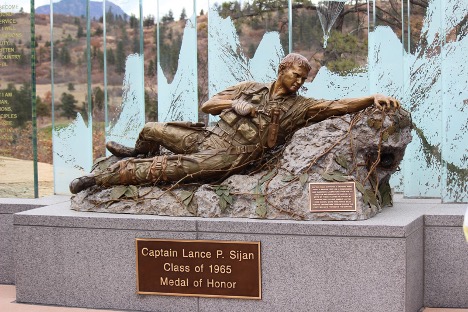
Sijan’s remains were returned to the States following the war and are now buried in Milwaukee. At the Air Force Academy there is a pavilion honoring the 151 graduates who died in Vietnam. The focus of this moving display is a large bronze statue depicting Sijan on the ground, his leg in a splint he had contrived, bleeding and beaten up, but seeking to crawl away to freedom. The magnificent sculpture by Jim Nance is an enduring tribute. Sijan’s incredible tale of courage and honor is told by Malcolm McConnell in “Into the Mouth of the Cat.”