
A Deterring Price of Deterrence
Even among jaded defense program watchers, a trillion dollars is still a sobering number. The defense community in Washington was rendered very sober in November when the Congressional Budget Office, in a new report, added up all the nuclear modernization programs now underway in the Navy and Air Force and concluded that pursuing them all will cost about $1.242 trillion, in 2017 dollars. That figure is about 20 percent larger than calculated under the previous administration, the CBO said.
Of that breathtaking figure, modernization costs—buying replacements for today’s obsolescent nuclear weapons and the secure communications enterprise for their command and control—will cost about $400 million. The other roughly $800 million represents the expense of operating and sustaining them (and modestly upgrading them) over 30 years, including the Department of Energy costs to maintain an enterprise for building and testing the nuclear warheads themselves.
The CBO is billed as a nonpartisan analysis agency.
The report, “Approaches for Managing the Costs of US Nuclear Forces, 2017 to 2046,” offers unusual insight into the dollars attending nuclear weapons, as such numbers have often been kept secret. The $1.2 trillion estimate was predicated on fulfilling the nuclear programs as they were outlined in President Barack Obama’s last defense budget. In case President Donald Trump wants to make revisions, the CBO offered a number of ways that sum could be reduced; chiefly by postponing modernization or eliminating some systems entirely, necking down from a nuclear triad to a dyad. But the CBO found few ways to dramatically reduce the overall price tag.
Due to the rising costs of modernization, the CBO warned that the cost of the nuclear weapons enterprise will rise from about $29 billion annually today to about $50 billion a year in the early 2030s, unless huge changes are made to the plan. The CBO dryly observed that, absent new infusions of cash for the nuclear modernization effort, these programs will compete with conventional programs for funds. This pressure on conventional programs would be additive to the prospect of further budget caps or sequestration, which are already depressing readiness and modernization.
The analysts were hard-pressed to find alternatives that could shave even 11 percent off the cost of upgrading and operating the nuclear enterprise, because no matter what, certain fixed costs can’t be avoided: The DOE nuclear labs have to be sustained, the command-and-control system is a requirement under any scenario, and logistics support must be maintained whether a system numbers 1,500 units or just 50.
Although CBO offered some scenarios that would save money by deferring modernization, those “savings” merely kick the can into a period beyond the 30 years the CBO looked at, with little net change in cost.
List for Shopping or Chopping
The shopping list is long, as some of the nuclear infrastructure dates back at least to the 1980s, while other elements go all the way back to the 1960s and 1970s. All have been patched up over the years, but both the Navy and Air Force say the life-extension programs will soon reach their limit. The CBO laid out the 11 programs required as:
- The new Columbia class of ballistic missile submarine, to replace the 30-year-old Ohio class;
- A new silo-based intercontinental ballistic missile to replace the Minuteman III, along with supporting infrastructure and refurbished silos, which the Air Force has collectively dubbed the Ground-Based Strategic Deterrent (GBSD) program;
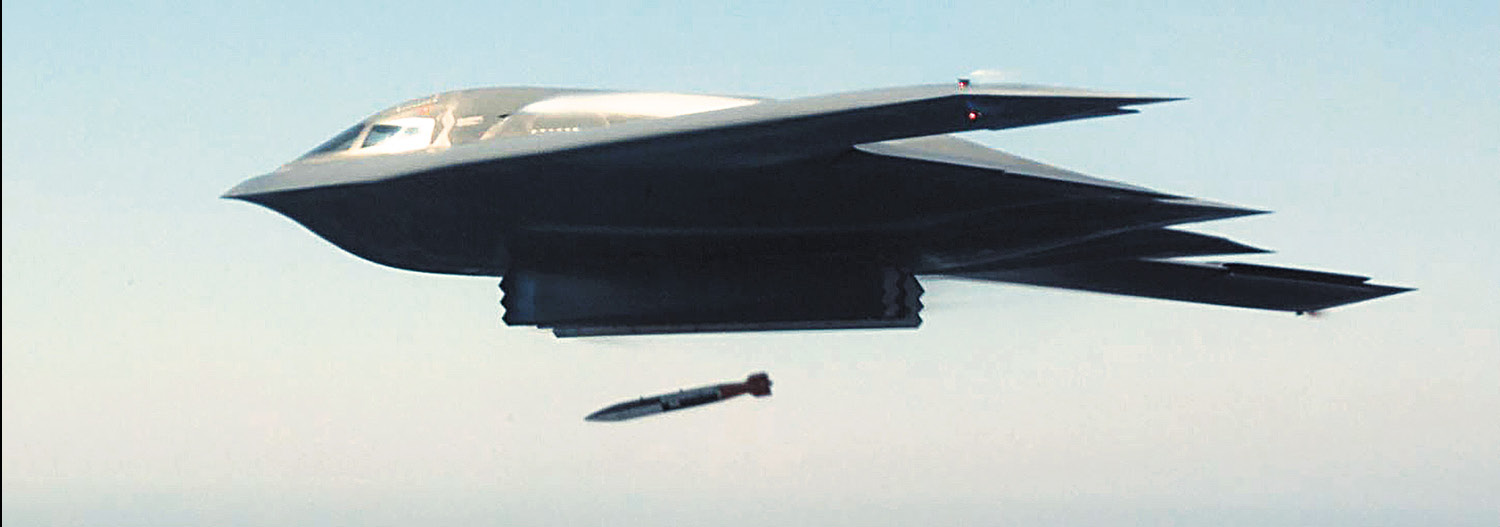
- The B-21 long-range, penetrating stealth bomber;
- Refurbishment of the Trident D5 submarine-launched ballistic missile;
- A new submarine-launched ballistic missile (SLBM) to eventually replace the D5;
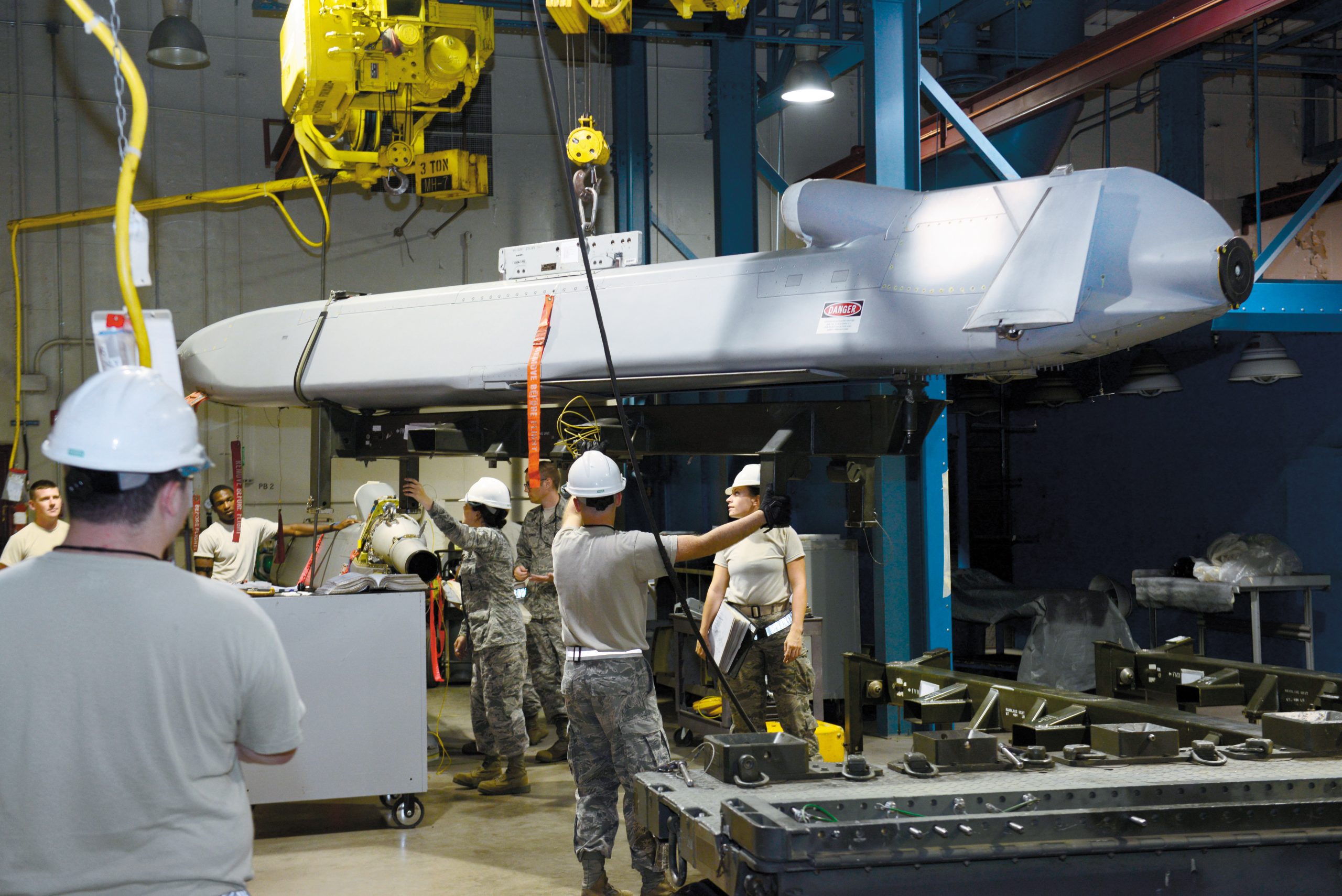
- The Long-Range Standoff (LRSO) weapon, to replace the AGM-86 Air-Launched Cruise Missile deployed on the B-52 bomber;
- Life extension of the B61 nuclear gravity bomb, consolidating several types into the B61-12;
- Life extension of the B61-12 when the time comes, called Next B61;
- Life extension of the W76 and W88 warheads that go on the SLBMs;
- Life extension of the W80 warhead to go on the LRSO; and
- A program to create interoperable warheads that could be used on both ICBMs and SLBMs.
The CBO also noted that the capability to deliver tactical nuclear weapons by fighter aircraft would also be preserved under the existing nuclear modernization plan, requiring the continued development of nuclear bombs of a size and yield suitable for fighter delivery.
Holistically, the CBO pegged the cost of the nuclear submarine leg as the most expensive, at $313 billion over 30 years. Next came bombers, at $266 billion, then the ICBMs, at $149 billion, with another $44 billion for “other nuclear activities.” The tactical nuclear delivery system and weapons would cost $25 billion; weapons labs and associated activities would cost $261 billion, and the command and control and early-warning networks would weigh in at $184 billion.
The biggest savings of all the options CBO looked at could be obtained by eliminating the land-based element of the triad, going to a dyad of bombers and nuclear subs. Such a move would save $120 billion, or 10 percent of the overall nuclear modernization bill. Going to a dyad of sub-launched and land-based missiles—eliminating the bomber element—would save $71 billion, or six percent of the total bill.
(Interestingly, the CBO counted all bombers, all the time, as being a charge to the nuclear mission. It noted that taking bombers out of the nuclear mission would still leave a need for the Air Force to buy at least 80 new bombers for conventional purposes. The Air Force has said it needs “at least 100” B-21s).
Getting rid of all nuclear gravity bombs and not bothering to develop any new ones would save $27 billion, or two percent of the overall cost, CBO reckoned. Reducing the triad to 10 ballistic missile subs with missiles and only 300 ICBMs (vice the 400 now deployed) would save $30 billion, or two percent versus the current plan. Canceling the LRSO would save $28 billion, or two percent of the overall nuclear modernization bill.
The study noted that overall costs could, of course, be reduced further if the US chose to unilaterally drop below the warhead and delivery vehicle agreements under the 2010 New START treaty with Russia, but such a move would be at odds with President Trump’s stated goal to increase the capability of the nuclear enterprise and modernize its elements.
To Go Fast, Crash, and Burn
After years of hanging managers out to dry if something goes wrong, Air Force leaders must now show acquisition specialists they won’t be punished if they try unconventional approaches to speeding the system up … and fail.
Top USAF uniformed acquisition chief Lt. Gen. Arnold W. Bunch Jr. told an AFA audience in October that service Secretary Heather Wilson is willing to trade some setbacks for speed in getting new systems deployed.
Senior leaders must show the acquisition corps “we mean it” when they encourage innovations that will accelerate the fielding of new hardware and software. Managers have to see at least a few examples where “they won’t have their heads handed to them” if they try something innovative and fail, Bunch said. In fact, Wilson has offered to buy the celebratory cake for the first experimental approach that fails, if it nevertheless yields useful lessons about how to go faster, Bunch said.
The service is trying to spread the “culture” of the Rapid Capabilities Office, which is heading up the B-21 program, Bunch noted. The RCO, he said, follows the original Lockheed Martin “Skunk Works” model of using a small group of people with clearly defined goals, the trust of leadership, limited oversight, and a very short reporting chain right to the top of the service. Along with that culture has to be more acceptance of risk, Bunch said. In pursuit of greater speed a “constructive failure” is okay, he said.
Contractors in software have told him that, “ ‘your engineers know exactly what to do [but] your program managers won’t do it.’ That tells me I’ve got to go back and re-look at what’s my reward system, and how we are measuring people, and how we set programs up.”
As an example of how the Air Force is putting its money where its mouth is, Bunch noted that the Long-Range Standoff (LRSO) weapon, the replacement for the 30-year-old Air-Launched Cruise Missile, is getting more funding in the technology, maturation, and risk reduction phase than the new ICBM replacement because of the need to make certain the LRSO is “reliable and available once it gets out to the field.” Historically, he said, similar programs don’t yield the needed reliability and availability, “so we took a different approach, put a lot more money in the [TMRR] phase” so the LRSO can truly be counted on.
Accelerating the CRH and the PGMs
Bunch told the AFA audience the Air Force is hoping to “accelerate” the Combat Rescue Helicopter program and will offer Lockheed Martin’s Sikorsky unit incentives to meet or beat program milestones. If they do, he said, “then … we immediately go into production and buy aircraft at a certain rate.”
He also said the Air Force hasn’t ruled out “any funding option” in acquiring new engines for the B-52 bomber, suggesting that a lease arrangement is under consideration. Speaking of “alternative” financing, Bunch said it would be a hard sell on Capitol Hill because “you’re probably signing people up longer-term for something, and a lot of people are reticent to do that.” A decision was expected late in 2017 as to whether to try that approach, he said.
Bunch noted that the Air Force is rapidly expanding production of precision guided munitions, which have been the preferred weapons in the war against ISIS because of the priority of limiting collateral damage. USAF is upping production of the Small Diameter Bomb I from 5,000 to 8,000 units a year, he said.
The Joint Direct Attack Munition is ramping up to 45,000 and could go as high as 55,000 a year, but Bunch said he doesn’t want the family of suppliers that provide the bomb bodies, bomb fill, guidance tail kits, and other elements to get out of sync with each other. He asked industry attendees to alert him immediately if they know of any potential obstacle to providing any element of the weapon.
Bunch reported, too, that USAF is coordinating higher production of Hellfire missiles with the Army and Advanced Precision Kill Weapon Systems with the Navy.