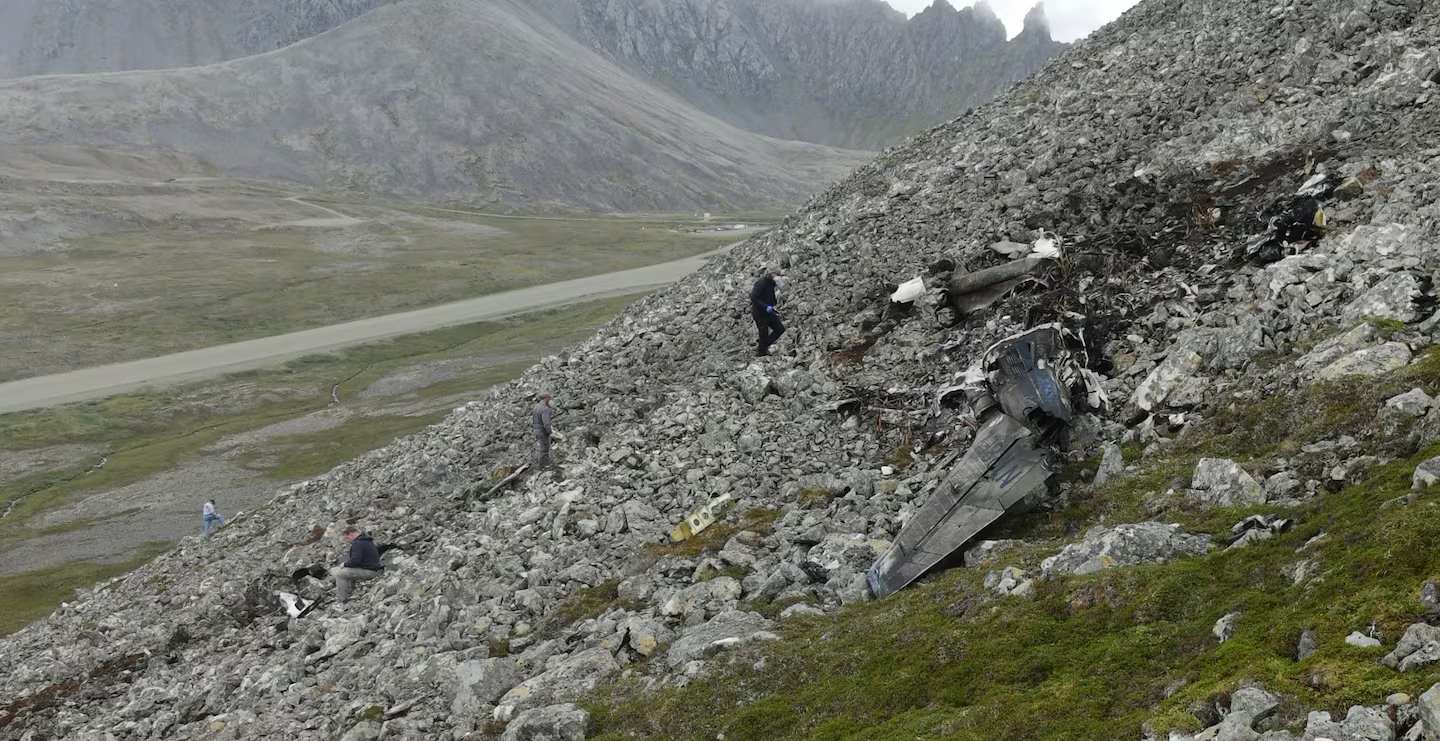


A 23-year-old Air Force civil engineer was among the eight people who were killed in a plane crash near a remote Alaskan radar site last week, officials announced Aug. 24.
2nd Lt. Leah A. Borsich was a member of the 611th Civil Engineer Squadron at Joint Base Elmendorf-Richardson, Alaska, flying on a Cessna 441, which was contracted by the U.S. military, to the Cape Newenham Long Range Radar Site on Aug. 20 when the plane crashed, killing all aboard.
The 611th is part of the Pacific Air Forces Regional Support Center under the 11th Air Force and helps to maintain more than 40 remote or austere radar sites across the region.
Col. Timothey Meerstein, commander of the center, described Borsich as “a positive leader who brought tremendous energy and enthusiasm to our command. She led with professionalism, compassion and purpose, and her presence strengthened the bonds between the people around her.”
According to social media posts and profiles, Borsich was an Ohio native who participated in the Air Force ROTC program while attending the University of Dayton.
The U.S. Army Corps of Engineers also identified two employees as victims of the crash on Aug. 24: Sabrina Hansen and Hayden Scalise, both of Anchorage, Alaska. Officials have yet to release the names of non-Pentagon personnel in the crash.
The Army Corps of Engineers also said in its statement that it had contracted with the air charter company Security Aviation for a flight to Cape Newenham to “inspect and perform maintenance on a new fire suppression system” at the site.
Cape Newenham is part of the Alaska Radar System, a network of 15 remote long-range radar sites and three remote radio sites that monitor Alaskan airspace, particularly for Russian activity. Built in the 1950s to host dozens of Air Force personnel, the site is now run by just a handful of contractors supported by the Air Force.
In an Aug. 21 media briefing hosted by the National Transportation Safety Board, Alaska Region Chief Clint Johnson said preliminary data indicates the crash “happened after one missed approach” as the two pilots had no visibility and were navigating solely using their instruments.
“What we understand is after the second missed approach, Anchorage … lost contact with the airplane, and then a search began shortly after that,” Johnson said.
An HH-60W helicopter, an HC-130 personnel recovery plane, and Guardian Angel Airmen from the Alaska Air National Guard all responded to the crash, according to the 11th Air Force.