


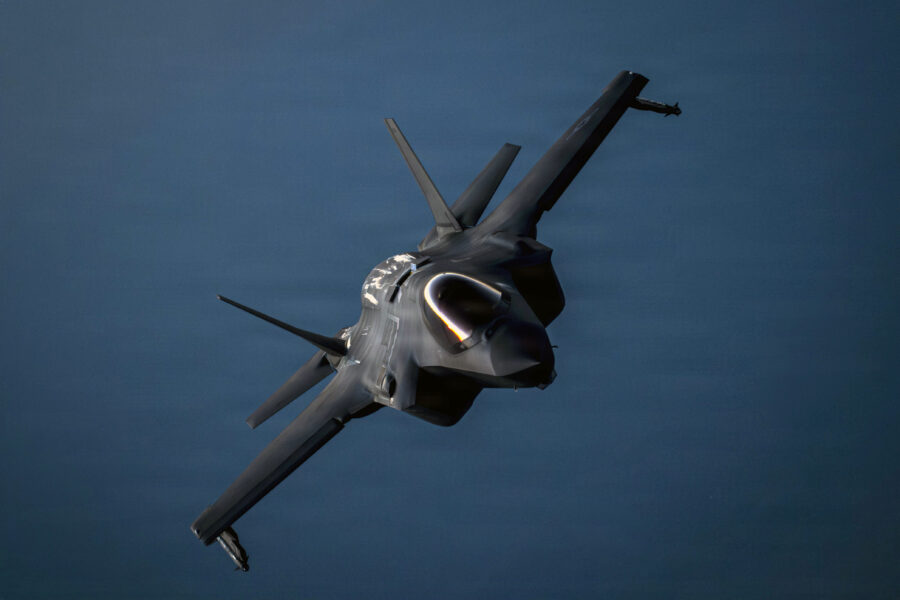
Roughly two of every five fighters in the Air Force fleet could be F-35As by 2035, according to a new fighter force structure report the service submitted to Congress on Oct. 16.
Lt. Gen. David Tabor, deputy chief of staff for plans and programs, revealed the new estimate during an Oct. 20 media roundtable at the Pentagon as he explained the report’s estimates of the future force’s mix of different types of fighters.
The Air Force did not provide a full copy of the report to reporters.
About 40 percent of the fleet could be F-35s, Tabor said. Another 20 percent would be a combination of F-22 Raptors and F-47s as the sixth-generation fighter replaces the Raptor. The Air Force built 186 operational F-22s, and Tabor said the Air Force still plans to replace them with roughly an equivalent number of F-47s. The remaining 40 percent of the fleet would likely be split evenly between F-15 Eagle variants and F-16 Fighting Falcons, Tabor said.
Today
2035
- F-35
- F-22 / F-47
- F-15
- F-16
Source: Air Force figures cited by Tabor. Excludes A-10s. Percentages are approximate.
View data table
| Aircraft | Today | 2035 |
|---|---|---|
| F-35 | 30% | 40% |
| F-22 / F-47 | 10% | 20% |
| F-15 | 15% | 40% combined |
| F-16 | 45% |
Currently, the fighter fleet—not counting A-10s—is split roughly 45 percent F-16s, 30 percent F-35s, 15 percent F-15s, and 10 percent F-22s.
Beyond the mix of the fighters, the force structure report also provides a new estimate of the total number of fighters the Air Force says it will need in the years to come: 1,509 combat-coded aircraft by 2035.
That’s up from the 1,271 the service estimated it would have in 2026 and the 1,369 combat-coded fighters it was shooting for by 2030 in last year’s report, Tabor said. The additional 140 jets would be a mixture of F-35s, F-15EXs, and F-47s.
The data used for the previous report was “pretty old,” Tabor said, so the service’s researchers set out to compile fresher and more accurate information. This analysis was going on before combat operations against Iran broke out earlier this year, he said, and was not driven by the war.
The Air Force’s analysis was based on geographic combatant commanders’ reported requirements to achieve their goals at “medium risk,” Tabor said, and he cautioned that is based on their subjective assessments of what they will need—and will likely change in the future.
“Certainly, world events and changing requirements in the combatant commands will change that number,” Tabor said. “Capabilities that we bring on to platforms will change the number, and I think really importantly, technology will change the number.”
Getting to the new 2035 goal depends on two key factors falling into place, Tabor said. First, Congress will need to provide the funds the Air Force needs to buy the jets. And the defense industrial base—in particular, prime contractors Lockheed Martin and Boeing—must produce enough aircraft in time.
Top Air Force officials have for years said the service needs to buy 72 new fighters each year to replace its older, retiring jets and modernize the fleet. The fiscal 2027 budget request doesn’t reach that level, proposing 38 new F-35s and 24 F-15EXs for a total of 62. Tabor said those purchases can “ramp over time” to hit the numbers the Air Force needs.
“The question is, can industry produce at those levels?” Tabor said. “They’ve assured us that they can, and we believe them, but we also actually need to see it manifest.”
Right now, 2027’s funding levels remain a big question mark. The administration’s strategy for funding the Pentagon this year relies on a budget reconciliation bill to add additional funding priorities on top of the proposed “base” appropriations.
The Air Force’s proposed budget counted on $2.34 billion coming through reconciliation to pay for 14 of those 38 new F-35s. If reconciliation doesn’t pass, Tabor said, the Air Force is not out of options. It could try to find money in the base budget to pay for more F-35s, he said—though that would require pulling billions from other critical programs.
“We just lose 14 times [an] F-35’s worth of other capabilities that we were planning on,” Tabor said.
Or, he said, the purchases could be pushed out to 2028, which would further put the Air Force behind on reaching its fighter fleet goals.
“It is really imperative that we get the resourcing we need in order to modernize the Air Force the way we want it to be,” Tabor said. “We need it all.”
In the meantime, the clock is ticking on large portions of the Air Force’s fleet such as older F-15s and F-16s, which are aging and reaching the end of their lifespans.
The Air Force is considering buying a new version of the F-16, which is tentatively being referred to as the F-16G. But the Air Force has not yet made any decision on that, Tabor said, “and we’re not in a position where that decision has to be made immediately.” That decision likely won’t be made as part of the 2028 budgeting process, he said, but perhaps the years that follow.
Older F-16s will reach the end of their lifespans in the mid-2030s, Tabor said, and “we are very conscious of that.” The simple—“and maybe the lazy”—way to approach that problem, Tabor said, is to automatically replace them with new F-16s. But that might not be the best strategy, he said.
“There is a spectrum of capability that we might want to replace the F-16s with,” he said. “It’s not urgent, frankly. What we don’t want to get to is a point where it is urgent, and we haven’t done the homework and decided ‘hey, this is really the right place to be.’ We do have time to churn through that and make sure that we have a good option going forward.”
One advantage to buying more F-16s, which Lockheed Martin now builds in Greenville, S.C., is that “it’s practically a ready-made aircraft,” Tabor said—if the Air Force wants to stick with the same type of capabilities.
Another potential wrinkle is the Pentagon’s push to expand its multiyear procurement authorities. The Air Force is eyeing such agreements for the F-35 and F-15EX, though its request is pending before Congress. More multiyear procurement deals will help provide industry more financial stability, Tabor said, which could make it easier for them to expand and stabilize production of fighters.
But while the Air Force is rapidly preparing to add hundreds of autonomous drone fighters known as Collaborative Combat Aircraft to its fleet—the goal is 500 airframes by 2032—Tabor said they’re not yet changing the service’s calculus on what fighter force it will need in the future.
“CCA is very much a reality,” Tabor said. “It is going to be a part of our future, and there is absolutely a world in which the incorporation of CCAs into the force will mitigate the requirement for the number of fighters. That’s not the CCA that we have right now, but it is advancing very, very rapidly. We’re confident that it will play a major role in future versions of the fighter force structure report.”