


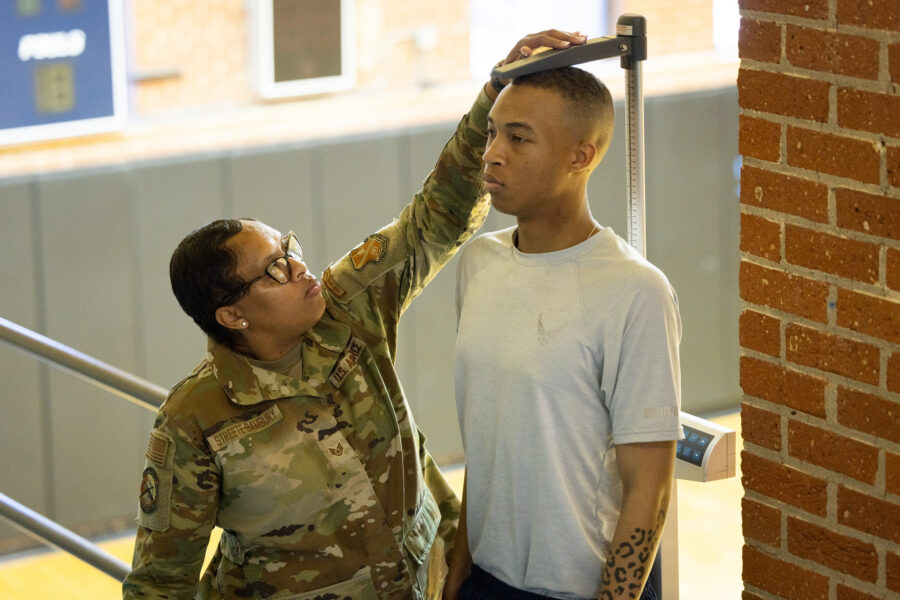
Active-Duty Airmen must ensure they have a waist-to-height ratio assessment in their official record within the next two weeks, Air Force Chief of Staff Gen. Kenneth S. Wilsbach said in a July 13 letter to the force focused on physical fitness and appearance standards.
The waist-to-height ratio is component of the service’s new Physical Fitness Readiness Assessment, or PFRA, designed to measure body composition.
In his July 13 message, Wilsbach wrote that all Active Airmen must have a current body composition measurement in the myBodyComp app by July 31, while Air Guard and Reserve Airmen must complete the requirement by Aug. 31.
The message comes just a few weeks after the Air Force started officially scoring Airmen on the new PFRA on July 1. Prior to that, there was a three-month diagnostic period where Airmen could try the new test and keep their scores if they were satisfied with them.
The service first announced changes to its fitness test last fall, including a requirement for Airmen to take the assessment twice a year. The assessment also includes different exercise options for measuring muscular strength and core endurance. The body composition portion of the PFRA requires Airmen divide their waist length by their height in inches. This component counts for 20 percent of the total score.
“To strengthen our readiness, every Airman must focus on fitness and appearance standards,” Wilsbach wrote. “The Waist-to-Height Ratio (WHtR) assessment is an important component of our overall fitness program and provides commanders another tool to understand the readiness and health of the force.”
The Air Force removed the body composition measurement from its former physical fitness test amid the COVID-19 pandemic in 2021. Since then, Airmen had their body composition measurements taken during their birth month or during their annual physical.
In the new PFRA, the Air Force will score body composition as part of the physical fitness test again, but Airmen do not have to take it the same day as their fitness test. In 2019, officials noticed holding both events on the same day sometimes prompted Airmen to adopt dangerous practices such as taking diuretics or just avoiding eating to pass the tape test.
Airmen can use the body composition measurement they received during the diagnostic portion for PRFA to fulfill the requirement, according to an Air Force official. Airmen who did not complete a diagnostic PFRA must complete a new body composition assessment by Wilsbach’s deadlines.
Throughout the message, Wilsbach focused on the importance of maintaining high standards.
“Standards are the foundation of discipline and readiness,” he wrote. “Consistently holding ourselves accountable builds trust within our formations, reinforces confidence in our teammates, and ensures we are prepared to answer our nation’s call.”
Wilsbach ended the message with a reminder for all Airmen to follow the service’s dress and appearance regulations.
“A professional image reflects discipline, pride, and attention to detail,” Wilsbach wrote. “That same mindset drives excellence across every career field and should be evident in how we present ourselves.”
The new PFRA’s main difference from past fitness assessments is that it requires Airmen to choose between a two-mile run and the 20-meter High Aerobic Multi-Shuttle Run, or HAMR, which requires participants to dash between lines 20 meters apart at a progressively faster pace. Both the run and the HAMR event count for 50 percent of the total score.
The Air Force initially planned on making the two-mile run mandatory for everyone, but in January, the service announced that Airmen will continue to have a choice.